Abstract
There is a blind spot at the center of American inheritance law. In the late twentieth century, revocable living trusts (rev trusts) replaced wills as the main estate planning tool. More recently, the widespread use of these mechanisms and the unprecedented amount of wealth passing between generations have reportedly caused an increase in trust litigation. But we know remarkably little about trust disputes. Data about trusts is notoriously elusive: Unlike wills, which pass through probate court—a jurisdictional silo that helps researchers find relevant cases—trusts are private instruments that can be litigated in multiple forums.
This Article starts to fill this gap by offering the first empirical study of trust litigation. It reviews thousands of civil filings to identify every contested trust proceeding that came on calendar between 2014 and 2020 in San Francisco Superior Court. This dataset of 640 petitions reveals four major points. First, a blessing of rev trusts—that, unlike wills, they allow a successor trustee to manage a settlor’s property long after death—is also a curse. This administrative process is the catalyst for roughly 75 percent of the lawsuits in our research. Second, although “will contests” (attempts to invalidate a will) have a reputation for being “strike suits” (groundless allegations brought to extort a hasty settlement), there is little evidence that trust litigation suffers from the same problem. Few trust petitioners settled quickly or accepted pennies on the dollar. Third, trust litigation has distinct pathologies. Cases often involve a clash between siblings, seem fueled as much by family dynamics as legal merit, and raise complex substantive and procedural issues. Fourth, devices that are intended to deter or efficiently resolve trust litigation diverge wildly in their effectiveness. No-contest clauses (which disinherit beneficiaries who pursue certain kinds of relief) and mandatory arbitration provisions (which have been a topic of much recent debate) play almost no role in the cases, but court-sponsored mediation reliably produces settlements.
Introduction
Nothing about Raymond Mar’s estate suggested that it would spark epic litigation. Raymond’s most valuable asset was his house on 22nd Avenue in San Francisco.1 He was a widower with two daughters and a son.2 In 2012, he signed a revocable living trust (rev trust) so that his children could inherit his property after he died without having to navigate the slow, expensive, and public probate system.3 He named himself initial trustee and beneficiary and stated that, when he passed away, his children would become successor co-trustees.4 He gave his son a life estate in the home but provided that the son’s right of exclusive possession would terminate if he stopped paying for its upkeep.5
The trouble began after Raymond died in 2016.6 His children disagreed about whether the son could accept a tenant.7 In 2019, the son sued his sisters in San Francisco Superior Court for breaching their duties as co-trustees, the daughters counterclaimed against the son, and the parties proceeded to fight tooth and nail for more than half a decade.8 The judge resolved the matter after a bench trial in an unusual ruling that dissolved the trust, ordered the house to be sold, and chastised everyone involved in the case:
[B]oth sides have over-litigated these petitions at every stage—through challenges to pleadings, through discovery, through appeals and writs, and now through trial. The cash assets [of the trust] were exhausted at least as far back as 2019. The underlying problem that this family faced when this case was filed . . . is the same as it is in 2024 . . . . It is difficult for this court to comprehend how five years of litigation have been of any aid whatsoever in resolving the challenging situation . . . .9
But despite this rebuke, the conflict between the siblings soon flared up again. As of October 2025, the court was once again hearing petitions and issuing opinions.10
* * *
In 2017, Jack Dane died, leaving an estate plan that was as chaotic as the last years of his life.11 Dane had created a rev trust in 2006 that divided his property into eight shares, allocated two shares each to his friends Anthony and Beatrice, and gave one share each to his friends Rosie, Margie, Jeremy, and Andrew.12 But Dane then began to rack up debts and stopped paying his taxes.13 By the time he passed away, none of the people he had named to be successor trustee were willing to serve.14 Finally, Anthony agreed to take the reins.15
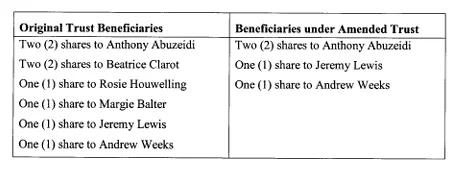
One day, Anthony was searching boxes in Dane’s garage when he found what appeared to be a copy of Dane’s rev trust with the names of Beatrice, Rosie, and Margie crossed out next to the initials “JD” and the dates “10-20-22” and “1-25-17.”16 In a letter to Beatrice, Anthony took the position that these markings amended the trust, doubling the size of his inheritance and eliminating the gift to her.17 Beatrice responded by filing a petition in San Francisco Superior Court challenging this determination and arguing that the purported revisions were ineffective.18
Figure 1: Jack Dane’s Rev Trust
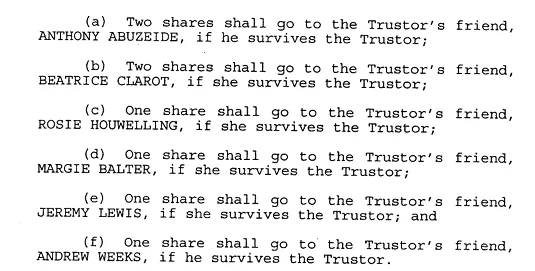
Figure 2: Possible Amendment to Jack Dane’s Rev Trust
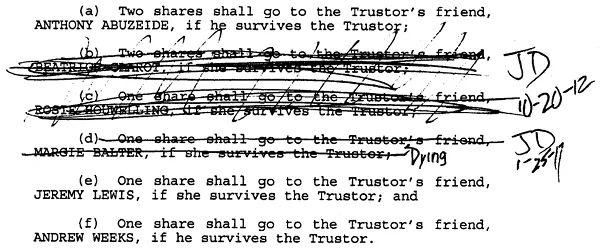
Figure 3: Chart from Anthony Abuzeide’s Pleading
* * *
In 2014, Alan Choy, acting as his own lawyer, filed a petition in San Francisco Superior Court seeking to invalidate the three amendments to his parents’ rev trust.19 Alan’s dad, James, and his mom, Lily, had executed a rev trust in 1999 that left their property to Alan and his brother Ronald equally.20 But in 2003, hours before James died, James and Lily had amended their trust to reduce Alan’s share to $40,000.21 In 2005 and 2010, Lily had reaffirmed this choice in two more trust amendments.22 According to Alan’s petition, James had lacked mental capacity when he signed the first amendment in 2003, and Alan’s brother, Ronald, had unduly influenced Lily when she approved the documents in 2003, 2005, and 2010.23
In turn, Ronald asked the court to disinherit Alan.24 Ronald observed that James and Lily’s original rev trust contained a no-contest clause, which declared that anyone who tried to nullify the instrument would surrender any gift under it.25 Thus, Ronald argued that Alan “ha[d] forfeited his right [to] receive . . . $40,000.00, or any amount” from his parents.26
* * *
There is a chasm in our understanding of estate-related litigation. Once, people who hired lawyers to plan their estates generally made wills, which meant that a probate court supervised the transfer of their assets after they died and resolved any disputes.27 Probate files facilitate empirical research. They tend to be accessible to the public and segregated from other court records.28 As a result, there is a rich literature about the probate process, including empirical studies of trial-level probate litigation.29
However, rev trusts have become the centerpiece of professional estate plans.30 Because rev trusts distribute wealth privately and are more flexible than wills or gifts, “[t]here is an almost unfathomable amount of wealth held in trust funds. . . .”31 Over the next twenty-five years, America will experience “the most dramatic shift in personal finance ever measured,” as roughly $124 trillion will pass between the generations—much of it via rev trusts.32
Yet nothing about trusts lends itself to empirical inquiry. Unlike wills, which must be filed in probate court, most trusts leave “no public record.”33 Indeed, “[t]here is no publicly available cache of donative trust instruments.”34 Even more importantly, trust litigation remains a mystery. Although there are anecdotal reports that trust disputes are on the rise,35 these matters are scattered throughout the civil dockets of federal and state courts and cannot be harvested as easily as probate cases.36 Thus, there has never been an empirical study of trust litigation, and our grasp of the subject comes from the minuscule number of cases that do not settle, go up on appeal, and are memorialized in an opinion that is accessible on a commercial research platform like Westlaw, Lexis, or Bloomberg.37
This Article remedies this deficiency by analyzing every trust lawsuit filed between the beginning of 2014 and the end of 2020 in San Francisco Superior Court. It distills thousands of civil cases to identify 640 contested trust petitions and then uses them to offer a thick description of trust litigation.38
The Article emphasizes four themes. First, trusts breed different types of claims than probate cases. The quintessential probate lawsuit is a will contest, which seeks to invalidate a will.39 Yet unlike wills, which transfer assets directly to the testator’s family or friends, trusts allow a trustee to manage property for the beneficiaries for years after the settlor dies, and 75 percent of the petitions in our data relate to the trustee’s exercise of these duties. In this way, a major benefit of rev trusts—that their longevity “implement[s] a settlor’s freedom of disposition across time”40—comes at a price. As in the war that engulfed the Mar family, survivors routinely quarrel about management decisions that arise after the settlor passes on.41
Second, although will contests have a reputation for being “strike suits”—baseless allegations designed to obtain a nuisance settlement42—trusts do not seem to suffer from the same problem. California requires some trust litigants to file their settlement agreements in the judicial record, and these documents show that petitioners often receive substantial payouts. Recall Beatrice Clarot’s challenge to the purported amendment to Jack Dane’s trust.43 If Beatrice had prevailed, she would have taken $484,500, and she settled for $295,000, or 61 percent of this sum.44 Like Beatrice, many petitioners settled for healthy proportions of their claim’s value, which suggests that their lawsuits are not shakedowns.
Third, even if few trust allegations are brazen efforts to obtain a quick settlement, trust litigation has its own dysfunctions. For starters, there is friction in the common scenario where a settlor leaves their assets to their children but selects just one of these siblings to be successor trustee. This pattern shows up in nearly a quarter of our data, likely because the children who were not chosen to be trustee felt slighted by the settlor and suspicious that the trustee-beneficiary’s managerial decisions were self-serving. Similarly, some petitioners and respondents seem to be guided less by a desire to win money or property and more by their emotions. Consider Alan Choy, whose petition turned out to be meritless,45 but who used it as a soapbox to accuse his brother Ronald of holding “a deep-seated animosity toward” him “for most of his life.”46 Finally, just as trusts are more sophisticated than wills, trust litigation raises thornier substantive and procedural issues than probate lawsuits.
Fourth, leading strategies for averting or streamlining trust disputes achieve mixed results. The Article starts by examining no-contest clauses, which purport to disinherit parties who initiate certain claims. In the context of challenges to the validity of a will or a trust, many jurisdictions refuse to enforce no-contest provisions if a beneficiary had “probable cause” for their lawsuit.47 But California is one of several states that limits no-contest penalties to frivolous breach of fiduciary duty claims, to try to ensure that the threat of forfeiture does not immunize trustees from liability for misconduct.48 The Article argues that this approach is too cautious because it renders no-contest clauses nearly impotent. Paradoxically, in the San Francisco files, no-contest clauses are extremely common and almost never invoked. The Article argues that subjecting filings against the trustee to the same probable cause standard that governs will and trust contests would better balance the goals of holding trustees accountable and discouraging weak petitions.
The Article then examines mandatory arbitration clauses in trusts. Arbitration’s increasing eclipse of the civil justice system has been well documented.49 Against this backdrop, it is not surprising that there has been a surge of interest in trust arbitration. Indeed, trust cases are “a lucrative new market for arbitration, with trillions of dollars’ worth of assets at stake,”50 and “trust law scholars and practitioners [have] considered to what extent arbitration may be used to solve these disputes more quickly, efficiently, and cost-effectively.”51 Although the Article unearths evidence that arbitration can be an upgrade over trust litigation, it also discovers that mandatory arbitration clauses in trusts and motions to compel arbitration of trust disputes are vanishingly rare. Thus, rightly or wrongly, settlors, practitioners, and parties remain wary of the process.
The Article’s final dispute resolution topic—mediation—is starkly different. The San Francisco Superior Court has been a trailblazer in cultivating a mediation program for estate-related disputes, and we find that the process is extremely valuable. Indeed, nearly 150 cases went to mediation, and 85 percent of them settled. This suggests that other court systems should follow San Francisco’s lead.
The Article contains four parts. Part I describes the larger universe of inheritance-related conflict. It reveals that even though rev trusts have become essential to estate planning, there has never been an empirical study of trust disputes. Part II details the Article’s methodology and presents its key findings. Part III examines the factors that separate trust cases from probate matters and other civil lawsuits. It shows that trust litigation often revolves around the management of the trust, is driven by sibling animosity, and takes place in a substantive and procedural thicket. Part IV critiques the role of no-contest clauses, mandatory arbitration provisions, and mediation in deterring and efficiently resolving trust litigation.
I. Death and Disputes
This Part provides background. It first compares the legal system’s dark view of will contests with empirical studies of probate litigation. It then explains why the rise of rev trusts has made the lack of hard evidence about trust disputes a glaring omission.
A. Probate Litigation
Traditionally, wills were the flagship device for transferring property after death.52 This Section reveals that a variety of factors give litigation over wills a bad reputation. It then shows that empirical analyses suggest that the truth is slightly more nuanced.
For several reasons, will-based disputes have long been regarded as troublesome. First, we think of these matters as being will contests (challenges to a will’s validity), which often rely on the much-maligned doctrines of incapacity and undue influence.53 Incapacity hinges, in part, on whether a testator “was capable of understanding who were the natural objects of [their] bounty”54—a concept that is “infinitely more vague than the standard of the hypothetical ‘reasonably prudent man’ in negligence cases.”55 Similarly, undue influence occurs when a wrongdoer uses “threats, misrepresentation, undue flattery, fraud, or physical or moral coercion” to “overpower volition, destroy free agency and impel the grantor to act against [their] inclination and free will.”56 As many scholars have observed, this rule, with its emphasis on abstract notions of “free agency” and “free will,” invites judges and juries to overturn documents based on their “own views of morality and propriety.”57
A second problem with probate litigation is procedural. Cases typically hinge on the intent of someone who is dead.58 This is known as the “worst evidence” dilemma: The star witness cannot appear at trial, and the factfinder must discern the truth from self-serving testimony and writings that may be outdated or ambiguous.59
Third, battles over wills are long, costly, and bitter. Here is one way in which the worst evidence handicap rears its head. Because the testator’s wishes are at issue but they are absent from the courtroom, cases “require an investigation of the[ir] entire life history . . . that protracts them for many days and sometimes many weeks.”60 In turn, these drawn-out proceedings drain the estate and burden the judicial system.61 Lastly, given the delicate topics at play—multiple marriages, sibling strife, elders with declining cognition—trials dredge up private, embarrassing facts.62 As David Cavers once put it, “there is no form of civil litigation more acrimonious and more conducive to the public display of soiled linen and the uncloseting of family skeletons.”63
Fourth, litigants supposedly wield these harmful attributes like a weapon by filing “strike suits”: “frivolous will contests” that attempt to extract a fast settlement.64 The logic here is intuitive: An heir who has been omitted from a will “ha[s] nothing to lose” by suing, and because contests can be so devastating to estates and reputations, the will’s proponents have strong incentives to settle.65 In fact, some commentators have speculated that the legal system is not aware of the full extent of the problem because settlements are usually confidential:
[C]hallenges to the integrity of the testator place tremendous financial strain on the corpus of the estate and, to prevent total depletion, are often settled out of court. Because of the extratribunal nature of these settlements, their consuming effect is seldom recorded, making the extent of their thievery difficult to determine; however, everyday knowledge and experience suggests that this practice is widespread.66
Yet a handful of empirical studies of probate litigation complicate this narrative. For example, in 1987, Jeffrey A. Schoenblum published pathbreaking work examining every will contest filed in Davidson County, Tennessee during an eight-year period.67 Schoenblum found sixty-six such cases.68 Twenty-five of these went to trial, and twenty-four settled.69 Schoenblum determined that challengers did not fare particularly well in the fully prosecuted matters: A judge or jury ruled in their favor just seven times.70 But in a finding that cuts strongly against the strike suit hypothesis, Schoenblum noted that contestants who settled “rarely obtained less than a substantial portion of the estate.”71
More recently, two of us (Horton and Weisbord) studied litigated probate cases—including twenty-five will contests—that occurred between 2014 and 2016 in San Francisco.72 Our data corroborated the prevailing view that disputes can derail the administrative process, exhaust the estate’s funds, and bring unflattering facts to light.73 For instance, the average matter with an incapacity or undue influence claim lasted for almost 800 days, racked up tens of thousands of dollars in attorneys’ fees, and was “riddled with disturbing facts that the parties did not hesitate to weaponize.”74 Yet our conclusions about outcomes mirrored Schoenblum’s. When the parties did not settle, contestants generally lost.75 But in sharp contrast, the vast majority of settlements were generous.76 Capitalizing on the information-rich environment of probate, where detailed pleadings reveal each parties’ stake in the matter, we calculated each litigant’s “success rate”: the amount of settlement proceeds divided by the share that party would have received if they had nullified the will.77 We discovered that the overall success rate for will contests was an unexpectedly high 62 percent.78
In sum, probate litigation is infamous, but empirical studies tell a more complex story. Yet this scholarship addresses only a slice of modern inheritance practice. As we explain next, rev trusts have replaced wills, and we know very little about trust litigation.
B. Trust Litigation
Today, almost any lawyer-written estate plan will contain a rev trust.79 This Section traces the rise of rev trusts and shows that it has raised unsettled questions about inheritance litigation. In addition, it demonstrates that there is no empirical evidence about trust disputes.
The trust is an ancient legal construct.80 It arises when a settlor transfers assets to a trustee to manage for the benefit of one or more beneficiaries.81 This makes a trust a “‘fiduciary relationship with respect to property’”: The trustee holds and distributes the corpus subject to the settlor’s instructions and the overarching duties to exercise due care, remain loyal to the beneficiaries, treat the beneficiaries impartially, and keep the beneficiaries reasonably informed.82
Trusts are tremendously flexible. Because they can last for years, decades, or even forever in some states, they allow settlors to dole out property slowly to beneficiaries.83 For example, a trust can specify that the trustee should not distribute property until a beneficiary reaches a certain age, or only make payments for certain purposes (such as a beneficiary’s health or education), or disburse assets to a class of potential recipients as the trustee deems best.84 This makes the trust “essentially a gift, projected on the plane of time and so subjected to a management regime.”85
There are four basic kinds of estate planning trusts. First, there is the testamentary trust, which arises out of a will and thus takes effect during probate administration.86 Because testamentary trusts empower a reliable third party to act for the beneficiaries, they are an elegant alternative to leaving property outright to people who are incapable of handling it themselves.87 Second, settlors create irrevocable trusts by transferring assets to a trustee during life. A common type of irrevocable trust is the “management trust,” which names an investment professional as trustee and provides for “ongoing fiduciary administration of wealth within a family and down the generations.”88 Third, special needs trusts are structured to supplement the income of disabled beneficiaries without disqualifying them from governmental assistance.89 And fourth, a rev trust arises when someone conveys possessions to the trustee while alive but also reserves the power to revoke or amend the arrangement.90
In the second half of the twentieth century, an improbable bestseller made rev trusts the cornerstone of most estate plans. A mutual fund salesman named Norman Dacey sold 2,000,000 copies of an originally self-published book called How to Avoid Probate! that informed readers how to use rev trusts to bypass probate administration.91 The insight that Dacey popularized has three moving parts: (1) Probate only governs assets that a person owns in their individual capacity when they die, (2) anything that someone places in trust no longer belongs to them, and so (3) a settlor can bypass the probate process by transferring their possessions into a rev trust while they are alive.92 For example, an individual can convey everything to themselves as initial trustee and beneficiary; reserve the power to use, consume, and revoke the corpus; declare that the trust will continue after their death (at which point it will be irrevocable); and name a successor trustee and remainder beneficiaries.93 In this way, rev trusts function as probate-exempt “will substitutes.”94
This technique proved to be wildly popular. In many states, the probate system is infuriatingly slow, bureaucratic, and public.95 The personal representative needs to obtain judicial approval before performing quotidian tasks such as opening and closing the estate, inventorying the property, and selling land.96 And because the process unfolds in court, it creates a paper trail that is “a matter of public record, open to examination by anyone who desires to proceed to the place the public records are kept.”97 Conversely, when a settlor passes away, the “trustee is able to perform its duties without court supervision,” which allows succession to occur immediately and privately.98
It would be hard to exaggerate the impact of the rev trust revolution. For starters, it christened a period in which trust law evolved rapidly. When How to Avoid Probate! hit bookstores, no state had a comprehensive statutory scheme that regulated trusts, and the common law was woefully outdated.99 Since then, there has been a flurry of law reform, including the widespread adoption of the Uniform Trust Code (UTC).100 In addition, the rise of rev trusts and a socioeconomic sea change have apparently caused a spike in trust litigation. The largest intergenerational wealth transfer in history has begun,101 and commentators have declared that “beneficiaries have declared war on trustees,”102 that there has been an increase in “the amount of litigation involving trust administration,”103 and that “[f]amily members are increasingly willing to initiate litigation against one another to protect what they view as theirs.”104
However, in stark contrast to probate litigation, data about trust disputes does not exist. There are many empirical studies of the probate process because all matters involving wills and intestacies feed into specialist courts, which helps scholars gather information.105 For example, Schoenblum’s groundbreaking work on probate litigation capitalized on the fact that the county where he conducted his research had a dedicated probate docket.106 Even today, as judicial files have migrated online, counties often allow users to search for probate court records specifically, which facilitates empirical inquiry.107 But trust matters are different. As mentioned, property held in trust does not belong to a decedent and is exempt from probate administration.108 Thus, subject to caveats that we discuss below, parties can bring trust disputes anywhere—even in federal district court if a case qualifies for federal subject matter jurisdiction.109 In addition, many states assign trust proceedings to their courts of general jurisdiction, where they blend in with business litigation, personal injury claims, and a motley assortment of other filings.110 Because of these hurdles to locating trust cases, our knowledge “about trust provisions, trust planning goals, trust successes, and trust party identity is anecdotal.”111
To conclude, although rev trusts pass staggering amounts of wealth, the disputes they generate are empirically elusive. In the next Part, we begin to rectify this situation.
II. What the Data Show
This Part provides an overview of our research techniques and results. It describes which kind of trusts spark disputes, who litigates, what the parties fight about, and the length and outcome of cases.
A. Data Description and Methodology
Collecting and refining our data involved multiple steps and took about four years. This section describes what we did.
To frame this topic, we need to pick up the thread from Section I.B about jurisdiction over trust matters.112 Although some states allow parties to bring trust litigation in courts of general jurisdiction—making building a large dataset next to impossible—others direct trust filings into certain channels. For example, in California, state trial courts (called “superior courts”) have the exclusive power to adjudicate “proceedings concerning the internal affairs of trusts,”113 which includes trust contests, petitions for breach of trust,114 and any other issue necessary to resolve “the whole controversy” between the parties.115 More importantly for our purposes, in large counties like San Francisco, where the superior court is divided into divisions, these “internal affairs of trusts” cases must be heard by the “probate division” (a group of judges who specialize in inheritance matters) rather than the “civil division” that deals with conventional litigation.116 Conversely, the probate division merely has concurrent jurisdiction with the civil division over “external affairs”: cases involving questions about whether a trust came into existence, creditor’s claims, or allegations against a trustee in their representative capacity for breaching a contract or committing a tort.117
To be clear, just because a case is heard by the probate division does not mean that it is subject to the probate process. The probate division is a roster of superior court judges who preside over inheritance cases.118 The probate process—which Norman Dacey helped readers bypass—is a series of mandatory steps, such as giving notice to creditors and inventorying the estate, that govern assets passing via wills or intestacy.119 Because property held by a trust is exempt from the probate process, it does not need to march through these administrative checkpoints.120 Accordingly, when the probate division resolves trust litigation, it acts much like any other general civil court.
This backdrop is necessary to understand the scope of our research. We used the San Francisco Superior Court’s online “calendar search” mechanism to review the case number of every civil filing from between January 1, 2014 and December 31, 2020.121 We learned that trust matters that the clerk assigns to the probate division have case numbers that begin with “PTR,” so we created a spreadsheet of all 1,568 such entries. Because California requires trust proceedings to be filed where the trustee administers the trust, the common denominator in these petitions is that the trustee lives or works in San Francisco County.122
Admittedly, our data is limited in two ways. First, it does not capture all trust cases with a nexus to San Francisco during the relevant timeframe. It excludes internal affairs matters that unfolded in federal court and external affairs proceedings that were either brought in federal court or the civil division.123 However, few disputes likely fell into one of these carveouts. Trust litigators always have the option to sue in the probate division and may prefer its expert decision-makers to the genericism of the civil division124 and the foreign terrain of federal court.125
Second, trust litigation in San Francisco County may not be representative of trust disputes elsewhere. The county consists entirely of the city of San Francisco, which is affluent and boasts high real estate prices.126 We do not know how those factors impact our data, but one possibility is that wealthier people are more likely to make trusts and to hire counsel to litigate about them. There is little we can do about this issue other than acknowledge it and call for more research into trust lawsuits in other regions.
When we read the dockets of our PTR cases, we were surprised to find that most of them were irrelevant for our purposes.127 For one, many did not involve litigation. We treated a petition as “litigated” if either (1) it inspired an objection or (2) even if no opposing party came forward, the remedy demanded would severely impact the settlor’s estate plan or the management of the trust by voiding a transfer of property or removing or surcharging a trustee. Nearly 1,000 filings did not fit this description.128 Moreover, others overlapped with (and were eventually merged into) related matters.129 After dropping proceedings that did not feature litigation or were consolidated, we had 640 petitions arising from 460 cases.
We then coded these filings for variables like the claims asserted,130 whether the parties had counsel,131 the parties’ role in the trust132 and relationship to the settlor,133 whether the trust featured a no-contest clause or a mandatory arbitration provision,134 whether the parties mediated,135 the outcome,136 and the length of the matter.137
B. Results
Figure 4 shows that 618 (97 percent) of the petitions involved a rev trust. Only eleven (2 percent) featured an irrevocable trust, six (1 percent) hinged on a testamentary trust, and five (1 percent) arose out of a special needs trust. Thus, almost all the cases in our dataset stemmed from conventional estate plans that used rev trusts to bypass probate.138
Figure 4: Trust Types
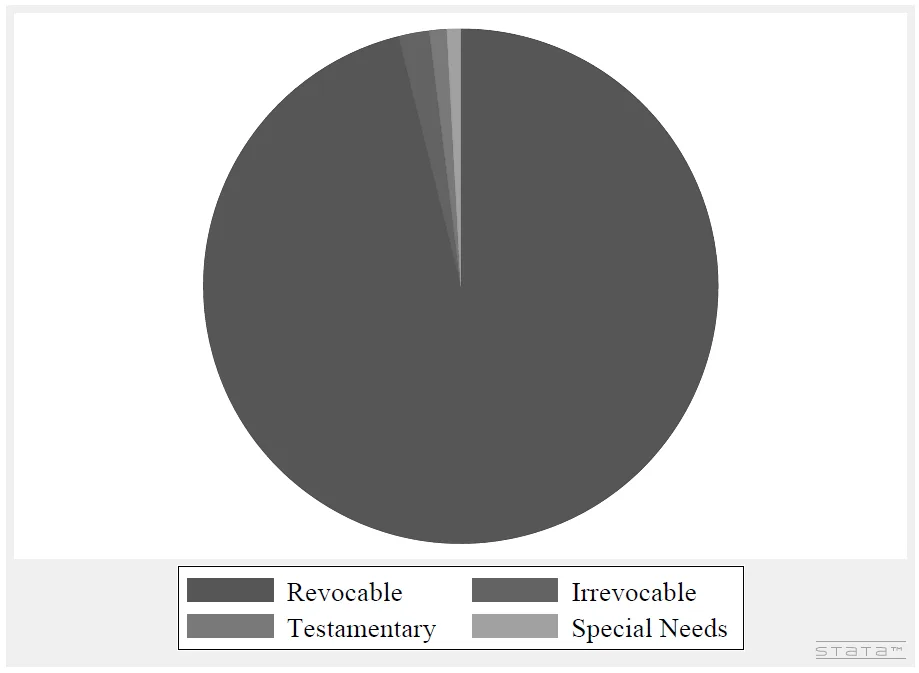
Figure 5 reveals that accusations of trustee misconduct dominated the files. These claims appeared in 474 petitions (74 percent). The three most common were asserted breaches of the duty of care (198, or 31 percent of all petitions), requests for accountings (197, 31 percent), or alleged violations of the duty of loyalty (154, 24 percent). Challenges to the validity of a document surfaced 149 times (23 percent) and generally sought redress for undue influence (114, 18 percent) or incapacity (79, 12 percent).139 Finally, California Probate Code section 850 allows parties to recover property that is wrongly held by another,140 and litigants tried to invoke this remedy ninety-seven times (15 percent).
Figure 5: Frequency of Claim Types
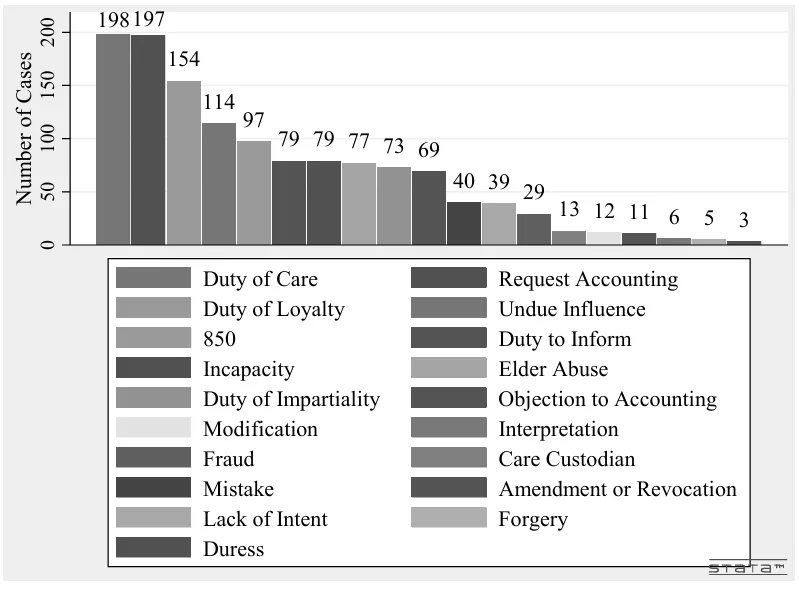
Table 1 displays the parties’ roles in the trust. It demonstrates that 397 petitioners (62 percent) were beneficiaries. An additional 128 (20 percent) were serving in the dual role of beneficiary and trustee (“beneficiary-trustees”) and 44 (7 percent) were trustees. Sixty-four (10 percent) were outsiders: people the settlor had omitted, or were creditors, or occupied positions on the peripheries of the trust, such as lawyers. At the opposite side of the courtroom, most respondents—342 (54 percent)—were beneficiary-trustees, followed by 143 trustees (22 percent), 119 beneficiaries (19 percent), and 29 outsiders (4 percent).
Table 1: Parties’ Roles
| Petitioners | Respondents | |||
| Role | N | Percent | N | Percent |
| Beneficiary | 397 | 62% | 119 | 19% |
| Beneficiary & Trustee | 128 | 20% | 342 | 54% |
| Trustee | 44 | 7% | 143 | 22% |
| Outsider | 64 | 10% | 29 | 5% |
| Other | 6 | 1% | 5 | 1% |
| Total | 639 | 100% | 638 | 100% |
| Notes: We were unable to determine the role of one petitioner and two respondents. |
Table 2 identifies the parties’ relationships to the settlor. A supermajority of both petitioners and respondents had a connection by blood or marriage. For example, 388 petitioners (61 percent) and 322 respondents (52 percent) were descendants, 87 petitioners (14 percent) and 76 respondents (12 percent) were other relatives, and 41 petitioners (6 percent) and 54 respondents (9 percent) were married to the settlor. As these numbers demonstrate, trust litigation is often a family affair.141
Table 2: Parties’ Relationships to the Settlor
| Petitioners | Respondents | |||
| Relationship | N | Percent | N | Percent |
| Descendant | 388 | 61% | 322 | 52% |
| Spouse | 41 | 6% | 54 | 9% |
| Other Relative | 87 | 14% | 76 | 12% |
| Non-Family | 69 | 11% | 104 | 17% |
| Professional Trustee | 21 | 3% | 51 | 8% |
| Self | 26 | 4% | 17 | 3% |
| Total | 632 | 100% | 624 | 100% |
| Notes: We were unable to determine the relationships of eight petitioners and sixteen respondents. |
Table 3 surveys case outcomes. It reveals that petitioners won 12 percent of the time, received partial remedies in 5 percent of matters, and lost 10 percent of disputes. A whopping 39 percent of petitions settled, and another 34 percent disappeared from the docket without a ruling on the merits (although we suspect that many of these also settled). The average length, including filings that settled, was 481 days (about a year and four months).142
Table 3: Petitions and Outcomes (Overall)
| N | Relief Granted in Full | Relief Granted in Part | Relief Denied | Settled | No Ruling and No Settlement | Mean Case Length (Days) |
| 636 | 78 (12%) | 31 (5%) | 65(10%) | 247(39%) | 215(34%) | 481 |
| Notes: Four cases were still pending when we collected our data. Data about case length excludes matters in which there was no ruling on the merits and no settlement. Fifteen matters that we coded as “relief granted in part” generated both some form of ruling on the merits and a settlement. |
Table 4 breaks down results by claim type. Three findings stand out. First, cases generally settle. For example, the parties settled at least half of pleadings with validity challenges and about 40 percent of petitions with breach of trust allegations. We say “at least” because (1) California merely requires some trust litigants to obtain judicial approval of settlements,143 (2) we coded matters as “settled” only when that fact affirmatively appeared in the record, and (3) we suspect that most of the cases that abruptly vanished from the docket also settled. Thus, the real proportion of petitions that settle may be closer to two-thirds or three-quarters.
Second, there is little divergence in petitioner success rates between claim types. Judges issued 174 rulings on the merits and granted full or partial relief—a result we will call a “p-win”—109 times (63 percent). Eighteen of the nineteen claim types we studied did not have a p-win average that differed from the mean in other cases by a statistically significant measure. The only exception was objections to accountings, which led to a p-win just 25 percent of the time (p = 0.000).144
Third, there was more variation in case length. Overall, validity matters (which averaged 684 days) took longer than administrative cases (which clocked in at a mean of 446 days). Filings with allegations of elder abuse (which took an average of 729 days), incapacity (695 days), and undue influence (743 days) lingered in the system longer than other petitions by statistically meaningful benchmarks (all p = 0.000).
Table 4: Petitions and Outcomes (By Claim)
| Claim Type | N/% Full Relief | N/% Partial Relief | N/% Denied | N/% Settled | N/% No Ruling or Settlement | Mean Case Length (Days) |
| Duty of Care | 18 (9%) | 11 (6%) | 12 (6%) | 77 (39%) | 78 (40%) | 519 |
| Request for Accounting | 22 (11%) | 10 (5%) | 12 (6%) | 76 (39%) | 75 (38%) | 523 |
| Duty of Loyalty | 6 (4%) | 11 (7%) | 9 (6%) | 74 (49%) | 52 (34%) | 552 |
| Section 850 | 11 (11%) | 4 (4%) | 10 (10%) | 36 (38%) | 35 (36%) | 618 |
| Undue Influence | 3 (3%) | 2 (2%) | 6 (5%) | 58 (51%) | 45 (39%) | 743 |
| Incapacity | 3 (4%) | 2 (3%) | 4 (5%) | 39 (49%) | 31 (39%) | 695 |
| Duty to Inform | 3 (4%) | 8 (10%) | 4 (5%) | 35 (44%) | 29 (37%) | 415 |
| Elder Abuse | 3 (4%) | 2 (3%) | 1 (1%) | 40 (52%) | 31 (40%) | 729 |
| Duty of Impartiality | 2 (3%) | 4 (5%) | 3 (4%) | 35 (48%) | 29 (40%) | 556 |
| Objection to Accounting | . | 6 (9%) | 18 (26%) | 28 (41%) | 17 (25%) | 326 |
| Modification | 7 (18%) | 5 (13%) | 6 (15%) | 15 (38%) | 7 (18%) | 466 |
| Interpretation | 6 (16%) | . | 8 (21%) | 13 (34%) | 11 (29%) | 644 |
| Fraud | . | 1 (3%) | 2 (7%) | 15 (52%) | 11 (38%) | 628 |
| Care Custodian | 1 (8%) | 1 (8%) | . | 8 (62%) | 3 (23%) | 642 |
| Mistake | 1 (8%) | . | 1 (8%) | 7 (58%) | 3 (25%) | 573 |
| Amendment/ Revocation | 1 (9%) | 1 (9%) | 1 (9%) | 2 (18%) | 6 (55%) | 650 |
| Lack of Intent | . | . | . | 5 (83%) | 1 (17%) | 487 |
| Forgery | . | . | 1 (20%) | 4 (80%) | . | 709 |
| Duress | . | . | . | 2 (67%) | 1 (33%) | 351 |
| Notes: Four cases were still pending when we collected our data. Data about case length excludes matters in which there was no ruling on the merits and no settlement. Fifteen matters that we coded as “relief granted in part” generated both a ruling on the merits and a settlement. |
Tables 5 and 6 report the results of two linear probability regression analyses.145 The first, which appears in Table 5, uses p-wins (coded as “1” if the petitioner obtained full or partial relief and “0” if the respondent prevailed) as the dependent variable. Unfortunately, because settlement is so common, the p-wins regression has a sample size of only 166 matters, which limits the number of independent variables we can reliably test. As a result, we supplemented it with Table 6’s “some relief” regression, where we coded cases as “1” if the petitioner either obtained a p-win or settled and “0” if the respondent was victorious. The “some relief” regression consists of 407 petitions and thus controls for a richer set of independent variables.146
Table 5: Petitioner Wins (“P-wins”)RegressionLinear Probability Model(Robust Standard Errors in Parentheses)
| Procedures | |
| Trial | -0.011 (0.150) |
| Petitioner is Pro Se | -0.310* (0.140) |
| Respondent is Pro Se | 0.161 (0.124) |
| Claim Type (Reference Category is 850 Petition) | |
| Administration | 0.086 (0.176) |
| Validity | -0.355 (0.257) |
| Multiple Claims | -0.089 (0.210) |
| Other | -0.030 (0.207) |
| Party Identity | |
| Petitioner is Trust “Insider” | 0.309**(0.102) |
| Respondent is Trust “Insider” | -0.012 (0.265) |
| Petitioner is Member ofSettlor’s Family | -0.228*(0.087) |
| Respondent is Member ofSettlor’s Family | 0.181*(0.083) |
| Constant | 0.403(0.257) |
| N | 166 |
| adj. R2 | 0.130 |
| Notes: * p < 0.05, ** p < 0.01, *** p < 0.001 |
Table 6: Petitioner Wins or Settles (“Some Relief”)RegressionLinear Probability Model(Robust Standard Errors in Parentheses)
| Procedures | |
| Trial | -0.478***(0.121) |
| Petitioner is Pro Se | -0.287**(0.092) |
| Respondent is Pro Se | -0.029(0.082) |
| Claim Type (Reference Category is 850 Petition) | |
| Administration | 0.026(0.084) |
| Validity | 0.087(0.094) |
| Multiple Claims | 0.020(0.084) |
| Other | -0.081(0.111) |
| Petitioner Role (Reference Category is Beneficiary) | |
| Trustee | -0.172(0.094) |
| Beneficiary & Trustee | -0.019(0.040) |
| Outsider | -0.199**(0.072) |
| Other | -0.026(0.190) |
| Respondent Role (Reference Category is Beneficiary) | |
| Trustee | -0.110(0.073) |
| Beneficiary & Trustee | -0.018(0.045) |
| Outsider | 0.134*(0.061) |
| Other | -0.656(0.366) |
| Petitioner Relationship to Settlor (Reference Category is Descendant) | |
| Petitioner is Settlor | -0.037(0.093) |
| Spouse | 0.052 (0.071) |
| Other Relative | 0.105(0.061) |
| Non-Family | 0.115(0.059) |
| Professional Trustee | 0.160(0.119) |
| Respondent Relationship to Settlor (Reference Category is Descendant) | |
| Respondent is Settlor | 0.233**(0.080) |
| Spouse | 0.047(0.052) |
| Other Relative | -0.139(0.071) |
| Non-Family | -0.073(0.057) |
| Professional Trustee | -0.189(0.102) |
| Constant | 0.932***(0.087) |
| N | 407 |
| adj. R2 | 0.175 |
| Notes: * p < 0.05, ** p < 0.01, *** p < 0.001 |
The regressions reveal several points of interest. First, pro se petitioners are thirty-one percentage points less likely to achieve a p-win (p = 0.029) and twenty-nine percentage points less likely to obtain some relief (p = 0.002) than those with lawyers. This is consistent with studies from other settings that find that self-represented litigants rarely prevail.147
Second, the “some relief” regression uncovers a penalty for petitioners who go to trial. This statement requires some elaboration. The judges in our dataset disposed of matters in two different ways. Most of the time, they issued summary judgment-style rulings based on the parties’ pleadings and oral argument.148 Yet some cases involved factual disputes or required live testimony, and therefore the court held a formal trial.149 Petitioners who participated in one of these evidentiary hearings suffered a forty-eight percentage point drop in the probability of winning or settling (p = 0.000).150 This echoes the empirical studies of will contests, which discovered that trials favor respondents.151 In combination, these findings suggest that petitioners in inheritance disputes who resist settlement cannot rationally gauge the strength of their claims.152
Third, trust “insiders” (settlors, trustees, beneficiaries, and beneficiary/trustees) outperform trust “outsiders” (creditors, attorneys, and people omitted from the trust). The p-wins regression estimates that petitioners who are insiders enjoy a probability of victory that is thirty-one percentage points higher than petitioners who are outsiders (p = 0.003). The “some relief” regression does not contain an “insider” category—instead, it disaggregates “insiders” into their specific role in the trust—but reaches similar results. For one, petitioners who are outsiders have a win or settlement probability that is twenty percentage points lower than the reference group of petitioners who are beneficiaries (p = 0.006). Likewise, when the respondent is an outsider, the petitioner’s chance of prevailing or settling increases by 13 percent when contrasted with respondents who are beneficiaries (p = 0.029). Outsiders may struggle because they must overcome threshold barriers such as the standing doctrine (at least when they are petitioners)153 and because insiders can access information that outsiders cannot, such as copies of the trust instrument and accountings.154
Fourth, members of the settlor’s family fare worse than litigants who are unrelated to the settlor.155 In the p-wins regression, the chance of prevailing for petitioners who are the settlor’s relatives is twenty-three percentage points lower than petitioners who are non-relatives (p = 0.010). Similarly, when the respondent is related to the settlor, the estimated success rate for petitioners increases by eighteen percentage points (p = 0.031). Both arrows point in the same direction: Parties who are tied by blood or marriage to the settlor are less likely to win.156
* * *
Trust litigation springs almost exclusively from rev trusts, largely takes the form of intra-familial conflict over trust administration, and produces less favorable results for, among other parties, those who are related to the settlor. These findings raise a deeper issue: What do these patterns say about trust disputes as a distinct category of litigation? The next Part tackles that subject.
III. What the Data Mean
This Part compares trust disputes to their probate and civil counterparts to reveal trust litigation’s distinctive character. It first explains that trust filings do not conform to the strike suit stereotype. It then contends that trust cases present unique challenges. For one, many trust matters feature siblings who are locked into an ongoing pecuniary relationship because of their parents’ trust. This structure breeds conflict—especially when there is bad blood between the parties. In addition, this Part explores the factual and procedural complications that arise from estate planning vehicles that are generally more sophisticated than garden-variety wills.
A. Strike Suits
Probate litigation is synonymous with strike suits. But as this Section explains, our research suggests that trust lawsuits break this mold.
We begin by conceding that our data on this point is limited. As discussed, a third of the San Francisco filings abruptly end and offer no guidance about case outcomes.157 Also, even when we can confirm that the parties settled, many settlement agreements either do not appear in the record or do not provide enough detail to enable us to calculate how much money was at stake.
Nevertheless, the settlements we reviewed seemed to be genuine compromises of colorable allegations. For example, a trustee who reportedly sold a house worth $1,000,000 for only $475,000 agreed to pay $235,000 to the trust,158 children who accused each other of elder abuse, conversion, and breach of trust negotiated an intricate division of the settlor’s property,159 and a petitioner who alleged that her father left everything to his siblings and accidentally omitted her from his $2,010,000 trust received $418,333.160 These were not meager recoveries.
In addition, strike suits are supposed to wrap up fast, but the settled cases in our dataset did not. A trademark of extortionate litigation is that the plaintiff does not intend “to litigate in good faith but to extort a quick nuisance settlement.”161 As Table 7 reveals, the average settled petition lasted for 563 days, which is longer than any other outcome type. This also suggests that most trust allegations are legitimate rather than blackmail-by-litigation.
Table 7: Case Length by Outcome
| Outcome | N | Mean Case Length (Days) |
| Relief Granted in Full | 78 | 295 |
| Relief Granted in Part | 29 | 475 |
| Relief Denied | 65 | 402 |
| Settled | 244 | 563 |
| Total | 416 | 481 |
| Notes: Four cases were still pending when we collected our data. Data about case length excludes matters in which there was no ruling on the merits and no settlement. Fifteen matters that we coded as “relief granted in part” generated both some form of ruling on the merits and a settlement. |
The paucity of strike suits makes sense considering the kinds of claims that trust litigants file. The gloomy view that probate petitions are often meritless focuses almost exclusively on will contests.162 But as we observed, the trust law equivalent—challenges to the validity of a trust instrument—account for less than a fourth of the caseload. Rather, the matters in our dataset overwhelmingly emphasize trust administration. In turn, these petitioners frequently request non-pecuniary remedies such as removing the trustee or compelling them to account. These parties are unlikely to be motivated by the prospect of financial gain: After all, they do not even seek damages. Accordingly, even if the strike suit problem plagues allegations of incapacity and undue influence, trust litigation is largely immune from it.163
Finally, although we found that petitioners who go to trial are less likely to obtain relief than those that do not, that datapoint does not support the strike suit theory. To be sure, petitioners who lose at trial may not have compelling claims. But their refusal to settle and insistence on litigating through the end of an evidentiary hearing belies the idea that they are trying to shake down the estate. After all, if the goal is a quick settlement, why go to trial? As this next section explores, the more likely explanation for their low win rate is that their judgment is clouded by extralegal factors.
B. Sibling Rivalry
Estate planners mechanically recommend that their clients execute rev trusts. However, this section exposes a downside to this strategy. Rev trusts that last after the settlor’s death can intensify animosity by locking siblings into a fiduciary relationship. In this way, rev trusts can transform ordinary family dysfunction into lawsuits.
There is tension inherent in the archetypical rev trust used as a will substitute. Many cases shared a common thread: Settlors with multiple children chose a child to be successor trustee and named that child and the others as remainder beneficiaries. After the settlors died, this innocuous-seeming way of transmitting wealth to the next generation proved to be a fertile breeding ground for disputes.
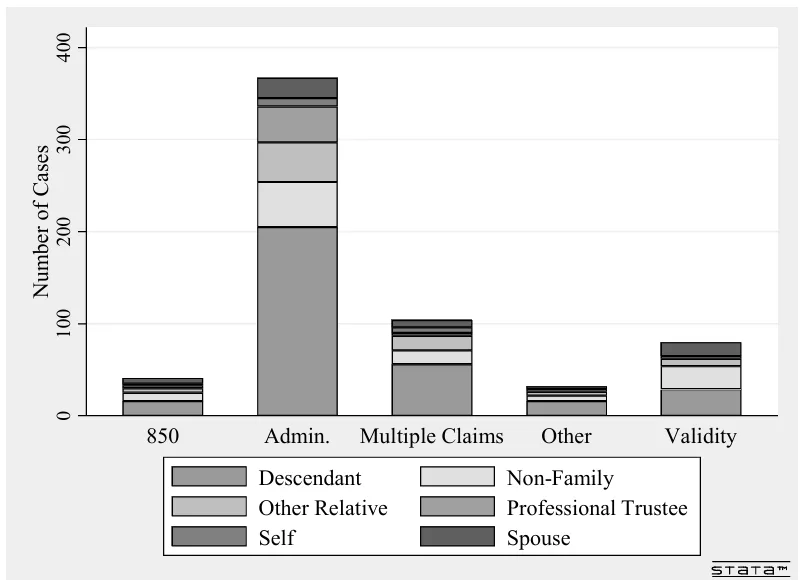
Figures 6 through 9 make this point concrete. They tabulate the petitioners’ and respondents’ roles in the trust and relationships to the settlor for each basic claim type. They show that although litigation comes in various shapes and sizes, a recurring motif is the structure we described above in which a beneficiary sues a beneficiary/trustee and both parties are the settlors’ descendants. Indeed, this alignment—which we have spotlighted with black bars in Figures 6 through 9—appears 149 times (23 percent), including in 131 cases with a trust administration claim (28 percent).164
Figure 6: Petitioners’ Role in Trust by Claim Type
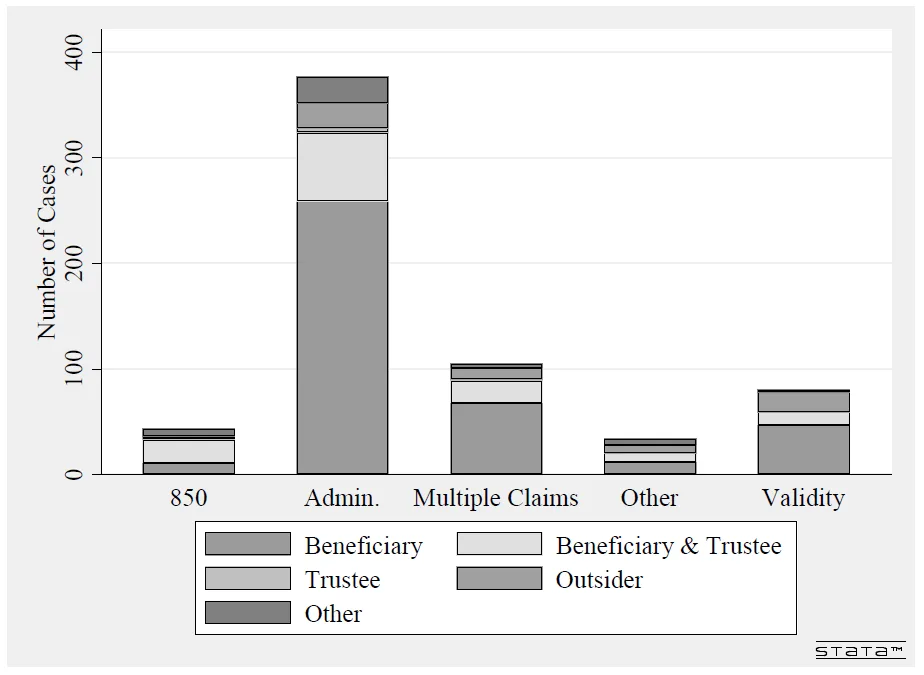
Figure 7: Respondents’ Role in Trust by Claim Type
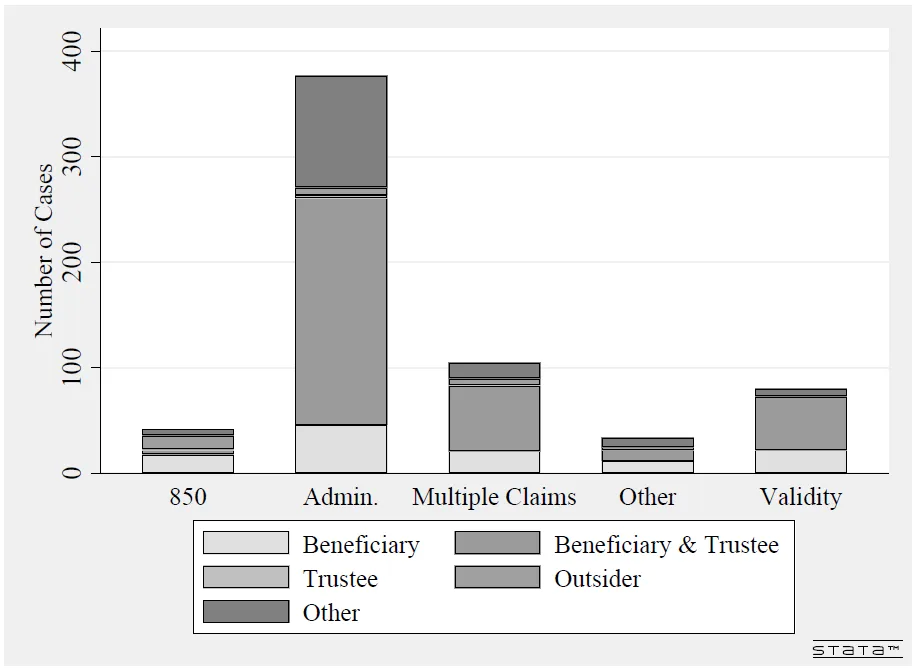
Figure 8: Petitioners’ Relationship to Settlor by Claim Type
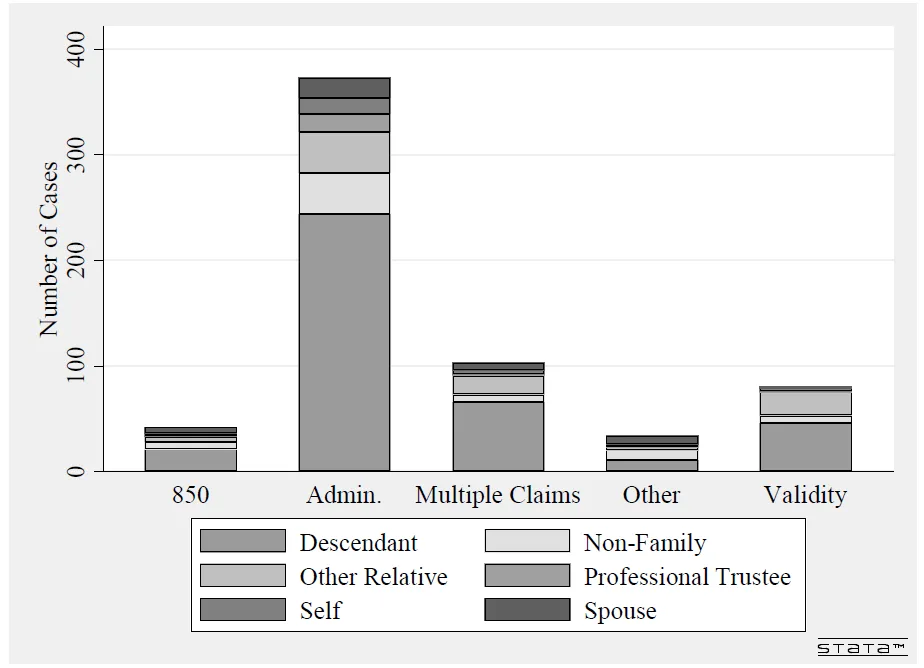
Figure 9: Respondents’ Relationship to Settlor by Claim Type
Naming one of several children to be successor trustee likely causes trouble for several reasons. For one, sibling relationships are uniquely comparative.165 Classic work in family sociology and developmental psychology shows that siblings are especially attuned to relative treatment, perceived favoritism, and symbolic indicators of parental approval.166 Therefore, making one child successor trustee embeds hierarchy into what is otherwise a lateral relationship and could be seen as an insult by the other children.167 Magnifying this issue, trustees occupy a position of pronounced structural advantage: They enjoy discretion over investments, distributions, and the valuation of property.168 But a trustee who is also a beneficiary can use this power to further their own interests. Even when they act in good faith, their brothers or sisters may suspect that they are being opportunistic.169 Thus, deputizing a responsible child to be successor trustee is a common estate planning move that sometimes backfires.170
In fact, we also found that some cases appear to be less about money and more about relationships. Parties pursued quixotic claims: brawling over bankrupt estates171 or litigating against each other for decades.172 When two siblings sparred throughout their lives “over matters big and small,” it can hardly be surprising that they also fought over who would be trustee of their mom’s trust.173 Similarly, recall that our p-wins regression found that petitioners and respondents who are related to the settlor are less likely to prevail than other cohorts. This suggests that family members struggle to make clear-eyed assessments of their legal positions.
Accordingly, the standard rev trust, in which parents name one child as successor trustee and all children as beneficiaries, can backfire by aggravating personal grievances. Yet family dynamics are only part of the story. As we explain next, trust disputes can also be factually and procedurally convoluted.
C. Complexity
A final characteristic of trust lawsuits is that they can be unwieldy. As this Section explains, some cases unfold in a fashion that creates headaches for courts and parties.
Trust lawsuits tend to be more complex than probate disputes in several ways. One is factual. In probate, breach of fiduciary duty claims are typically straightforward: Because the decedent’s personal representative has little to do other than to inventory and distribute the estate, violations can be as simple as failing to follow the will’s terms or committing blatant self-dealing.174 But trusts are basically private mini-corporations. They task the trustee with managing the corpus year after year and making decisions about thankless issues such as how to handle real property that turns out to be contaminated or a lease that the settlor signed as a guarantor before they died.175 Moreover, some trustees manage the property aggressively by entering into byzantine financial arrangements.176 For these reasons, questions about whether a trustee discharged their obligations prudently and loyally can be anything but simple.
Other complications are procedural. Although jurisdiction over probate litigation is rarely an issue—the probate judge who is managing the decedent’s assets resolves conflict—as noted above, in California and other states, separate branches of the court system share power over trust cases.177 This spawns parallel proceedings. For example, several matters in the probate division referenced identical cases pending in the civil division.178 Others came to a screeching halt because the parties started litigating where they should be litigating.179 One group of beneficiaries even brought a petition alleging breach of trust in the probate division, received an adverse ruling on a discovery motion, dismissed the action, and refiled it a week later in the civil division.180 Thus, the options available to trust litigants create inefficiencies and invite forum shopping.
* * *
Trust litigation poses distinct challenges. This creates a need for mechanisms to prevent disputes from arising or spiraling out of control. Are the tools that settlors, attorneys, and courts employ up to the task? The next Part addresses this question.
IV. Managing Trust Litigation
This Part assesses three devices that are supposed to disincentivize or resolve trust disputes: no-contest clauses, mandatory arbitration provisions, and mediation. First, it shows that although no-contest clauses are extremely common, few litigants try to enforce them—a situation we attribute to California caselaw that makes it hard to disinherit beneficiaries who accuse trustees of breaching their fiduciary duties. Second, despite intense interest in arbitrating trust disputes, we find that mandatory arbitration clauses rarely appear in trusts. Third, we call for greater use of mediation, which reliably generates settlements.
A. No-Contest Clauses
No-contest clauses are the best-known method of deterring estate-related claims. This Section explains why they are an underutilized resource in trust litigation. It then proposes a doctrinal change that would fix this problem.
The legal system has long been deeply ambivalent about no-contest provisions. These clauses, which emerged in the seventeenth century, disinherit anyone who files certain kinds of claims.181 They divide policymakers, courts, and scholars because they implicate compelling but contradictory policies. On the one hand, no-contest clauses facilitate the testator’s intent, prevent “waste of the estate in litigation, and avoid[] use of a will contest to coerce a more favorable settlement to a dissatisfied beneficiary.”182 But on the other hand, the specter of forfeiture can discourage meritorious lawsuits.183 This clash of values has made the law governing no-contest language a tangled mess. Although states follow a variety of approaches, many of them—including California—refuse to penalize a litigant who challenges the validity of a will or trust if they had “probable cause” for their petition.184 “Probable cause” means “the existence, at the time of the initiation of the proceeding, of evidence which would lead a reasonable person, properly informed and advised, to conclude that there is a substantial likelihood that the contest or attack will be successful.”185
However, California is also one of several jurisdictions that apply a different rule to breach of fiduciary duty claims. Instead of the probable cause standard, these states exempt all allegations about a trustee’s performance of their obligations with the sole exception of those that are frivolous.186 In other words, to invoke a trust’s no-contest clause, a trustee must clear the high hurdle of showing that the lawsuit was “‘manifestly insufficient as a matter of law.’”187 The logic here is that no-contest clauses should almost never disinherit beneficiaries for filing removal or surcharge petitions because that would shield trustees from liability and permit them to loot the trust.188
Our data suggests that this approach may be too conservative. We uncovered two incongruous facts about no-contest clauses in trusts. For one, they were pervasive.189 Astoundingly, 496 of the 620 litigated petitions (80 percent) that disclosed the trust featured a no-contest provision. In addition, and counterintuitively, this ocean of no-contest clauses rarely influenced the outcome of cases. Parties asked the court to enforce such a provision only nine times (1 percent) and a judge granted such a request just once (< 1 percent).190 Thus, no-contest clauses were, bizarrely, both ubiquitous and impotent.
The most plausible explanation for this “dog that did not bark” is that California’s frivolousness standard makes no-contest provisions in trusts essentially worthless.191 Recall that three-quarters of petitions included claims against the trustee. In fact, 414 of these (65 percent) involved administrative claims only. As a result, in a super-majority of cases, the trustee could only invoke the no-contest clause if the allegations were utterly lacking in serious purpose and good faith. This bar may be set too high. Although, as we have discussed, fiduciary litigation does not seem to have a strike suit problem, there was no shortage of tenuous allegations that may have been motivated by spite. Therefore, lawmakers in California and states with similar approaches should consider subjecting petitions against fiduciaries to the same probable cause standard that governs contests.192
Two additional points warrant discussion. First, a skeptic might wonder whether we can draw inferences about the impact of no-contest clauses from our data because these provisions might add value in a way we cannot detect. Perhaps there were scores of potential petitioners who decided not to sue because they feared being disinherited. However, this seems unlikely. As mentioned, 80 percent of the petitions in our data stemmed from trusts with no-contest provisions. Yet only 615 of the 1,020 trusts (64 percent) that underlay the non-litigated filings that came on calendar in San Francisco during the same seven-year period included no-contest clause, which is a statistically significant gap (p=0.000). If no-contest provisions discouraged lawsuits, we would expect to see the opposite: fewer such clauses among litigated trusts than among trusts that did not generate disputes.193 But instead, no-contest provisions are overrepresented in cases that end up in adversarial proceedings—a pattern that is hard to square with the idea that these clauses suppress trust litigation.
Second, some of the no-contest clauses in our data may have been too narrow to cover allegations against the trustee. For one, some provisions only applied to trust contests (although others expressly covered claims of breach of fiduciary duty).194 Also, no-contest provisions are often boilerplate,195 and a commonly recycled form penalizes litigants who “seek[] to obtain an adjudication in any proceeding in any court that this trust or any of its provisions . . . is void.”196 Arguably, a petition to surcharge or remove the trustee falls outside the ambit of this clause because—as some courts outside of California have held—it does “not attack[] the trust itself or its existence.”197
But California courts read this language more broadly. Settlors routinely empower the trustee to do things that would otherwise be prohibited (for instance, to self-deal)198 or immunize them from damages for certain conduct (for example, for negligence).199 Several California appellate opinions have held that petitions that are inconsistent with these explicit textual grants of authority in the trust—say, when a beneficiary contends that the trustee impermissibly sold trust property to themselves or breached the trust by acting carelessly—attempt to void, nullify or set aside a provision of the trust.200 Thus, we believe that it is primarily the frivolousness principle, and not the scope of no-contest clauses, that accounts for the irrelevance of no-contest provisions in trusts.
B. Mandatory Arbitration Provisions
Mandatory arbitration provisions in trusts have been a hot topic for two decades. This Section demonstrates that although trust arbitration has potential, it played almost no role in our data.
For better or for worse, arbitration has become a hallmark of modern civil justice. In 1925, Congress passed the Federal Arbitration Act (FAA) to abolish ancient rules that made it hard to obtain specific performance of a pre-dispute arbitration clause.201 The FAA does so by presumptively validating arbitration provisions in “contract[s].”202 In the 1980s, the U.S. Supreme Court began expanding the statute’s orbit, opining that it radiates with a “federal policy favoring arbitration agreements, notwithstanding any state substantive or procedural policies to the contrary.”203 Businesses saw a chance to create their own dispute-resolution fiefdoms and placed arbitration clauses in millions of consumer and employment contracts.204 Critics object that nobody reads the fine print and that the process favors the companies that write its rules,205 but arbitration’s proponents argue that it is an ingenious private solution to litigation because it is faster, cheaper, and confidential.206
The legal status of trust arbitration is hazy. Whether the FAA applies to arbitration provisions in trusts despite its textual limitation to “contract[s]” is an open question.207 However, in several states, recent statutes or judicial opinions have made arbitration clauses in trusts enforceable when applied to what are called “internal” trust disputes: those between trustee and beneficiary or rival beneficiaries over the management or interpretation of the trust.208 The rationale is that these parties implicitly agree to the trust’s terms, including any arbitration clause, when they accept fees or distributions.209 In fact, because trustees can decline to serve and beneficiaries can disclaim any gift, their choice not to do so seems at least as consensual as a consumer’s click on a website or an employee’s receipt of an employment manual—two common forms of binding people to contractual arbitration.210
By contrast, these laws and decisions generally refuse to compel arbitration when a litigant challenges the validity of the trust that contains the arbitration clause.211 The key difference, as one California appellate court put it, is that such a party “has not either expressly or implicitly sought the benefits of a trust instrument containing the disputed arbitration provision.”212
Our research suggests that trust arbitration can be useful. For starters, most claims that relate to trust administration thus involve arbitration-amenable internal disputes rather than non-arbitrable validity claims. Moreover, the fact that arbitration takes place behind closed doors seems like a valuable perk. As noted, trust disputes can get ugly.
Nevertheless, we discovered that mandatory arbitration clauses in trusts are rare. Unlike no-contest clauses, which were omnipresent, mandatory arbitration provisions surfaced in just 34 of the 620 petitions that disclosed the trust instrument (5 percent). In addition, there was a grand total of one motion to compel arbitration in our dataset.213 To be sure, some of the San Francisco trusts are from the 1990s or earlier and predate the outpouring of interest in trust arbitration. But unless norms have experienced a recent seismic shift, arbitration has yet to colonize trust law.214
C. Court-Sponsored Mediation
Scholars have increasingly advocated for the use of mediation in probate disputes. This Section shows that this technique can be effective.
Mediation was once uncommon in inheritance litigation. For example, in 1997, Susan Gary observed that “[m]ediation in the probate context is still in its infancy.”215 Mediators cited the worst evidence problem and the fact that “the disputes are too emotional” as obstacles to guiding the parties to an amicable resolution.216
But more recently, mediation has established a foothold in inheritance law. Several states have created court-sponsored mediation programs for trusts and estates cases.217 In addition, a wave of scholarship has touted the benefits of mediation in this arena.218 This work echoes the arbitration literature to some degree: It cites the advantages of alternative dispute resolution, including its confidentiality and relative affordability.219 However, because mediation, unlike arbitration, is facilitative rather than adjudicatory, commentators believe that it is less disruptive to families.220
The San Francisco Superior Court has been a pioneer in this movement. Since the 1990s, it has offered a pro bono mediation program in trusts and estates matters.221 A judge from the probate division can refer a dispute to mediation with the parties’ consent.222 Mediators are lawyers who have at least ten years of experience in the field and who have agreed to provide up to six hours of their time for free.223 In addition, the court paves the way for mediation with small touches such as offering a conference room for the proceeding224 and making forms available online.225
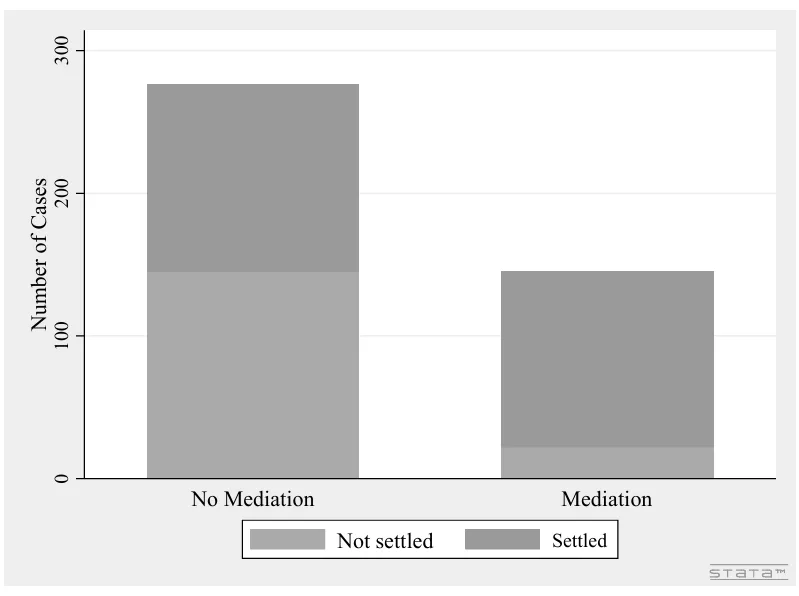
We found that this option is tremendously helpful for ending conflict over trusts. Figure 10 highlights the strong connection between mediation and settlement in our data. Parties settled 131 of the 276 petitions (47 percent) in which there was no record of mediation. But 123 of the 145 filings (85 percent) that went to mediation settled, which is a statistically significant difference (p = 0.000).226 Admittedly, this result may stem, in part, from selection bias: Litigants who are willing to try to hammer out their differences in mediation may be more open to compromise than those who are not. Nevertheless, our research shows that the process is a veritable settlement factory. Courts that are in the market for ways to efficiently resolve trust litigation should consider borrowing the San Francisco model.
Figure 10: Settlements by Mediation Status
Conclusion
Although rev trusts have been “a necessary staple of every estate plan” for roughly half a century, there has never been an empirical study of trust litigation.227 This Article has used a hand-collected dataset of seven years of trust lawsuits from a major California county to illuminate this previously unexplored corner of the civil justice system. On the one hand, it finds little support for the entrenched idea that inheritance claims tend to be strike suits. On the other hand, it also discovers that many cases arise from the administration of the trust and feature complex and emotionally fraught disputes between siblings. In this way, the fact that rev trusts can last for long after the settlor’s death is a double-edged sword. Finally, the Article shows that no-contest clauses and mandatory arbitration provisions do not function as intended, but mediation routinely produces settlements. We hope that this glimpse into ground-level trust lawsuits will be helpful to legislatures, judges, scholars, lawyers, and settlors as trusts begin to ferry a record amount of wealth from one generation to the next.
- See Order After Bench Trial at 6, 11, In re The Raymond L. Mar Revocable Tr., No. PTR-19-302661 (Cal. Super. Ct. July 23, 2024) [hereinafter Mar Order]. ↩︎
- See id. at 1. ↩︎
- See id. at 2. ↩︎
- See Petition to Modify Trust, to Compel Co-Trustees to Account, to Remove Co-Trustees, to Declare Deeds Void; for Redress of Breaches of Trust; to Enjoin Co-Trustees from Taking Action to Evict Petitioner from Trust Property; and to Disqualify Respondent’s Law Firm at 34, 39, In re Mar Tr., No. PTR-19-302661 (Mar. 7, 2019). ↩︎
- See id. at 52. ↩︎
- See Mar Order, supra note 1, at 9–15. ↩︎
- See id. at 10–12. ↩︎
- See id. at 2–3. ↩︎
- Id. at 21–22. ↩︎
- See Order re Petition of Antoinette Mallette & Veronica Ligne Mar for Surcharge of Gregory Mar’s Distributive Share of Trust Property & Award of Attorney Fees from Trust at 4, In re The Raymond L. Mar Revocable Tr., No. PTR-19-302661 (Cal. Super. Ct. Oct. 9, 2025). ↩︎
- See Petition for Instructions re Amended Trust & Accounting at 2–3, In re The Jack Dane Tr., No. PTR-18-302234 (Cal. Super. Ct. Sept. 20, 2018). ↩︎
- See id. at 5. ↩︎
- See id. at 3. ↩︎
- See id. ↩︎
- See id. ↩︎
- See id. at 5. ↩︎
- See Petition to Determine Validity of Trust Provision at 3, In re The Revocable Tr. Declaration Creating the Jack Dane Tr., No. PTR-18-302276 (Cal. Super. Ct. Oct. 3, 2018). ↩︎
- See id. at 1, 12. ↩︎
- See Petition to Determine Validity of Trust Provision at 2, In re The James Gee Choy & Lily May Chin Choy 1999 Fam. Tr., No. PTR-14-297727 (Cal. Super. Ct. May 8, 2014) [hereinafter Choy Petition]. ↩︎
- See id. at 33. ↩︎
- See id. at 2, 45. ↩︎
- See id. at 56, 68. ↩︎
- See id. at 2–3. ↩︎
- See Amended Answer & Opposition to Petition to Determine Validity of Trust Provision at 5–6, In re Choy Fam. Tr., No. PTR-14-297727 (June 2, 2014). ↩︎
- See id. ↩︎
- Id. at 6. ↩︎
- See, e.g., Richard V. Wellman, The Uniform Probate Code: A Possible Answer to Probate Avoidance, 44 Ind. L.J. 191, 195 (1969) (commenting that “‘estate planning’ . . . used to mean will drafting”). ↩︎
- See infra text accompanying notes 105–07. ↩︎
- For empirical studies of probate disputes, see David Horton & Reid Kress Weisbord, Probate Litigation, 2022 U. Ill. L. Rev. 1149, 1172–92; Jeffrey A. Schoenblum, Will Contests—an Empirical Study, 22 Real Prop. Prob. & Tr. J. 607, 607 (1987). For empirical studies that focus more on the process itself, see Marvin B. Sussman, Judith N. Cates & David T. Smith, The Family and Inheritance 44–45 (1970) (reporting on the probate process in Cuyahoga County, Ohio); Olin L. Browder, Jr., Recent Patterns of Testate Succession in the United States and England, 67 Mich. L. Rev. 1303, 1304 (1969) (examining 187 estates from Michigan and 100 estates from London); Allison Dunham, The Method, Process and Frequency of Wealth Transmission at Death, 30 U. Chi. L. Rev. 241, 241 (1963) (analyzing 97 estates from 1953 and 73 estates from 1957 from Illinois); David Horton, In Partial Defense of Probate: Evidence from Alameda County, California, 103 Geo. L.J. 605, 627–51 (2015) (describing probate in a large California county); Richard R. Powell & Charles Looker, Decedents’ Estates: Illumination from Probate and Tax Records, 30 Colum. L. Rev. 919, 923–25 (1930) (parsing data about estate administration from New York); Robert A. Stein, Probate Administration Study: Some Emerging Conclusions, 9 Real Prop. Prob. & Tr. J. 596, 596 (1974) (focusing on four Minnesota counties in 1969); Edward H. Ward & J. H. Beuscher, The Inheritance Process in Wisconsin, 1950 Wis. L. Rev. 393, 393–95 (studying records from several periods in Wisconsin). ↩︎
- See Lee-ford Tritt, The Curious Case of the James Brown Estate, 92 Geo. Wash. L. Rev. 753, 789 (2024) (“[T]he [w]ill is no longer the primary dispositive estate planning instrument of an individual’s assets—the revocable trust has become the dispositive instrument of choice.”). ↩︎
- Natalie Banta Lynner, The Price of Privacy at Death, 67 B.C. L. Rev. 1193, 1215 (2026). As of 2024, financial institutions that are part of the Federal Reserve System—a relatively small subset of all financial institutions—managed $1.56 trillion in roughly 732,000 trusts. See Robert Sitkoff & Jesse Dukeminier, Wills, Trusts, and Estates 405 (12th ed. 2026). Banks that are Federal Reserve members merely “account[] for 34 percent of all commercial banks in the United States.” Bd. of Governors of the Fed. Rsrv. Sys., 108th Annual Report 28 (2021). ↩︎
- Nick Lichtenberg, The $124 Trillion Great Wealth Transfer Is Bigger than Ever—and Millennials Will Get the Biggest Cut, Fortune (July 23, 2025, at 09:32 ET), https://fortune.com/2025/07/23/great-wealth-transfer-124-trillion-bigger-than-ever-millennials-gen-x/ [https://perma.cc/R8KJ-NR77]. ↩︎
- Cunniffe v. Cunniffe, 60 A.3d 1051, 1054 (Conn. App. Ct. 2013). ↩︎
- Adam Hofri-Winogradow, The Demand for Fiduciary Services: Evidence from the Market in Private Donative Trusts, 68 Hastings L.J. 931, 934 (2017) (comparing the utter privacy of trusts to the partial sunshine of corporate contracts, some of which must be disclosed to the Securities and Exchange Commission and made publicly available). ↩︎
- See Frances H. Foster, Trust Privacy, 93 Corn. L. Rev. 555, 573–74, 574 n.121 (2008). ↩︎
- See infra text accompanying notes 109–10. ↩︎
- See, e.g., Brittany L. Deitch, Estate to State: Pay-to-Stay Statutes and the Problematic Seizure of Inherited Property, 95 U. Colo. L. Rev. 839, 871 n.139 (2024) (“Empirical research on estate planning in the United States is often limited by the reality that trusts are private . . . .”). ↩︎
- This is the final article in a three-part series that uses the San Francisco data. Our first paper focused on the narrow problem of settlors who fail to fully fund their rev trusts during life. See David Horton, Reid Kress Weisbord & Christopher J. Ryan, Jr., The Trust Transfer Problem, 104 N.C. L. Rev. 1007 (2026). Our second piece, a symposium contribution, examined non-litigated petitions. See C.J. Ryan, David Horton & Reid Kress Weisbord, Uncontested Trusts in Court, 33 Geo. Mason L. Rev. (forthcoming 2026), https://papers.ssrn.com/sol3/papers.cfm?abstract_id=5572178 [https://perma.cc/TU28-T4UU]. ↩︎
- See, e.g., Jeffrey P. Rosenfeld, Will Contests: Legacies of Aging and Social Change, in Inheritance and Wealth in America 173, 173–74 (Robert K. Miller, Jr. & Stephen J. McNamee eds., 1998) (calling will contests “deviant behavior of beneficiaries” that “are socially and economically significant events . . . [which] can rupture and realign the social fabric of families and keep millions of dollars tied up in litigation for years”); Leon Jaworski, The Will Contest, 10 Baylor L. Rev. 87, 88 (1958) (“It has been said, and I think accurately, that a will is more apt to be the subject of litigation than any other legal instrument.”). ↩︎
- David J. Feder & Robert H. Sitkoff, Revocable Trusts and Incapacity Planning: More than Just a Will Substitute, 24 Elder L.J. 1, 9 (2016). ↩︎
- See supra text accompanying notes 1–10. ↩︎
- See John H. Langbein, Living Probate: The Conservatorship Model, 77 Mich. L. Rev. 63, 65–66 (1978) (“[T]he odor of the strike suit hangs heavily over this field.”); Daniel B. Kelly, Strategic Spillovers, 111 Colum. L. Rev. 1641, 1685–86 (2011) (“Contestants may initiate litigation because they realize that, by increasing costs through delays, negative publicity, and litigation expenses, they may be able to extract a settlement from the estate.”). ↩︎
- See supra text accompanying notes 11–18. ↩︎
- Dane’s trust held $1.2 million and another $737,979.94 poured into the trust from his probate estate. See Petition for Instructions re Amended Trust & Accounting at 6, In re The Jack Dane Tr., No. PTR-18-302234 (Cal. Super. Ct. Sept. 20, 2018); Order for Final Distribution & for Allowance of Statutory Compensation to Executor and Attorneys at 5, In re Est. of Dane, No. PES-17-300731 (Cal. Super. Ct. Oct. 8, 2020). Dane’s original trust gave Clarot two of eight shares, or $484,500. She settled for a flat $295,000 payment. See Order Approving of Agreement, Indemnification & Mutual Release at 5, In re Dane Tr., No. PTR-18-302234 (July 9, 2019). ↩︎
- See Joint Petition for Order Approving Stipulated Settlement at 3–4, In re The James Gee Choy & Lily May Chin Choy 1999 Fam. Tr., No. PTR-14-297727 (Cal. Super. Ct. Apr. 28, 2015) (reporting that Alan had agreed to be disinherited under his parents’ trust in return for Ronald not arguing that his petition was frivolous). ↩︎
- Choy Petition, supra note 19, at 4. Similarly, the Mar siblings peppered their pleadings with personal attacks. See Mar Order, supra note 1, at 22 nn.6 & 8 (“The [b]riefs filed by the lawyers on both sides are replete with accusation of improprieties,” including “conspiracy, self-interest, and trying to get their hands on the money. . . .”). ↩︎
- See, e.g., Felten v. Hoffman (In re Est. of Felten), 28 N.W.3d 251, 260 (Iowa 2025) (noting that the view that courts should “enforce no-contest clauses unless the challenge to the will is supported by probable cause . . . enjoys wide support”). ↩︎
- See infra text accompanying notes 186–88. ↩︎
- See, e.g., David Horton, Arbitration About Arbitration, 70 Stan. L. Rev. 363, 367 (2018). ↩︎
- S. I. Strong, Facilitating Trust Arbitration by Amending the Federal Arbitration Act, 14 Am. U. Bus. L. Rev. 669, 669 (2025). ↩︎
- Lee-ford Tritt, The Use of AI-Based Technologies in Arbitrating Trust Disputes, 58 Wake Forest L. Rev. 1203, 1205–06 (2023). ↩︎
- See Schoenblum, supra note 29, at 612 n.28 (citing a treatise that calls the will “the single most important planning document”) (quoting 1 Frederick K. Hoops, Family Estate Planning Guide §§ 9-10 (3d ed. 1982)); Wellman, supra note 27, at 195 (noting that lawyers once primarily relied on wills). ↩︎
- See Deborah S. Gordon, Forfeiting Trust, 57 Wm. & Mary L. Rev. 455, 461 (2015) (describing the primacy of will contests). ↩︎
- Law v. Jones (In re Law’s Est.), 138 N.W. 531, 534 (Iowa 1912). ↩︎
- Milton D. Green, Judicial Tests of Mental Incompetency, 6 Mo. L. Rev. 141, 165 (1941); see also Pamela Champine, Expertise and Instinct in the Assessment of Testamentary Capacity, 51 Vill. L. Rev. 25, 31 (2006) (“The sole certainty in testamentary capacity case law is unpredictability.”). ↩︎
- Bill and Dena Brown Tr. v. Garcia, 880 N.W.2d 269, 277–78 (Mich. Ct. App. 2015) (quoting Kar v. Hogan, 251 N.W.2d 77, 78 (Mich. 1976)). ↩︎
- Elias Clark, Louis Lusky, Arthur W. Murphy, Mark L. Ascher & Grayson M.P. McCouch, Cases and Materials on Gratuitous Transfers: Wills, Intestate Succession, Trusts, Gifts, Future Interests and Estate and Gift Taxation 231 (5th ed. 2007); see also Melanie B. Leslie, The Myth of Testamentary Freedom, 38 Ariz. L. Rev. 235, 258 (1996) (arguing that undue influence is so manipulable that “testators who wish to distribute their property in a way that a court may view immoral, unjust or improper have limited freedom to do so”); Carla Spivack, Why the Testamentary Doctrine of Undue Influence Should Be Abolished, 58 Kan. L. Rev. 245, 245 (2010) (“[U]ndue influence fails to meet any standard of clarity, fairness, or predictability that a legal doctrine should satisfy.”); Ray D. Madoff, Unmasking Undue Influence, 81 Minn. L. Rev. 571, 576 (1997) (“[R]ather than furthering freedom of testation, the undue influence doctrine denies freedom of testation for people who deviate from judicially imposed testamentary norms.”). ↩︎
- See Ashbel G. Gulliver & Catherine J. Tilson, Classification of Gratuitous Transfers, 51 Yale L.J. 1, 2 (1941) (discussing the importance of the decedent’s intent in inheritance law). ↩︎
- See John C.P. Goldberg & Robert H. Sitkoff, Torts and Estates: Remedying Wrongful Interference with Inheritance, 65 Stan. L. Rev. 335, 344 (2013) (quoting John H. Langbein, Will Contests, 103 Yale L.J. 2039, 2046 (1994) (reviewing David Margolick, Undue Influence: The Epic Battle for the Johnson & Johnson Fortune (1993)). ↩︎
- Henry W. Taft, Comments on Will Contests in New York, 30 Yale L.J. 593, 603 (1921). ↩︎
- See Donegan v. Wade, 70 Ala. 501, 505 (1881) (opining that will contests “waste away vast estates”). ↩︎
- See Smithsonian Inst. v. Meech, 169 U.S. 398, 415 (1898) (“[C]ontests are commenced wherein not infrequently are brought to light matters of private life that ought never to be made public, and in respect to which the voice of the testator cannot be heard either in explanation or denial . . . .”). ↩︎
- David F. Cavers, Ante Mortem Probate: An Essay in Preventive Law, 1 U. Chi. L. Rev. 440, 441 (1934). ↩︎
- Adam J. Hirsch, Testation and the Mind, 74 Wash. & Lee L. Rev. 285, 324 n.171 (2017); see also Barry v. Am. Sec. & Tr. Co., 135 F.2d 470, 473 (D.C. Cir. 1943) (claiming that “only a very small percentage of will contests made on the grounds of defective execution, mental incapacity or undue influence are successful” but citing no supporting authority); Howard Fink, Ante-Mortem Probate Revisited: Can an Idea Have a Life After Death?, 37 Ohio St. L.J. 264, 287 (1976) (“[O]ften the threat of a will contest by ‘laughing heirs’ is enough to exact an unreasonable settlement.”). ↩︎
- Edmond Nathaniel Cahn, Undue Influence and Captation: A Comparative Study, 8 Tul. L. Rev. 507, 518 (1934); see also Alper v. Alper, 65 A.2d 737, 740 (N.J. 1949) (opining that “a disappointed heir, striving for an undue advantage” can challenge “wills as a means of coercing a settlement”). ↩︎
- Aloysius A. Leopold & Gerry W. Beyer, Ante-Mortem Probate: A Viable Alternative, 43 Ark. L. Rev. 131, 135 (1990). John Langbein has taken a similar position: A major reason that the impact of capacity litigation in America is so difficult to measure is that most of it is directed towards provoking pretrial settlements, typically for a fraction of what the contestants would be entitled to receive if they were to defeat the will. Especially when such tactics succeed, they do not leave traces in the law reports. Langbein, supra note 42, at 66. ↩︎
- See Schoenblum, supra note 29, at 608. ↩︎
- See id. at 618. ↩︎
- See id. at 619 chart 6. In addition, the contestant withdrew, dismissed, or took a voluntary nonsuit in ten and three were pending. See id. ↩︎
- See id. at 626 chart 8. Schoenblum observed that judges seemed less likely to hold for the contestant, doing so just twice in twelve matters (17 percent). See id. at 627. ↩︎
- Id. at 621; see also id. at 624 (“[T]he data suggests that contestants cannot always be easily bought off with minimal settlements.”). ↩︎
- See Horton & Weisbord, supra note 29, at 1156, 1181. ↩︎
- In addition, despite the widespread association of probate litigation with will contests, we discovered that claims of fiduciary misconduct were almost as common. See id. at 1180–81. ↩︎
- See id. at 1187, 1200. ↩︎
- The court either upheld the will or the contestant dismissed their claim in eight matters and the judge either invalidated the document or the proponent withdrew it only twice. See id. at 1190 tbl. 10. ↩︎
- See id. at 1191 tbl. 11. ↩︎
- See id. For example, if T had three children, A, B, and C; owned $300,000; and left everything to A and B, and C settled a will contest for $50,000, C’s success rate would be 50 percent. This is because winning on the merits would have netted C one-third of the estate ($100,000) in intestacy, and C compromised for half of that sum. See id. at 1190 n.242. ↩︎
- See id. at 1190. We observed similar contestant success rates in settlement data drawn from testamentary capacity and undue influence litigation. See Reid Kress Weisbord & David Horton, The Future of Testamentary Capacity, 79 Wash. & Lee L. Rev. 609, 649 (2022); David Horton & Reid Kress Weisbord, The New Undue Influence, 2024 Utah L. Rev. 231, 267 [hereinafter Horton & Weisbord, New Undue Influence]. ↩︎
- See Bradley E.S. Fogel, Trust Me? Estate Planning with Revocable Trusts, 58 St. Louis U. L.J. 805, 806 (2014). ↩︎
- See 3 Frederic William Maitland, The Unincorporate Body, in The Collected Papers of Frederic William Maitland 271, 272 (H.A.L. Fisher ed., 1911) (“[The Trust] is the greatest and the most distinctive achievement performed by Englishmen in the field of jurisprudence.”). ↩︎
- Collins v. Mosher, 91 F.2d 582, 584–85 (9th Cir. 1937) (quoting Restatement (First) of Trs. § 2 (A.L.I. 1935)). ↩︎
- See, e.g., Restatement (Third) of Trs. §§ 77–84 (A.L.I. 2007) (describing the trustee’s duties); D. Gordon Smith, The Critical Resource Theory of Fiduciary Duty, 55 Vand. L. Rev. 1399, 1453 (2002) (“The core fiduciary duty of a trustee is an obligation to act in the interest of the beneficiary of the trust.”). ↩︎
- In a controversial development, several states have abolished the Rule Against Perpetuities, which limited the duration of trusts. See Jesse Dukeminier & James E. Krier, The Rise of the Perpetual Trust, 50 UCLA L. Rev. 1303, 1304 (2003). ↩︎
- See Fogel, supra note 79, at 810 (explaining that settlors can give a “gift to his or her son to be held in trust until the son reached a certain age”); Feder & Sitkoff, supra note 40, at 9 (“By making a transfer in trust rather than outright, a settlor ensures that the property will be managed and distributed in accordance with the settlor’s wishes as expressed in the terms of the trust rather than the whims of the beneficiaries.”); Simpson v. State, Dep’t of Soc. & Rehab. Servs., 906 P.2d 174, 178 (Kan. Ct. App. 1995) (involving a trust in which “[t]he trustees have absolute discretion as to whom they will make distributions and may exclude any one or more of the beneficiaries from any payment or distribution”). ↩︎
- Bernard Rudden, Book Review, 44 Mod. L. Rev. 610, 610 (1981). ↩︎
- See, e.g., In re Est. of Davis, 261 N.E.3d 574, 580 (Ohio Ct. App. 2025) (“A testamentary trust can be established through a will, but it is a bequest in a will just like any other.”). ↩︎
- See, e.g., Lux v. Lux, 288 A.2d 701, 705 (R.I. 1972) (concluding that an ambiguous bequest in a will created a testamentary trust because the testator “intended that someone would hold and manage the property until [the beneficiaries] were of sufficient age to do so themselves”). ↩︎
- Feder & Sitkoff, supra note 40, at 2. ↩︎
- See, e.g., In re Riddell, 157 P.3d 888, 893 (Wash. Ct. App. 2007) (explaining how a special needs trust functions). ↩︎
- See, e.g., Siegel v. Novak, 920 So. 2d 89, 95 (Fla. Dist. Ct. App. 2006) (“The central characteristic of a revocable trust is that the settlor ‘has the right to recall or end the trust at any time, and thereby regain absolute ownership of the trust property.’” (quoting Fla. Nat’l Bank v. Genova, 460 So. 2d 895, 897 (Fla. 1984)). ↩︎
- See generally Norman F. Dacey, How to Avoid Probate! (1965). For background on Dacey’s colorful life and unexpected success, see Richard D. Lyons, Norman Dacey, 85; Advised His Readers to Avoid Probate, N.Y. Times (Mar. 19, 1994), http://www.nytimes.com/1994/03/19/nyregion/norman-dacey-85-advised-his-readers-to-avoid-probate.html [https://perma.cc/Y38P-F6Z]; Edwin McDowell, Book Notes, N.Y. Times (Mar. 7, 1990), http://www.nytimes.com/1990/03/07/arts/book-notes-459190.html [https://perma.cc/LJZ5-SDSJ]. ↩︎
- See Restatement (Third) of Trs. § 25 cmt. a (A.L.I. 2003) (“[P]robate administration is not required for assets transferred to the trustee inter vivos.”). ↩︎
- See Fogel, supra note 79, at 807 (“During the settlor’s life, the settlor is frequently the trustee (or at least a co-trustee) and a beneficiary of the revocable trust.”); Zackary C. Nehls, Note, Death Is Certain but Probate Is Optional: How to Transfer Wealth and Dodge Creditors Using a Revocable Trust, 65 St. Louis U. L.J. 431, 433 (2021) (“Titling assets in a revocable trust has no practical effect on ownership and control . . . .”). ↩︎
- John H. Langbein, The Nonprobate Revolution and the Future of the Law of Succession, 97 Harv. L. Rev. 1108, 1108 (1984) (coining the phrase “will substitute”). ↩︎
- See John H. Martin, Reconfiguring Estate Settlement, 94 Minn. L. Rev. 42, 43 (2009) (“The deficiencies of probate, chief among them being delay, expense, and lack of privacy, are acknowledged by estate planners and by other voices within the legal community who have joined in a chorus of criticism.”). ↩︎
- See Ward & Beuscher, supra note 29, at 406 n.19 (describing this process). ↩︎
- A. James Casner, Estate Planning—Avoidance of Probate, 60 Colum. L. Rev. 108, 123 (1960). ↩︎
- In re Peierls Fam. Inter Vivos Trs., 77 A.3d 249, 270 (Del. 2013); Vena v. Vena, 899 N.E.2d 522, 528 (Ill. App. Ct. 2008) (“In the ordinary course of a private trust’s administration, no reason exists for a court to approve the trustee’s accounts.”); Feder & Sitkoff, supra note 40, at 16 (“Even if the settlor had been acting as the sole trustee, at the settlor’s death a successor trustee can act immediately and without need for a court order.”); Foster, supra note 35, at 563 (“[M]any see privacy as an essential feature of the revocable trust.”). Trusts can also provide an elegant solution to problems that arise when a settlor becomes mentally infirm. See Feder & Sitkoff, supra note 40, at 27–33 (explaining why “a funded revocable trust that is meant to be a will substitute at death is a common planning alternative to a court-appointed conservator or a durable power of attorney in the event of incapacity”). ↩︎
- See David M. English, The Uniform Trust Code (2000): Significant Provisions and Policy Issues, 67 Mo. L. Rev. 143, 144 (2002) (noting that as late as the early twenty-first century, “the trust law in most states is thin, with many gaps between the often few statutes and reported cases”); John H. Langbein, Why Did Trust Law Become Statute Law in the United States?, 58 Ala. L. Rev. 1069, 1071 (2007) (explaining that even though trust law is very old, it was not suitable for regulating the modern rev trust, which “bears only a distant relationship to the trust of former centuries”). ↩︎
- Thirty-five states and the District of Columbia have adopted some version of the UTC. See, e.g., Thomas P. Gallanis, Trusts and the Choice of Law: What Role for the Settlor’s Choice and the Place of Administration?, 97 Tul. L. Rev. 805, 814 (2023). ↩︎
- See Talmon Joseph Smith, The Greatest Wealth Transfer in History Is Here, with Familiar (Rich) Winners, N.Y. Times (May 23, 2023), https://www.nytimes.com/2023/05/14/business/economy/wealth-generations.html [https://perma.cc/Z4Q2-4QVY]. ↩︎
- Foster, supra note 35, at 573; see also id. at 574 n.121 (collecting anecdotes). ↩︎
- Lauren Z. Curry, Note, Agents in Secrecy: The Use of Information Surrogates in Trust Administration, 64 Vand. L. Rev. 925, 931 (2011); cf. Nicole K. Mann & Peter B. Allport, Planning for Post-Death Litigation, Est. Plan., Sept. 2020, at 4, 4 (“While disgruntled heirs have brought will and trust contests for centuries, the variety and complexity of estate and trust litigation has [sic] increased tremendously in recent years.”); Stuart Bear, Elizabeth Henry & Francis Rondoni, How to Navigate Capacity Issues in Intra-Family Estate Planning, Prac. Law., Feb. 2024, at 14, 14 (“Over the last decade, there has been a substantial increase in estate and trust litigation.”). ↩︎
- Dawn Hall Cunneen, The Impact of Changing Trends and Laws on the Estate Planning Process, in Best Practices for Structuring Trusts and Estates: Leading Lawyers on Drafting a Flexible Plan, Protecting the Client’s Assets, and Leveraging Tax Strategies (2013 ed.), 2012 WL 4964461, at *1. ↩︎
- See Lewis M. Simes & Paul E. Basye, The Organization of the Probate Court in America: I, 42 Mich. L. Rev. 965, 994 (1944) (explaining that although practice varies widely throughout America, probate matters tend to be the province of “separate courts”). ↩︎
- See Schoenblum, supra note 29, at 610. In Tennessee, the location of Schoenblum’s study, county probate courts logged all wills in a register and then transmitted the contested ones to a circuit court, which resolved the matter. See id. This enabled Schoenblum to easily identify will contests. ↩︎
- See, e.g., David Horton & Andrea Cann Chandrasekher, Probate Lending, 126 Yale L.J. 102, 130 (2016) (“The dataset was culled from the county’s online case filing system . . . .”); Mark Glover, The Timing of Testation, 107 Ky. L.J. 221, 258–59 (2019) (“This data set was compiled by reviewing every probate matter that was opened in Hamilton County in 2014 through an on-line database maintained by the county’s probate court.”). ↩︎
- See supra text accompanying note 92. ↩︎
- Trust cases in federal court invariably invoke diversity jurisdiction because the state law claims that are the staple of trust litigation do not raise federal questions. See, e.g., Wieland v. Savetz, 734 F. Supp. 409, 410 (E.D. Mo. 1990) (holding that case did not qualify for federal question jurisdiction when “plaintiffs seek a declaration of the proper construction of a testamentary trust under state law”). In addition, there is a “probate exception” to federal subject matter jurisdiction, but it only “reserves to state probate courts the probate or annulment of a will and the administration of a decedent’s estate.” Marshall v. Marshall, 547 U.S. 293, 311 (2006). Thus, the probate exception generally does not apply to trust cases. See, e.g., Curtis v. Brunsting, 704 F.3d 406, 409 (5th Cir. 2013) (holding that breach of trust claim brought in federal court under diversity jurisdiction falls “outside the scope of the probate exception . . . because the [t]rust is not property within the custody of the probate court”). ↩︎
- States often give “circuit courts,” which typically are general trial courts, “exclusive original subject matter jurisdiction to hear trust matters.” Stokes v. Jones, 319 So. 3d 166, 169 (Fla. Dist. Ct. App. 2021); Trial Courts—Circuit, Fla. Cts., https://www.flcourts.gov/Florida-Courts/Trial-Courts-Circuit [https://perma.cc/6ZNB-TC2G]. Some jurisdictions allow both “district courts” and “circuit courts” to hear trust matters. See, e.g., Ky. Rev. Stat. Ann. § 386B.2-030(1) (West 2025). District courts have “limited jurisdiction” and handle small value cases, whereas circuit courts hear all civil matters. Contrast District Court, Ky. Ct. of Just., https://www.kycourts.gov/Courts/District-Court/Pages/default.aspx [https://perma.cc/D9CN-KMJG], with Circuit Court, Ky. Ct. of Just., https://www.kycourts.gov/Courts/Circuit-Court/Pages/default.aspx [https://perma.cc/D8EP-C37R]. Alternatively, other states give their general civil courts and probate courts concurrent jurisdiction of matters involving rev trusts. See, e.g., Bank One Tr. Co. v. Nye, 698 N.E.2d 519, 520 (Ohio Prob. Ct. 1998) (commenting in a trust case that “the plaintiff had the discretion to bring this action in either the court of common pleas, general division or probate division”). The salient point for our purposes is that, in these states, every variety of trust case can be mixed in with the general population of other civil proceedings. ↩︎
- Deborah S. Gordon, Engendering Trust, 2019 Wis. L. Rev. 213, 232–33. ↩︎
- See supra text accompanying notes 109–10. ↩︎
- Cal. Prob. Code § 17000(a) (West 2025). ↩︎
- See id. § 17200(b) (providing a non-exhaustive list of “internal affairs” proceedings); Hawley v. McSweeney (In re Est. of Mullins), 255 Cal. Rptr. 430, 434 (Ct. App. 1988) (“Internal trust affairs, for example, include modification of the terms of the trust, changes in a designated successor trustee, other deviation from trust provisions, authority over the trustee’s acts, or the administration of the trust’s financial arrangements.”); David v. Hermann, 28 Cal. Rptr. 3d 622, 630 (Ct. App. 2005) (holding that an undue influence challenge to a trust and one of its amendments “concern[ed] the internal affairs of a trust”). ↩︎
- Cavalli v. Cavalli (In re Est. of Bowles), 87 Cal. Rptr. 3d 122, 130 (Ct. App. 2008). ↩︎
- See Prob. § 17000 cmt. (“[I]t is intended that the department of the superior court that customarily deals with probate matters will exercise the exclusive jurisdiction relating to internal trust affairs . . . .”). Smaller counties do not have probate or civil divisions, which means that there is no distinction between “internal affairs” trust cases and other kinds of trust matters. See Harnedy v. Whitty, 2 Cal. Rptr. 3d 798, 807 (Ct. App. 2003). ↩︎
- Prob. § 17000(b)(1)–(3). ↩︎
- See Memorandum from Rochelle C. East, Presiding J. Elect, Super. Ct. of Cal., Cnty. of S.F., to All Judicial Officers (Nov. 8, 2024), https://sf.courts.ca.gov/system/files/general/pj-judicial-assignments-effective-21012025.pdf [https://perma.cc/UHF3-7KTZ] (noting that two judges entertain all “probate” cases). ↩︎
- See supra text accompanying notes 95–96. ↩︎
- See supra text accompanying note 92. ↩︎
- See Case Calendar, Super. Ct. of Cal., Cnty. of S.F., https://webapps.sftc.org/cc/CaseCalendar.dll (to access each day’s filings, choose “Probate” from the “Case Type” dropdown; then select the appropriate “Court Date”). ↩︎
- See Prob. § 17005. ↩︎
- There is one more complication: Parties can repackage certain challenges to the validity of a trust as statutory elder abuse or common law tortious interference with an expectancy claims and also file them in either federal court or the civil division. See, e.g., Horton & Weisbord, New Undue Influence, supra note 78, at 236–37, 259–60. ↩︎
- See, e.g., Opening Brief on the Merits at 14, Barefoot v. Jennings, 456 P.3d 447 (Cal. 2020) (No. S251574), 2019 WL 1313628 at *14 (“[P]robate departments commonly have staff that specialize in probate matters such as probate research attorneys, probate examiners and probate technicians or clerks exclusively assigned to the probate department who assist the judge with analyzing complex trust disputes.”). ↩︎
- For years, the probate exception to federal subject matter jurisdiction was “frequently raised as a defense when [trust] actions [we]re filed in federal court.” Peter Nicolas, Fighting the Probate Mafia: A Dissection of the Probate Exception to Federal Court Jurisdiction, 74 S. Cal. L. Rev. 1479, 1493 (2001). It was only relatively recently that the Supreme Court clarified that the probate exception rarely applies to trust litigation. See, e.g., Curtis v. Brunsting, 704 F.3d 406, 408–10 (5th Cir. 2013) (discussing the Court’s approach and applying it to a trust case). ↩︎
- See Eric Reed, The Average Salary in San Francisco, SmartAsset (Nov. 29, 2022, at 02:01 ET), https://smartasset.com/retirement/average-salary-in-san-francisco [https://perma.cc/ZQ4K-9WVA] (reporting that the median household income in the city is $119,136 and that “[t]otal monthly payments on a home of median value . . . will average around $3,858”); Thomas Smith, Is San Francisco a County? What to Know, Bay Area Tel. (Apr. 5, 2023), https://bayareatelegraph.com/2023/04/05/is-san-francisco-a-county/ [https://perma.cc/D932-E3QA] (“San Francisco is unique in that it serves as both a city and a county . . . .”). ↩︎
- We also did not record petitions that seemed tangential to our focus. For instance, we excluded attempts to disqualify judges, requests to approve settlement agreements, and battles over attorneys’ fees. Each of these issues is governed by its own trans-substantive rule and thus falls outside the domain of what we consider to be trust law. ↩︎
- We explored these non-litigated trust petitions in Ryan, Horton & Weisbord, Uncontested Trusts in Court, supra note 38. ↩︎
- As we will discuss, trust matters tend to sprawl. See infra text accompanying notes 179–80. As a result, we discovered that conflict within a single family often took the form of overlapping requests for relief in actions that had discrete PTR case numbers. Our general rule of thumb was to combine substantially similar petitions into one representative matter but preserve cases that either involved different parties or different trusts. ↩︎
- One issue proved to be trickier than we had anticipated: identifying the “petitioner,” “petition,” and “respondent” in certain settings. To be sure, this task was often simple: If a party opened a case by asking the court to invalidate a trust or remove a trustee, they were the “petitioner,” their complaint-like initial pleading was the “petition,” and the litigant who urged the court to deny relief was the “respondent.” But trust disputes can also arise in a different posture. Trustees sometimes seek judicial approval of accountings or sales of real property. These requests are not inherently adversarial—they often sail through the system without a dispute—and thus our default was not to include them in our statistics about litigation. Yet a counterparty occasionally opposed this kind of routine action by the trustee. Because the conflict began with this document, it seemed to be the equivalent of a trust contest or breach of trust allegation, and so we labeled the party who brought it as the “petitioner,” their filing as the “petition,” and the trustee as the “respondent.” ↩︎
- We deemed a party to be pro se if they were self-represented at any time during a case. ↩︎
- We determined whether the party was a beneficiary, trustee, or settlor of the trust. ↩︎
- We identified the following party relationships with respect to the trust settlor: spouse, unmarried partner or companion, descendant, other family relative, caretaker, friend or unrelated beneficiary, charitable beneficiary, the settlor themselves, a professional fiduciary, the settlor’s attorney, or a creditor. ↩︎
- We read the operative trust instrument and coded the existence of one of these clauses as a binary variable. ↩︎
- The docket entries, filings, and orders indicate whether, as a binary matter, the parties participated in mediation. ↩︎
- For litigation outcomes, we coded categorically whether: (1) the relief sought was granted in full; (2) the relief sought was granted in part; (3) the relief sought was denied; (4) the matter settled; or (5) no ruling or settlement appears in the record. ↩︎
- Here, we created a continuous variable, in days, from the date of the first petition filed in the matter to the court’s final order in the matter. ↩︎
- We were surprised to find so few irrevocable trusts because of the supposed popularity of management trusts. See supra text accompanying note 88; Feder & Sitkoff, supra note 40, at 2 (calling the management trust “perhaps the most familiar” kind of estate planning trust); John H. Langbein, Rise of the Management Trust, Tr. & Est., Oct. 2004, at 52, 53 (“Today’s trust has ceased to be a conveyancing device for land and has become, instead, a management device for holding a portfolio of financial assets.”). One possibility is that because management trusts often name large financial institutions with multistate presences as trustees, litigation over them is more likely to qualify for diversity jurisdiction and thus take place in federal court. See, e.g., John H. Langbein, The Contractarian Basis of the Law of Trusts, 105 Yale L.J. 625, 638–39 (1995) (describing “the prototypical modern trustee” as a “profit-seeking enterprises, often listed on the New York Stock Exchange and called something like the Wells Fargo Bank or the Northern Trust Company”). ↩︎
- Incapacity and undue influence allegations are internal affairs matters that must go to the probate division. See supra text accompanying note 114. Thus, we captured all such cases other than the presumably rare filings that both qualify for diversity jurisdiction and feature petitioners who prefer federal court. ↩︎
- California lawyers call these “850 petitions” because of the numbering of the underlying probate code section that authorizes them. See Cal. Prob. Code § 850 (West 2025). ↩︎
- As we mentioned supra note 138, we did not expect to find so few irrevocable management trusts in our data. Another sign that management trusts are less common than believed (or that they tend to be litigated in federal court) is that we also uncovered only a handful of professional trustees. ↩︎
- This figure understates the time it takes to resolve most filings. Because of the unique nature of trust litigation, courts are able to resolve some contested petitions with lightning speed. These tend to be routine matters that draw an opposition, like requests to approve accountings or to sell real property. See supra text accompanying note 130 (explaining why these cases are unique). The petitioner typically receives a court date that is only a few weeks in the future (at most) and the judge usually resolves any objection at that hearing. Thus, forty-six objections were resolved in less than ninety days. ↩︎
- Parties must seek judicial approval of settlements that affect title to real property or “require[] the transfer or encumbrance of property of the estate . . . in an amount or value in excess of twenty-five thousand dollars.” Prob. §§ 9832(a)(1), 9833. Some of the petitions we uncovered—for instance, battles over a family home or attempts to invalidate a trust or deed—likely satisfied these criteria. But other claims, such as requests for information or attempts to bring property within the trust estate, did not. Therefore, not every settled case led to a petition for approval of the settlement agreement. ↩︎
- In fact, no judge granted an objection to an accounting wholesale. Six granted relief in part and eighteen denied the request. ↩︎
- The regression samples are smaller than the overall samples because some cases are missing data. ↩︎
- We should clarify one potentially confusing aspect of the regressions. Both investigate the relationship between party status on the likelihood of petitioner success. When the relevant variable relates to the petitioner, the regressions are straightforward. A positive coefficient means that a variable is correlated with an increase in the probability of a petitioner win or a win/settlement and a negative coefficient means that the variable is correlated with a decrease in the probability of a petitioner win or a win/settlement. But when the variable at issue pertains to the respondent, the opposite is true: A negative coefficient reveals that the variable correlated with an increase in the probability of a petitioner win or a win/settlement and a positive coefficient means that the variable is correlated with a decrease in the probability of a petitioner win or a win/settlement. ↩︎
- See, e.g., Mitchell Levy, Comment, Empirical Patterns of Pro Se Litigation in Federal District Courts, 85 U. Chi. L. Rev. 1819, 1837 (2018) (“One of the most important aspects of pro se litigation in federal district courts is that pro se litigants fare extremely poorly.”). Pro se respondents are a different story. Although the fact that a respondent did not have counsel raises the chance of a p-win (as one would expect), the result is not statistically meaningful (p = 0.198). And counterintuitively, in the “some relief” regression, respondents without lawyers perform better than those with attorneys—although, again, the difference is not statistically significant (p = 0.728). ↩︎
- See, e.g., Order Denying Petition at 1, In re Margie Lee Earles 2005 Revocable Living Tr., No. PTR-19-303223 (Cal. Super. Ct. Dec. 18, 2020) (denying petition after “[h]aving considered the papers filed, as well as the oral argument of the parties”). California allows courts to decide contested trust matters without an evidentiary hearing if the parties consent or if a case presents pure questions of law. See, e.g., Bennett v. Smith Heavy Indus. Transit Corp. (In re Est. of Bennett), 78 Cal. Rptr. 3d 435, 441 (Ct. App. 2008) (“[T]he restriction on the use of declarations in contested probate hearings is inapplicable when ‘the parties d[o] not object to the use of affidavits in evidence and both parties adopt[] that means of supporting their positions.’”) (quoting Reynolds v. Fraysher (In re Est. of Fraysher), 301 P.2d 848, 851 (Cal. 1956)); Cairns v. Cairns (In re Est. of Cairns), 115 Cal. Rptr. 3d 735, 747 (Ct. App. 2010) (affirming trial court’s denial of an evidentiary hearing when there were no outstanding factual issues). ↩︎
- See, e.g., Order Setting Trial in the Department of the Presiding Judge and Notice of Trial at 1, In re The Vishwas Narurkar Tr., No. PTR-19-302798 (Cal. Super. Ct. Feb. 22, 2021). ↩︎
- Admittedly, there is another factor at play. One would expect to find fewer instances in which a petitioner obtained “some relief” in fully tried matters than in the universe of all other cases. As we mentioned, most petitioners who obtain “some relief” do so through settlement. But the subset of disputes that ended after trial contains zero settlements, which means that it excludes the most common path to petitioners receiving “some relief.” Nevertheless, although this may exaggerate the gap between petitioners who go to trial and other petitioners, the raw data reinforces the conclusion that there is such a gap. Petitioners won just seven of eighteen trials (39 percent), which is lower by a statistically significant margin than the petitioner win rate outside of trial (102 of 156, or 65 percent, p = 0.028). Trials are not statistically significant in the p-wins regression likely because of its small overall sample size. ↩︎
- See supra text accompanying notes 70, 75. ↩︎
- Cf. George L. Priest & Benjamin Klein, The Selection of Disputes for Litigation, 13 J. Legal Stud. 1, 4, 17–24 (1984) (predicting that if “potential litigants form rational estimates of the likely decision,” all but the very closest cases will settle and the plaintiff win rate at trial will be about 50 percent regardless of the underlying legal rule). ↩︎
- See, e.g., David Horton, Probate Standing, 123 Mich. L. Rev. 1, 24–27 (2024) (discussing how rev trusts create thorny standing issues). ↩︎
- See Cal. Prob. Code § 16060 (West 2025) (mandating that the trustee “keep the beneficiaries of the trust reasonably informed of the trust and its administration”); id. § 16060.7 (allowing beneficiaries to request a copy of the trust instrument); id. § 16062(a) (setting a default rule of annual accountings). ↩︎
- “Family” includes the settlor themselves and their spouse. ↩︎
- Curiously, in the “some relief” regression, settlor respondents are twenty-three percentage points less likely to be victorious or to settle than the reference group of respondents who are descendants. We had assumed that settlors would be hard to beat—that petitioners would go down in flames when they targeted the party who signed the trust—but the opposite appears to be true. When we dug into the cases, we found a possible explanation: Perhaps because of the perception that judges will be skeptical of claims against settlors, people only sued when they had strong claims, such as clear violations of the duty to provide a copy of the trust instrument or powerful evidence that a settlor who was serving as trustee had lost mental capacity. Thus, cases with settlor respondents illustrate the adage that “[i]f you come at the king, you best not miss.” Martin v. Robertson, No. ED CV 18-935, 2020 WL 1705406, at *7 (C.D. Cal. Feb. 27, 2020) (quoting The Wire: Lessons (HBO television broadcast July 28, 2002)). ↩︎
- See supra Section II.B. ↩︎
- See Petition for Approval of Settlement Agreement and for Instructions at 2–4, In re The Luis Carrillo Tr., No. PTR-14-298038 (Cal. Super. Ct. Aug. 11, 2015). ↩︎
- See Petition for Order Approving Settlement Agreement and Mutual General Release at 2–5, In re Wing & Wai Leung Fam. Tr., No. PTR-14-297777 (Cal. Super. Ct. Dec. 4, 2015). ↩︎
- See Petition for Approval of Settlement Agreement at 2–11, In re The Desmond J. Eyre Tr., No. PTR-20-303643 (Cal. Super. Ct. Aug. 31, 2022). ↩︎
- Commonwealth Lab’ys, Inc. v. Quintron Instrument Co., No. 14-cv-20083, 2015 WL 11216331, at *1 (S.D. Fla. Aug. 14, 2015). ↩︎
- See supra text accompanying notes 64–66. ↩︎
- Notably, the most marginal-seeming lawsuits in our dataset were challenges to the validity of a trust. Some such claims settled for pennies on the dollar or worse. See, e.g., Order Granting Petition to Approve Settlement Agreement at 6–10, In re Ellen A. Hood Revocable Tr., No. PTR-14-297521 (Cal. Super. Ct. Nov. 25, 2014) (settling a trust contest over a $1,300,000 property for $140,000); Notice of Settlement of Entire Case at 3, In re The Mattie B. Lyons Revocable Tr., No. PTR-20-303965 (Cal. Super. Ct. Oct. 17, 2022) (featuring multiple heirs who settled a trust contest over a house worth between $900,000 and $1,000,000 for just $80,000); see also Joint Case Management Statement at 1–6, In re Lyons Tr., No. PTR-20-303965 (Aug. 17, 2022) (identifying the contestants and the real estate); 234 Minerva Street, San Francisco, CA, 94112, Redfin, https://www.redfin.com/CA/San-Francisco/234-Minerva-St-94112/home/2017692 [https://perma.cc/T9XA-7BWQ] (estimating the value of the home at roughly $900,000 to $1,000,000); supra text accompanying note 46 (describing the settlement of a trust contest in which the petitioner agreed to be disinherited under the trust’s no-contest clause in exchange for not being accused of filing a frivolous claim). This suggests that there is a blackmail litigation problem with contests—not inheritance litigation writ large. ↩︎
- Admittedly, this could say more about estate planning patterns than litigation. If most settlors choose descendants to be both beneficiaries and trustees, then one would expect to find that a substantial proportion of litigated trusts pitted descendant/beneficiaries against descendant/beneficiary/trustees. Nevertheless, for the reasons we mention infra text accompanying notes 165–70, we believe that these trusts are especially likely to be litigated. Indeed, they combine the structural power asymmetries inherent in trust administration with well-studied dynamics of sibling rivalry. Finally, for whatever it is worth, appellate opinions featuring trusts also seem to involve siblings litigating among themselves. See Hamer v. Wolak, No. FST CV 22-6057360 S, 2026 WL 593370, at *1 (Conn. Super. Ct. Feb. 24, 2026) (“This trial, and the proceedings leading up to it, revealed deep divisions among siblings. While nothing this Court does can repair those relationships, the evidence laid bare wounds that remain palpable.”); Miller v. Miller, No. 125,952, 2024 WL 4521959, at *1 (Kan. Ct. App. Oct. 18, 2024) (describing trust dispute as “an acrimonious and long-running quarrel between five siblings”); Lund v. Lund, 924 N.W.2d 274, 277 (Minn. Ct. App. 2019) (describing trust dispute as arising from “decades-long friction among the Lund siblings”); Fisher v. Vieira, No. C098922, 2024 WL 5063602, at *1 (Cal. Ct. App. Dec. 10, 2024) (describing dispute as a “contentious and long-running battle between siblings over the administration of the family trust”); In re Guardianship of G.I.C., 17 N.W.3d 569, 571 (N.D. 2025) (featuring dispute among siblings over distribution of trust assets). ↩︎
- See Gary S. Becker, A Treatise on the Family 205–07 (expanded ed., 1991) (offering an economic account of family dynamics). ↩︎
- See Judith Rich Harris, The Nurture Assumption: Why Children Turn Out the Way They Do 60–62 (1998) (“[S]iblings are born to be rivals, fighting to get their fair share . . . of family resources and parental love.”). ↩︎
- See Janet Finch & Jennifer Mason, Passing On: Kinship and Inheritance in England 97–103 (2000) (demonstrating that intergenerational transfers are not merely interpreted as economic allocations but as moral judgments); cf. David Horton, Testation and Speech, 101 Geo. L.J. 61, 66 (2012) (arguing that because estate planning “takes place against the backdrop of death and is the last word in a web of complex relationships, it is virtually impossible to convey a message with the same emphasis or emotional punch”). ↩︎
- See, e.g., Old Colony Tr. Co. v. Comstock, 195 N.E. 389, 392 (Mass. 1935) (“A trustee is given a wide discretion in making investments.”); Gordon v. Gordon (In re John B. Gordon Trs.), No. 308008, 2013 WL 3198131, at *4 n.8 (Mich. Ct. App. June 25, 2013) (featuring a trust in which “the trustees have been given broad discretion concerning whether to distribute funds”); Sturdevant v. Sturdevant (In re Sturdevant), 340 N.W.2d 888, 890 (N.D. 1983) (involving trustees who had “considerable discretion regarding the valuation and distribution of the[] assets”). ↩︎
- As Kenneth Arrow famously observed, asymmetric access to information is itself a source of power, enabling the informed party to shape outcomes even when they are acting in good faith. See Kenneth J. Arrow, Economic Welfare and the Allocation of Resources for Invention, in The Rate and Direction of Inventive Activity: Economic and Social Factors, 609, 615–16 (1962). But trust governance only magnifies this effect. Unlike arms-length contracts, trusts are relational arrangements characterized by a host of complexities like trustee discretion, longevity, and limited ex ante specification. These are precisely the dynamics and dimensions that Oliver Williamson predicted would heighten conflict, especially in a relational setting, where parties are locked into long-term relationships, monitoring is costly, and opportunism is difficult to distinguish from legitimate discretion. See Oliver E. Williamson, The Economic Institutions of Capitalism: Firms, Markets, Relational Contracting 47–52 (1985). ↩︎
- Scholars have speculated that the choice of trustee can be emotionally fraught: In most cases, the decedent, not the surviving family members, chooses the fiduciary. The fiduciary, not the beneficiaries, will control the management of the property until the estate or trust is distributed. If the fiduciary is a family member, other family members equidistant in relationship to the decedent may feel slighted. If the fiduciary is a beneficiary of the estate, the conflict of interest may lead to perceived inequities. Susan N. Gary, Mediation and the Elderly: Using Mediation to Resolve Probate Disputes over Guardianship and Inheritance, 32 Wake Forest L. Rev. 397, 423 (1997). Our research provides empirical support for this intuition. ↩︎
- See Petition to Determine Trustee of the Trust at 2–3, In re The Fesko Fam. Legacy Tr., No. PTR-16-299774 (Cal. Super. Ct. May 10, 2016) (describing the dispute); Declaration in Support of Attorney’s Motion to be Relieved as Counsel—Civil at 1, In re Fesko Tr., No. PTR-16-299774 (June 9, 2020) (noting that the settlor declared bankruptcy in 2019). ↩︎
- See Petition for Appointment of Gary P. Poon as Trustee Without Bond at 2–4, In re Tr. of Patrick Allen Shy On Pun aka Patrick Poon, No. PTR-15-299140 (Cal. Super. Ct. Sept. 17, 2015) (detailing how two brothers began suing each other in 2000 and one of them eventually fled the country “[i]n an apparent effort to avoid paying the judgments” courts had issued against him). ↩︎
- Petition for Redress of Breaches of Trust; For Breach of Fiduciary Duty; For Unjust Enrichment; Pursuant to Probate Code Section 850; For Money Had and Received; and Requesting Instructions to the Trustee at 2–3, In re Declaration of Tr. for Sheila Corry, No. PTR-20-303793 (Cal. Super. Ct. Apr. 22, 2022). ↩︎
- See, e.g., Froemke v. Ciccone (In re Est. of Froemke), 994 N.W.2d 419, 427–31 (N.D. 2023) (featuring claims against an executor for undervaluing farmland, submitting an untimely and incomplete inventory, and failing to distribute small-value property “in accordance with the wishes in the will”); James Toomey, Executor Discretion, 110 Iowa L. Rev. 1323, 1364 & nn.285–87 (2025) (discussing an executor’s “duty to follow the terms of the will” and collecting cases involving alleged breaches of that obligation). ↩︎
- See, e.g., Petition for Instructions and/or to Establish a Reserve or Constructive Trust to Ensure Environmental Remediation of Trust Property at 2–8, In re The Corpuz Revocable Tr., No. PTR-16-299414 (Cal. Super. Ct. Jan. 7, 2016) (featuring land owned by a trust that had been contaminated by a previous owner’s dry cleaning business); Verified Petition to Recover Unpaid Rent and Penalty at 2–5, In re Muriel A. Wanderer Tr., No. PTR-17-301324 (Cal. Super. Ct. Oct. 18, 2017) (featuring a landlord alleging that a deceased settlor had signed as a guarantor on a spiritual organization’s commercial lease and thus owed rent). ↩︎
- See, e.g., Petition for an Accounting; to Recover Property Wrongfully Taken and for Constructive Trust; Damages for Breach of Trust; For Double Damages and Attorney’s Fees and Costs Pursuant to Probate Code § 859 at 4–5, In re The Helen Fesko Exempt Tr., No. PTR-18-301520 (Cal. Super. Ct. Jan. 8, 2018) (alleging that the trustee bought and sold property using trust funds “us[ing] multiple aliases,” “a Bahamian based investment fund,” and “a fictitious loan” of more than $2,000,000). ↩︎
- See supra text accompanying notes 117, 123–25. This issue rarely arises in probate litigation because the probate division “has exclusive jurisdiction to probate and interpret a will, determine entitlement to distribution, and administer and distribute a decedent’s estate.” Capra v. Capra, 273 Cal. Rptr. 3d 402, 409 (Ct. App. 2020). ↩︎
- See, e.g., Joint Case Management Conference Statement at 1, In re The Jo Ann Morales Revocable Tr., No. PTR-19-302675 (Cal. Super. Ct. Mar. 3, 2020) (explaining that “[t]here are two pending, related matters” and that “[t]he allegations raised in both . . . are the same”); Notice of Related Case, In re The Harrington 1989 Revocable Tr. Agreement, No. PTR-15-298463 (Cal. Super. Ct. Aug. 4, 2016) (flagging a civil action relating to the trust matter). ↩︎
- Compare Declaration of Bernard J. Hagan in Support of Objection to Petition for Order Determining Interest in Property at 5, In re Bernard P. Hagan Tr., No. PTR-17-301371 (Cal. Super. Ct. July 27, 2018) (arguing that claims for breach of contract and declaratory relief “are in the nature of a civil dispute and are more properly determined in that forum”), with Order Denying Petition for Order Determining Interest in Property at 1–2, In re Hagan Tr., No. PTR-17-301371 (Oct. 17, 2018) (agreeing and holding that “the matters raised . . . should be determined in a civil action”). ↩︎
- See Petition for Instructions and to Confirm Right to Payment of Legal Fees at 7–8, In re The Alberta W. Chandler Tr., No. PTR-15-298633 (Cal. Super. Ct. Mar. 25, 2015). ↩︎
- See Powell v. Morgan (1688) 23 Eng. Rep. 668, 668–69; 2 Vern. 91, 91–92. ↩︎
- Rodriguez v. Gavette (In re Est. of Shumway), 9 P.3d 1062, 1065 (Ariz. 2000); Olin L. Browder, Jr., Testamentary Conditions Against Contest, 36 Mich. L. Rev. 1066, 1068 (1938) (“[I]t is easy to see why courts might look upon the practice of inserting no-contest clauses in wills as an effective means of preventing unseemly litigation.”) [hereinafter Browder, Conditions]; Olin L. Browder, Jr., Testamentary Conditions Against Contest Re-Examined, 49 Colum. L. Rev. 320, 328 (1949) (“That it is consistent with public policy to discourage vexatious or unfounded litigation, the family quarrels frequently attending proceedings of this type, and the wasting of a testator’s estate or the defaming of his reputation in protracted litigation over his will, is self-evident and rarely denied.”) [hereinafter Browder, Conditions Re-Examined]; Martin D. Begleiter, Anti-Contest Clauses: When You Care Enough to Send the Final Threat, 26 Ariz. St. L.J. 629, 678 (1994) (arguing that courts should “give the no-contest clause the meaning and scope that testators intend”). ↩︎
- See, e.g., In re Friend’s Est., 58 A. 853, 854 (Pa. 1904) (reasoning that “unbending” enforcement of no-contest clauses “would sometimes not only work manifest injustice, but accomplish results that no rational testator would ever contemplate”); Browder, Conditions, supra note 182, at 1073 (“[E]vasions of testamentary rules will not be known unless someone raises the question; but no one will be likely to do so if he fears forfeiture of any interest he may have been given under the will.”). ↩︎
- See Cal. Prob. Code §§ 21310(b), 21311(a)(1) (West 2025) (declaring that, subject to some exceptions, no-contest clauses only extend to validity challenges that lack probable cause); see also Unif. Prob. Code § 2-517 (Unif. L. Comm’n 2019); Restatement (Third) of Prop.: Wills and Other Donative Transfers § 8.5 (A.L.I. 2003) (adopting the probable cause standard); Ariz. Rev. Stat. Ann. § 14-2517 (West 2026) (same); Colo. Rev. Stat. § 15-12-905 (West 2025) (same); Minn. Stat. § 524.2-517 (West 2025) (same); N.J. Stat. Ann. § 3B:3-47 (West 2025) (same); In re Est. of Primiani, No. 34200-0-III, 2017 WL 1655759, at *6 (Wash. Ct. App. May 2, 2017) (“[A] no contest clause is inoperable if the challenger brings his or her contest in good faith and with probable cause.”). Other jurisdictions robotically uphold no-contest clauses. See, e.g., Ackerman v. Genevieve Ackerman Fam. Tr., 908 A.2d 1200, 1202 (D.C. 2006) (“[T]here is no exception to enforcement of a ‘no contest’ clause even when litigation is brought in good faith and with probable cause.”); Finkle-Rowlett Revocable Tr. v. Stiens, 558 S.W.3d 95, 99–100 (Mo. Ct. App. 2018) (“[N]o-contest clauses are ‘to be [strictly] enforced [according to their terms] upon violation without regard to any exception based upon the good faith and probable cause of the contestant’” (quoting Cox v. Fisher, 322 S.W.2d 910, 913 (Mo. 1959))); Butler v. Stegmaier, 884 S.E.2d 806, 815 (Va. Ct. App. 2023) (“At present, there is no statutorily created good faith and probable cause exception to enforcement of no contest clauses in Virginia.”). At the opposite pole, Florida reflexively invalidates no-contest clauses. See Fla. Stat. § 732.517 (West 2025) (“A provision in a will purporting to penalize any interested person for contesting the will or instituting other proceedings relating to the estate is unenforceable.”). ↩︎
- Restatement (Second) of Prop.: Donative Transfers § 9.1 cmt. j (A.L.I. 1983). Or as one court recently explained, probable cause is the reasonable belief that a claim “may be valid at common law or under an existing statute, or so believe in reliance upon the advice of counsel received and acted upon.” Kelderman v. Bachman (In re Est. of Bachman), No. 24-1657, 2025 WL 3170938, at *4 (Iowa Ct. App. Nov. 13, 2025) (holding that consultation with legal counsel did not, alone, establish probable cause because contestants “had no basis for . . . challeng[ing] the will other than their general concerns and family gossip”). ↩︎
- See Dae v. Traver, 284 Cal. Rptr. 3d 495, 507 (Ct. App. 2021) (“[T]o establish that the breach of fiduciary duty claims . . . triggered the [n]o [c]ontest [c]lause, [the respondent] will need to prove that those claims were frivolous.”). Admittedly, California law is fuzzy on this issue. The frivolousness rule originated in a 1998 case, Plumleigh v. Ferber (In re Est. of Ferber), 77 Cal. Rptr. 2d 774, 780 (Ct. App. 1998). Shortly afterwards, state lawmakers “went one step further and banned the enforcement of a no contest clause against any action to remove a fiduciary.” Fazzi v. Klein, 119 Cal. Rptr. 3d 224, 232 n.5 (Ct. App. 2010). Then, about a decade later, the legislature repealed that statute. See id. California’s current legislation does not explicitly say that no-contest clauses can ever govern claims against fiduciaries. See Cal. Prob. Code §§ 21310(b), 21311(a)(1). However, it also contains a catchall provision declaring that “[t]his part is not intended as a complete codification of the law governing enforcement of a no contest clause” and that “[t]he common law governs enforcement of a no contest clause to the extent this part does not apply.” Id. § 21313. Arguably, this means that Ferber remains good law. For an example of another state with an approach like California’s, see Salce v. Cardello, 301 A.3d 1031, 1044 (Conn. 2023) (exempting from no-contest clauses “challenges to the actions of a fiduciary that are brought in good faith”). Other states go even further. See, e.g., Nev. Rev. Stat. § 163.00195(4)(a)(4) (2025) (exempting lawsuits that attempt to “[e]nforce the fiduciary duties of the trustee” from no-contest clauses). ↩︎
- Neiss v. Bludworth, 114 F.4th 1038, 1045 (9th Cir. 2024) (quoting Frivolous, Black’s Law Dictionary (12th ed. 2024)). ↩︎
- See, e.g., Ferber, 77 Cal. Rptr. 2d at 779 (justifying the non-frivolousness rule on the grounds that it “protect[s] the estate and ensure[s] its assets are properly protected for the beneficiaries”); Salce, 301 A.3d at 1042 (“‘A no-contest clause shall not be enforced to the extent that doing so would interfere with the enforcement or proper administration of the trust.’”) (quoting Restatement (Third) of Trs. § 96(2) (A.L.I. 2012)). To be clear, some states also apply this rule to alleged breaches of fiduciary duty stemming from wills. See, e.g., Sinclair v. Sinclair, 670 S.E.2d 59, 61 (Ga. 2008) (holding that a no-contest clause “cannot make an executor unanswerable for any violations of the will or of the laws governing personal representatives in Georgia”); Brooks v. Woitel (In re Est. of Wojtalewicz), 418 N.E.2d 418, 421 (Ill. App. Ct. 1981) (reaching the same result and explaining that “[o]therwise, [a beneficiary] would be forced to stand by silently while the executor jeopardizes the assets of the estate”). ↩︎
- We are aware of only two other data points about the prevalence of no contest clauses. First, Schoenblum found four such provisions in the sixty-six contested wills he studied (6 percent). See Schoenblum, supra note 29, at 651 chart 23. Second, two of us located no-contest language in 306 of 442 wills (69 percent)—both litigated and non-litigated—offered for probate in Alameda County, California in roughly 2008 to 2010. See David Horton & Reid Kress Weisbord, Boilerplate No Contest Clauses, 82 Law & Contemp. Probs., no. 4, 2019, at 69, 85. ↩︎
- See Order Granting Cross-Petition to Ascertain Beneficiaries and Instruct Trustee at 2, In re Irene M. Lieberman Revocable Tr., No. PTR-15-299196 (Cal. Super. Ct. Nov. 9, 2016). ↩︎
- A “dog that did not bark” is a situation in which the absence of something—rather than its presence—is revealing. See Anita S. Krishnakumar, The Sherlock Holmes Canon, 84 Geo. Wash. L. Rev. 1, 1–2, 2 n.1 (2016). ↩︎
- Other jurisdictions do not apply special rules to no-contest clauses in breach of fiduciary duty cases. See In re Shaheen Tr., 341 P.3d 1169, 1172 (Ariz. Ct. App. 2015) (applying the probable cause standard to claims against the trustee); Knopik v. Shelby Invs., LLC, 597 S.W.3d 189, 192 (Mo. 2020) (en banc) (holding in this context that “[w]hen a settlor explicitly and unambiguously describes the type of conduct by a beneficiary that will cause forfeiture, the settlor’s clear intent cannot be overlooked.”); Peterson v. Peck, 430 S.W.3d 797, 802 (Ark. Ct. App. 2013) (enforcing no-contest provision that forbade efforts to remove the trustee or “question her actions”). For a thoughtful proposal that lawmakers should borrow insights from the law governing exculpatory provisions to regulate this area, see Gordon, supra note 53, at 507–12. ↩︎
- The predominance of no-contest terms in litigated trusts may stem from foresight. These settlors or their lawyers may have correctly predicted that family discord or a controversial estate planning choice would cause trouble. But the fact that so many trusts with no-contest provisions end up sparking conflict raises questions about whether the law as it stands allows this mechanism to serve its purpose of keeping the peace. ↩︎
- See, e.g., Petition 1) to Invalidate the Irene M. Lieberman Revocable Trust, Dated June 16, 2000 Amended and Restated October 1, 2010; 2) for Permanent Removal of Trustee and Suspension of Powers; 3) for Court Approved Accounting at 58–60, In re Lieberman Tr., No. PTR-15-299196 (Oct. 8, 2015) (containing an ultra-broad and detailed no-contest provision). ↩︎
- See Horton & Weisbord, supra note 189, at 88 (collecting evidence that many no-contest provisions are “borrowed from templates or prior instruments”). ↩︎
- Marzaro v. Marzaro, 333 A.3d 134, 147–48 (Conn. App. Ct. 2025); cf. Sharon J. Ormond, Note, No Contest Clauses in California Wills and Trusts: How Lucky Do You Feel Playing the Wheel of Fortune?, 18 Whittier L. Rev. 613, 615 (1997) (calling a will-based version of this language “the form predominantly used in modern California wills”). ↩︎
- In re Lieselotte H. Rogoish Revocable Living Tr., 720 S.W.3d 28, 37 (Tenn. Ct. App. 2023); Spurlock v. Wyo. Tr. Co., 542 P.3d 1071, 1077 (Wyo. 2024) (“This case differs from others where we found no-contest clauses were triggered because [the petitioner] was not seeking to void, nullify, or set aside any of the [t]rust’s provisions.”); Restatement (Third) of Trs. § 96 cmt. e (A.L.I. 2012) (“Suits to enforce the duties of trustees . . . normally have the effect of seeking to ascertain and implement settlor intentions and trust provisions under the instrument—rather than constituting a ‘contest’ or challenge to the instrument or its provisions.”). ↩︎
- See, e.g., Restatement (Second) of Trs. § 170 cmt. t (A.L.I. 1959) (“By the terms of the trust the trustee may be permitted to sell trust property to himself individually . . . or otherwise to deal with the trust property on his own account.”). ↩︎
- See, e.g., Reid Kress Weisbord, Fiduciary Authority and Liability in Probate Estates: An Empirical Analysis, 53 U.C. Davis L. Rev. 2561, 2598 (2020) (“Most trusts exculpate the trustee.”). ↩︎
- Gowdy v. Cook, 455 P.3d 1201, 1205, 1210–11 (Wyo. 2020) (holding that petition requesting removal of trust’s requirement that a corporate trustee meet certain requirements impermissibly “attempt[ed] to obtain a court ruling voiding, nullifying or setting aside any of the trust provisions”); Dae v. Traver, 284 Cal. Rptr. 3d 495, 504 (Ct. App. 2021) (“A challenge to investment decisions that a trust expressly empowers a trustee to make can amount to a contest.”); Hearst v. Ganzi, 52 Cal. Rptr. 3d 473, 486 (Ct. App. 2006) (holding that beneficiaries’ attempt “to hold the [t]rustees personally liable for breach of fiduciary duty . . . conflicts with the terms of the instrument and therefore would amount to a contest”); Betts v. City Nat’l Bank, 67 Cal. Rptr. 3d 152, 161 n.9 (Ct. App. 2007) (“When a testamentary instrument contains a provision exculpating the trustee for certain types of conduct, and a beneficiary . . . file[s] a claim against the trustee that would offend the exculpation provision, the beneficiary would run afoul of the no contest clause . . . .”); cf. Pittman v. Lee (In re Est. of Pittman), 73 Cal. Rptr. 2d 622, 627 (Ct. App. 1998) (reasoning that petition seeking to recharacterize property held in trust violates no-contest clause that “prohibits anyone from seeking to merely set aside any of the provisions of the trust”). ↩︎
- See Federal Arbitration Act, 9 U.S.C. §§ 1–14; Ian R. Macneil, American Arbitration Law: Reformation—Nationalization—Internationalization 34–57 (1992) (describing the passage of the FAA and state arbitration statutes). ↩︎
- 9 U.S.C. § 2. The “contract” also must “evidenc[e] a transaction involving [interstate] commerce.” Id. ↩︎
- Moses H. Cone Mem’l Hosp. v. Mercury Constr. Corp., 460 U.S. 1, 24 (1983). ↩︎
- See Aaron-Andrew P. Bruhl, The Unconscionability Game: Strategic Judging and the Evolution of Federal Arbitration Law, 83 N.Y.U. L. Rev. 1420, 1422 (2008) (explaining that arbitration “permeates the contemporary economy”). ↩︎
- See, e.g., David S. Schwartz, Enforcing Small Print to Protect Big Business: Employee and Consumer Rights Claims in an Age of Compelled Arbitration, 1997 Wis. L. Rev. 33, 58 (“If an arbitration clause has been inserted in a contract of adhesion on a ‘take-it-or-leave-it’ basis, it is difficult to characterize it as the product of ‘consent,’ ‘agreement’ or ‘bargaining.’”); Jean R. Sternlight, Panacea or Corporate Tool?: Debunking the Supreme Court’s Preference for Binding Arbitration, 74 Wash. U. L.Q. 637, 638 (1996) (observing that arbitration “may allow companies to select the arbitrators, set the arbitration in a location convenient for the company but not for the [plaintiff], exclude certain recoveries such as punitive damages, shorten the statute of limitations, deny discovery and other procedural protections, and eliminate virtually any right to appeal”). ↩︎
- See, e.g., Allied-Bruce Terminix Cos. v. Dobson, 513 U.S. 265, 280 (1995) (“[A]rbitration’s advantages often would seem helpful to individuals, say, complaining about a product, who need a less expensive alternative to litigation.”); Christopher R. Drahozal & Stephen J. Ware, Why Do Businesses Use (or Not Use) Arbitration Clauses?, 25 Ohio St. J. on Disp. Resol. 433, 452 (2010) (“[A]rbitration may better protect confidential information from disclosure.”). ↩︎
- There is only one case squarely on point. In 2022, the Virginia Supreme Court held that Congress expressly limited the FAA to arbitration clauses in “contract[s]” and that “a trust does not qualify as a contract.” Boyle v. Anderson, 871 S.E.2d 226, 228 (Va. 2022). The state justices explained that trusts are “donative instruments” that, unlike contracts, neither require “‘actual acceptance of an offer’” nor an exchange of consideration. Id. at 228–29 (quoting Amy Morris Hess, George Gleason Bogert & George Taylor Bogert, Bogert’s the Law of Trusts and Trustees § 17 (2021)). The court also noted that the essence of trust is the fiduciary relationship between the trustee and the beneficiaries but that there is no similar bond between contracting parties. See id. at 229. For the same syllogistic reason, the court also held that the Virginia Uniform Arbitration Act, which also only governs “contracts,” does not apply to trusts. See id. at 227–30. Other judges have invoked the same rationale when faced with the issue of whether their state arbitration statutes cover trusts. See In re Calomiris, 894 A.2d 408, 409–10 (D.C. 2006) (“[A] trust is not a ‘written contract’ requiring arbitration.”) (quoting Schoneberger v. Oelze, 96 P.3d 1078, 1079 (Ariz. Ct. App. 2004)). But see David Horton, The Federal Arbitration Act and Testamentary Instruments, 90 N.C. L. Rev. 1027, 1055–58, 1068-73 (2012) (collecting authority that the FAA does not require an arbitration clause to appear in a conventional “contract” and that trusts satisfy the FAA’s “involving commerce” element). ↩︎
- S.I. Strong, Arbitration of Trust Disputes: Two Bodies of Law Collide, 45 Vand. J. Transnat’l L. 1157, 1161 (2012) (explaining that “internal trust disputes” “address matters relating to the inner workings of the trust and involving controversies between some or all of the various parties to a trust, including trustees, . . . and beneficiaries”). To be clear, “internal trust disputes” are not the same as “internal affairs” petitions under California law. Internal trust disputes generally exclude all attempts to invalidate the trust that includes the arbitration clause, but California includes some attacks on the trust in its litany of internal affairs petitions. See supra text accompanying note 114. For statutes and courts compelling arbitration of internal trust disputes, see Fla. Stat. Ann. § 731.401(1) (West 2025); Kan. Stat. Ann. § 58a-205(a)(1) (West 2026); Mo. Ann. Stat. § 456.2-205(1) (West 2025); Nev. Rev. Stat. Ann. § 164.930(1) (West 2025); N.H. Rev. Stat. Ann. § 564-B:1-111A(a) (West 2025); S.D. Codified Laws § 55-1-54 (West 2026); Rachal v. Reitz, 403 S.W.3d 840, 847 (Tex. 2013); Bazazzadegan v. Vernon, 588 S.W.3d 796, 803 (Ark. Ct. App. 2019). ↩︎
- See, e.g., Rachal, 403 S.W.3d at 847 (“In accepting the benefits of the trust and suing to enforce its terms against the trustee so as to recover damages, [the beneficiary’s] conduct indicated acceptance of the terms and validity of the trust.”). ↩︎
- See Horton, supra note 207, at 1075–76. ↩︎
- See Fla. Stat. § 731.401(1) (West 2025); Kan. Stat. Ann. § 58a-205(a)(2) (West 2026); Mo. Rev. Stat. § 456.2-205(2) (West 2025); Nev. Rev. Stat. § 164.930(1) (West 2025); N.H. Rev. Stat. § 564-B:1-111A(d) (West 2025); S.D. Codified Laws § 55-1-54 (West 2026); Gibbons v. Anderson, 575 S.W.3d 144, 150 (Ark. Ct. App. 2019) (“[T]he arbitration provision cannot compel arbitration to determine the validity of the trust itself.”). ↩︎
- McArthur v. McArthur, 168 Cal. Rptr. 3d 785, 795 (Ct. App. 2014). ↩︎
- See Petition to Compel Binding Arbitration Pursuant to Section 5.6 of the Cassie Mae Gainer Trust of April 1, 2013; and to Stay the Pending Action, In re Cassie Mae Gainer Tr., No. PTR-17-300844 (Cal. Super. Ct. June 5, 2019). However, the case settled before the court ruled. See Notice of Settlement of Entire Case at 1, In re Gainer Tr., No. PTR-17-300844 (Nov. 22, 2019); cf. Petition to Confirm Contractual Arbitration Award at 5–9, In re Wilma L. Daniels Tr., No. PTR-20-303495 (Cal. Super. Ct. Apr. 5, 2022) (agreeing to submit an existing dispute to a retired probate judge for arbitration). ↩︎
- Three quick clarifications deserve mention. First, trusts typically enumerate the trustee’s powers—declaring that the trustee can do things like borrow or hire employees—and some of these laundry lists also allow the trustee to “submit [claims] to arbitration.” Petition for Appointment of Debra J. Dolch as Sole Successor Trustee of the Pearl A. Hennigh Trust Dated June 22, 1999, As Amended; For an Order Bringing the Pearl A. Hennigh Trust Dated June 22, 19, as Amended, Under the Continuing Supervision of the Court; For Periodic Payment of Fees on Account; and Setting Bond at 29–32, In re The Pearl A. Hennigh Tr., No. PTR-14-297572 (Cal. Super. Ct. Mar. 7, 2014). Because this language does not compel anyone to arbitrate, we did not count it as a “mandatory arbitration clause.” Second, a popular arbitration clause in trusts contains a whopper of an ambiguity. Several instruments contained a paragraph entitled “No Court Proceedings” which states: “I request that any questions or disputes that arise during the administration of this trust be resolved by . . . arbitration.” E.g., Petition: for Removal, Appointment, or Confirmation of Trustee; for Breach of Fiduciary Duty and Damages; to Compel Trust Accounting; to Compel Production of Information and Documents; for Recovery of Trust Property; for Recovery of Estate Property; and for Financial Elder Abuse at 75, In re The Maureen E. Crowe Tr., No. PTR-20-303964 (Cal. Super. Ct. Oct. 16, 2020) (emphasis added). There is a split of authority over this clause. Contrast Archer v. Archer, No. 05-13-01341-CV, 2014 WL 2802735, at *5 (Tex. App. June 17, 2014) (holding that it is not mandatory), with Bazazzadegan v. Vernon, 588 S.W.3d 796, 800–01 (Ark. Ct. App. 2019) (reaching the opposite result). There is a robust literature about the baffling persistence of poorly drafted form terms, and the “No Court Proceedings” is a shining example of this phenomenon. See, e.g., Mitu Gulati & Robert E. Scott, The Three and a Half Minute Transaction: Boilerplate and the Limits of Contract Design 12–17 (2013) (describing how drafters of sovereign debt agreements continued to use to a meaningless but risky term); David Horton, Forced Arbitration in the Fortune 500, 109 Minn. L. Rev. 2165, 2221–26 (2025) (documenting galling mistakes in arbitration provisions written by large companies). Since there is a plausible argument that the “No Court Proceedings” language is a mandatory arbitration clause, we treated it as such. Third, our data on trust arbitration clauses likely does not suffer from selection bias even though it stems from state court. Given the prominence of the FAA (a federal statute), a reader might wonder if most parties file motions to compel trust arbitration in federal court. But even setting aside the unresolved issue of whether the FAA applies to trusts, the statute does not independently confer federal subject matter jurisdiction. Instead, a party seeking arbitration under the FAA must proceed in state court unless the underlying substantive case qualifies for federal jurisdiction. See Vaden v. Discover Bank, 556 U.S. 49, 59 (2009). Thus, if trust arbitration was customary, we would have unearthed evidence of it in state court. ↩︎
- Gary, supra note 170, at 434; see also Mary F. Radford, An Introduction to the Uses of Mediation and Other Forms of Dispute Resolution in Probate, Trust, and Guardianship Matters, 34 Real Prop. Prob. & Tr. J. 601, 666 (2000) (“ADR has developed so slowly in probate, trust, and guardianship matters . . . .”). ↩︎
- Ray D. Madoff, Mediating Probate Disputes: A Study of Court Sponsored Programs, 38 Real Prop. Prob. & Tr. J. 697, 699, 720 (2004). ↩︎
- See, e.g., Lela P. Love & Stewart E. Sterk, Leaving More than Money: Mediation Clauses in Estate Planning Documents, 65 Wash. & Lee L. Rev. 539, 542 n.8 (2008) (finding mediation programs for trusts and estates matters in Alabama, Alaska, Arizona, Arkansas, Colorado, the District of Columbia, Illinois, Kansas, Maryland, Massachusetts, Michigan, New Hampshire, New Jersey, North Carolina, Ohio, Tennessee, Utah, and Washington); Madoff, supra note 216, at 701–18 (surveying programs in California, Florida, Georgia, and Texas); Ronald Chester, Less Law, but More Justice?: Jury Trials and Mediation as Means of Resolving Will Contests, 37 Duq. L. Rev. 173, 199–200 (1999) (providing detail about the probate mediation programs in Fulton County, Georgia; Hawaii; and Oregon). ↩︎
- See, e.g., Love & Sterk, supra note 217, at 583 (arguing that some testators and settlors should consider placing mandatory mediation clauses in their estate plan); Andrew Stimmel, Note, Mediating Will Disputes: A Proposal to Add a Discretionary Mediation Clause to the Uniform Probate Code, 18 Ohio St. J. on Disp. Resol. 197, 220 (2002) (proposing that the Uniform Probate Code adopt a provision encouraging mediation). But see Victoria J. Haneman, The Inappropriate Imposition of Court-Ordered Mediation in Will Contests, 59 Clev. St. L. Rev. 513, 530 (2011) (arguing that mediation tends to produce split-the-baby outcomes that do not reflect a decedent’s intent). ↩︎
- See, e.g., Radford, supra note 215, at 634 (“Privacy is an advantage of mediation . . . .”); Madoff, supra note 216, at 700 (“The mediation process often is faster and less expensive than litigation . . . .”). ↩︎
- See, e.g., Love & Sterk, supra note 217, at 541 (“[M]ediation avoids the zero-sum, winner-loser aspects of litigation as a mechanism for dispute resolution and also avoids the havoc that an adversarial process can wreak on relationships.”). ↩︎
- See Madoff, supra note 216, at 714. The program is only available for disputes in estates worth $3,000,000 or less. See Probate Pro Bono Mediation Program FAQs, The Super. Ct. of Cal., Cnty. of S.F. [hereinafter SF Mediation FAQ], https://sf.courts.ca.gov/system/files/mediator-faqs-final.pdf [https://perma.cc/D7JE-B3CJ]. ↩︎
- The probate division also “has the power to order the parties into mediation.” Breslin v. Breslin, 276 Cal. Rptr. 3d 913, 918 (Ct. App. 2021) (holding that parties who received notice of a court-ordered mediation but did not appear waived their right to complain about the settlement). ↩︎
- See SF Mediation FAQ, supra note 221, at 1. ↩︎
- See id. ↩︎
- See Probate Pro Bono Mediation Program, The Super. Ct. of Cal., Cnty. of S.F., https://sf.courts.ca.gov/divisions/probate-court/probate-pro-bono-mediation-program [https://perma.cc/3GNJ-3J87]. ↩︎
- These figures are based on the 421 petitions in which we were able to observe outcomes. That is, they exclude the 215 filings where the docket entries abruptly stopped and the four matters that are still pending. Interestingly, Ray Madoff’s 2004 article also reported an estimated 80 percent settlement rate for the San Francisco program. See Madoff, supra note 216, at 715. Conversely, figures from Fulton County around 1999 put the settlement rate at 65 percent. See Love & Sterk, supra note 217, at 551. ↩︎
- Melanie B. Leslie & Stewart E. Sterk, Revisiting the Revolution: Reintegrating the Wealth Transmission System, 56 B.C. L. Rev. 61, 82 (2015). ↩︎