Abstract
Every year, federal, state, and local law enforcement agencies take ownership of billions of dollars’ worth of property that is thought to be connected to criminal activity. This legal process is known as asset forfeiture and often proceeds with little adversarial process and few checks. The Excessive Fines Clause of the Eighth Amendment prohibits asset forfeitures that are grossly disproportionate to the gravity of the alleged criminal activity. But this constitutional restriction has only recently been applied to the states, and courts have struggled to define what makes a forfeiture “excessive.”
This Article provides the first survey evidence showing how ordinary people view the fairness and excessiveness of asset forfeitures. This evidence is doctrinally and practically relevant. The Supreme Court has recognized for decades that the Eighth Amendment must be interpreted according to an “evolving standard of decency”—a doctrinal framework that explicitly considers public attitudes towards punishment. Yet our findings show the public’s views towards forfeiture conflict with current law. For example, we find the public has virtually no tolerance for forfeitures when a crime is low in severity, even though such forfeitures will typically not be held excessive by courts, if a court reviews them at all. The public also views forfeitures as more unfair when the property owner is poor—a factor courts rarely and inconsistently consider.
In practice, our findings can guide law enforcement agencies, property owners, lawmakers, and courts tasked with assessing the constitutionality of particular forfeitures and forfeiture policies. For example, we propose that law enforcement agencies and lawmakers categorically prohibit forfeitures for low-severity crimes; in nearly all cases, such forfeitures are likely to be unconstitutional. We also note that for high-severity crimes, most of the public views a forfeiture as somewhat excessive when the forfeited property’s value roughly equals the proceeds of the crime, and very excessive when it exceeds the proceeds by a factor of nine or more.
Introduction
In 2019, the U.S. Supreme Court decided Timbs v. Indiana.1 A New York Times headline summarized the uncomplicated facts of Timbs in just eleven words:
“He Sold Drugs for $225. Indiana Took His $42,000 Land Rover.”2
Timbs was an asset forfeiture case. The case began when Tyson Timbs was arrested for selling heroin to an undercover officer in May 2013. Upon his arrest, the police seized the Land Rover Timbs was driving.3 Two years later, Timbs pled guilty to selling $385 worth of drugs and was sentenced to community supervision and probation: a minor punishment for a minor crime.4 A few months later, Indiana filed a forfeiture action, seeking to take ownership of the Land Rover on the ground that it was an instrumentality of Timbs’s crime.5
Forfeiture laws, like the one Indiana invoked in Timbs, have existed for centuries—dating back to old English common law and earlier. These laws allow law enforcement agencies to permanently take private property that they allege is connected to crime, although there need not be (and often is not) any accompanying arrest or criminal case. Property obtained via asset forfeiture is often used to fund law enforcement activities, making asset forfeiture a lucrative law enforcement practice, similar to the law enforcement agency practice of deriving operating revenue from fines and fees.
Asset forfeiture is broad in scope. Asset forfeiture reaches enormous amounts of property, including property that is vital to people’s livelihoods, such as their savings, homes, cars, and electronics.6 And, the forfeiture power includes the power to seize assets, allowing law enforcement agencies to quickly deprive people of property, as in Timbs.
Despite its expansive reach, forfeiture law provides few procedural rights to property owners. A law enforcement agency accomplishes a forfeiture by simply taking property based on its own allegation that the property is forfeitable. The burden is then placed on the owner who believes the forfeiture is unlawful to fight to get their property back. Most forfeitures in the United States are administrative: entirely conducted and reviewed by the same law enforcement agency that seizes the property, without a judge involved.7 The process of contesting a forfeiture is complicated, with short time limits.8 In many cases, the expense and hassle of contesting a forfeiture—which at its simplest costs several thousand dollars—will not be worth it.9 Although the U.S. Supreme Court recognizes that many forfeitures are punitive, there is no constitutional guarantee to counsel in forfeiture proceedings. And even with counsel, an attorney who checks the wrong box on a federal form can forever lose their client’s hundreds of thousands of dollars of savings, even when the agency has not provided evidence of criminality.10
The U.S. Supreme Court recently granted certiorari in another forfeiture case.11 The petitioner is Kenneth Jouppi, an eighty-two-year-old pilot. Fourteen years ago, Jouppi was hired to fly passengers to Beaver, Alaska, a dry village.12 One of the passengers brought along a six-pack of Budweiser beer in a grocery bag.13 Police discovered the beer, and Jouppi was convicted of bootlegging, a misdemeanor.14 He spent three days in jail and was placed on three years of probation.15 Jouppi and his company, KenAir LLC, also each paid a $1,500 fine.16 On top of that, the state of Alaska moved to forfeit Jouppi’s airplane.17 Like Timbs, Jouppi argued that the forfeiture of his airplane violates the Excessive Fines Clause of the Eighth Amendment. Jouppi lost in the Alaska Supreme Court.18
If the Court reaches the merits, Jouppi will be just the second time in its history that the Court will analyze an Excessive Fines challenge to an asset forfeiture. In doing so, it will ask whether the forfeiture is “grossly disproportional to the gravity of [Jouppi]’s offense.”19 This proportionality principle is notoriously difficult to apply in practice. How is a court to compare the value of a piece of property to the harm of a criminal offense? As we describe below, case law provides little guidance as to when a forfeiture will be unconstitutionally excessive.
Against this doctrinal backdrop, this Article provides the first empirical evidence of how everyday people view fairness and excessiveness in asset forfeiture.20 We collected this evidence by conducting three studies, each of which surveyed a representative sample of roughly 600 U.S. adults. Our questions asked participants how they viewed the fairness and excessiveness of a variety of hypothetical forfeitures based on real-life practice. Our goal was to understand how ordinary people view asset forfeiture and the extent to which the public’s views correspond with current law. Our survey design and results are described in detail in Part II, and we briefly highlight here the findings that most directly contradict current forfeiture law and practice.
In Study 1, we find that a slim majority of people view a forfeiture as unfair when the property owner was aware of but uninvolved in the criminal use of their property. The law generally permits such forfeitures because statutory innocent-owner exceptions do not extend to owners who know their property will be used in a crime. We also find that the public views forfeitures as less fair when the property (such as a computer or car) is likely to be important for non-criminal uses than when the property (such as laboratory scales) is likely to be used solely for criminal purposes. These public attitudes echo strains of ancient in rem property theory described in Section I.A but are inconsistent with how forfeiture law treats instrumentality forfeitures today.
In Study 2, we find that participants are very wary of forfeitures involving low-severity crimes. Our low-severity scenario involved selling drugs worth $385, which was the amount Timbs sold to undercover agents. In all our low-severity scenarios, a majority of survey respondents assigned the forfeiture the most unfair or excessive rating possible, even when the property being forfeited was itself low in value. On the other hand, participants were much more varied in their views of forfeitures in our high-severity scenario (selling drugs worth $20,000).
In Study 3, we consider other forfeiture characteristics that we theorize could affect fairness perceptions. We find that participants view forfeitures as less fair when the property owner is indigent compared to rich, all else equal. This finding contradicts the approach that many lower courts take in evaluating forfeitures under the Excessive Fines Clause, which is to mostly ignore the property owner’s financial circumstances.
Understanding how ordinary people view asset forfeiture is important for many reasons. First, it has been just seven years since the Supreme Court unanimously ruled in Timbs that the Excessive Fines Clause is incorporated against the states. This ruling created the opportunity for many more property owners (like Jouppi) to raise Excessive Fines Clause challenges in forfeiture actions. However, as described in Section I.C.1, there is little case law in which courts have applied the proportionality principle embedded in the Excessive Fines doctrine. Our findings suggest the public also evaluates fairness and excessiveness with a proportionality framework, and we recommend common-sense limits that the law does not currently place on forfeitures.
Second, and relatedly, the history of the Eighth Amendment suggests public attitudes about forfeiture are not only useful but also necessary for analyzing a forfeiture’s constitutionality. Unlike its approach to interpreting other constitutional amendments, the U.S. Supreme Court has recognized since the middle of the twentieth century that the Eighth Amendment must be interpreted according to changing public attitudes towards punishment.21 Just as the meaning of “cruel and unusual punishment” in the Eighth Amendment is interpreted according to an “evolving standard of decency,” so too should the Excessive Fines Clause be understood.22 This analysis puts public attitudes at the forefront of the legal analysis law enforcement agencies must do ex ante in ensuring they comply with the Constitution, and that courts must do ex post in analyzing a forfeiture’s constitutionality.
Third, our work focuses on property owners who are often overlooked when asset forfeiture captures public attention: those who are guilty. We do test and find, unsurprisingly, that our survey participants view forfeitures as very unfair when the property owner is completely innocent of criminal activity. But given the scarcity of procedural protections in forfeiture actions, it is impossible to know how many forfeitures involve innocent property owners. And as in Timbs and Jouppi, there are many cases in which the property owner was plausibly engaged in criminal activity yet has a credible constitutional challenge to a forfeiture under the Excessive Fines Clause. Therefore, our studies focus almost entirely on property owners who unambiguously have committed a crime.
Fourth, our findings challenge the legitimacy of asset forfeiture, which in turn challenges the overall legitimacy of the criminal system. A criminal system rife with excessive punishment is less legitimate than one without because excessive punishments stray from the public’s moral intuitions. As Paul Robinson and John Darley have put it: “The law needs to have earned a reputation for accurately representing what violations do and do not deserve moral condemnation from the community’s point of view. This reputation will be undercut if liability and punishment rules deviate from a community’s shared intuitions of justice.”23
Consistent with Robinson and Darley’s view, social psychologists have found that the public’s assessment of the morality of the criminal system are undermined when people are punished in ways the public views as inappropriate.24 Moreover, when the law deviates from community norms, citizens become more likely to flout not only the laws they view as immoral but also unrelated laws.25
This Article thus joins a large literature considering whether criminal punishments do and should correspond with public expectations.26 This literature for the most part focuses on carceral, rather than financial, punishment. Our findings suggest current forfeiture practice, which has already sustained a substantial amount of criticism of perceived excessiveness, is compatible with public attitudes in some ways and incompatible in other ways.27
In short, our results show that, were the government constrained by either judicial or legislative mandates to follow public beliefs, there would be far fewer forfeitures in the United States. We therefore think reform is due.
The Article proceeds as follows. Part I provides background information about the laws governing asset forfeiture in the United States and explains—in broad strokes—how asset forfeiture is carried out today. Part II presents our methodology and results. Part III considers the implications of our findings for forfeiture doctrine and practice. It first makes the case that understanding public attitudes is critical to evaluating the constitutionality of asset forfeitures under the Excessive Fines Clause. It then discusses the ways in which the public’s views converge and diverge with current doctrine and practice. We then briefly conclude.
I. Asset Forfeiture Law and Practice
Asset forfeiture has existed in legal systems around the world for thousands of years.28 Today, asset forfeiture statutes authorize law enforcement agencies to take possession of property that is connected to crime. Forfeiture power is thus created by federal and state statutes. At the federal level, most forfeitures are conducted by the U.S. Department of Justice and the U.S. Department of the Treasury. In addition, all fifty states have forfeiture laws that authorize law enforcement agencies to take possession of property connected to crime.29
A. Brief History
Forfeiture law in the United States traces its roots to old English common law. In the late eighteenth century, English law permitted two types of forfeiture. First, a person who was convicted of treason or a felony was subject to forfeiture of estate, which was also called common law forfeiture. As its name suggests, this procedure transferred ownership of all property (real and personal) to the sovereign at the time the owner was convicted.30 The Framers rejected forfeiture of estate when the United States was formed. The First Congress explicitly prohibited forfeiture of estate for all felonies in the Crimes Act of 1790.31 England itself abolished forfeiture of estate roughly one century later.32
U.S. forfeiture law today most closely resembles the second type of forfeiture that existed at the time of the Founding—English statutory or commercial forfeiture. This form of forfeiture was used by the English government to take ownership of property that was used in crime (often, ships and cargo). Unlike common law forfeitures—which proceeded against a convicted person—commercial forfeitures were in rem proceedings against an offending object. The English government primarily used statutory forfeiture in cases involving smuggling and other admiralty crimes, and early U.S. law embraced this approach. As the U.S. Supreme Court later described,
[A]lmost immediately after adoption of the Constitution, ships and cargoes involved in customs offenses were made subject to forfeiture under federal law, as were vessels used to deliver slaves to foreign countries, and somewhat later those used to deliver slaves to this country. The enactment of forfeiture statutes has not abated; contemporary federal and state forfeiture statutes reach virtually any type of property that might be used in the conduct of a criminal enterprise.33
Under this in rem theory of forfeiture, the owner’s innocence is irrelevant; what matters is that the property was used in criminal activity. Throughout the nineteenth and early twentieth centuries, the U.S. Supreme Court routinely tolerated forfeitures that involved innocent owners, explaining in 1974 that “the innocence of the owner of property subject to forfeiture has almost uniformly been rejected as a defense.”34 Using this logic, the Court upheld a forfeiture of a distillery when the lessee did not pay its taxes,35 forfeitures of vehicles whose owners were unaware their cars were being used to conceal and transport alcohol,36 a forfeiture of a luxury yacht whose renters left “one marihuana cigarette” behind,37 and a forfeiture of a car jointly owned by a husband and innocent wife after the husband used the car for sexual activity with a sex worker.38
A flurry of legislative activity reshaped asset forfeiture in the late twentieth century. First, beginning in the 1980s, asset forfeiture became an important weapon in the War on Drugs. During this period, Congress passed laws expanding forfeiture’s reach in drug cases, and the federal government massively increased its use of forfeiture. Congress planted the seeds of this expansion in 1970 with the Racketeer Influenced and Corrupt Organizations (RICO) Act, which for the first time created a process of criminal asset forfeiture.39 As described in the next Section, a criminal asset forfeiture allows the government to seek forfeiture as part of a criminal case, rather than as a separate civil action. This innovation allowed law enforcement agencies to use forfeiture more efficiently and aggressively in criminal prosecutions.40
RICO and the Continuing Criminal Enterprise (CCE) Act (which was passed two weeks later) also allowed the government to take property that represented the proceeds of violations.41 With these two laws, the government could—for the first time—use forfeiture to acquire money and property that were criminal profits.
In the early 1970s, few people were prosecuted under the RICO and CCE Acts.42 But by the end of that decade, the national War on Drugs had expanded beyond major kingpins. In 1978, Congress enlarged forfeiture law to reach all money used in or obtained from the sale of illegal drugs.43 The Supreme Court later observed that this “important expansion of government power” untethered modern asset forfeiture from “the early statutes used to enforce the customs laws, the piracy laws, and the revenue laws.”44
To temper this expansion, Congress included exceptions that prevented forfeitures against innocent property owners. In the 1978 Act, the exception prohibited forfeitures from owners who did not know of or consent to the criminal use of their property.45 This exception is narrow—it does not apply to a property owner who is merely aware of (but does not participate in) the crime underlying a forfeiture action. Moreover, under the relation-back doctrine developed in the 1980s, a person who transacts with someone they know or suspect to have engaged in criminal activity can also be subject to forfeiture. For example, “the heart surgeon who performs a by-pass upon a patient widely reputed to be a mobster may forfeit his fee, because he may have reason to believe that the money used to pay him originated in crimes chargeable under RICO.”46
In response to growing criticism of forfeiture’s excessiveness, lack of formal process, and opportunities for abuse, Congress reformed civil forfeiture with the Civil Asset Forfeiture Reform Act (CAFRA) in 2000.47 Innocent owners were a primary focus of CAFRA. To that end, the law created a uniform innocent-owner defense in all forfeiture proceedings and raised the government’s burden of proof to a preponderance of the evidence. CAFRA also created a right to counsel for indigent homeowners facing forfeiture of their homes.48 However, real property comprises a very small share of forfeited property in the United States, and there is no right to counsel for indigent owners of other types of property.49 As one of us showed in prior work, CAFRA does not appear to have meaningfully affected forfeiture practices.50
B. The Mechanics of Federal and State Asset Forfeiture
Asset forfeitures today proceed in three ways, called administrative, civil, and criminal forfeitures. Most forfeitures conducted in the United States are administrative forfeitures.51 An administrative forfeiture is an in rem proceeding in which the government is the plaintiff and the property is the defendant. An administrative forfeiture proceeds before the agency that seized the property when no owner has contested the seizure, meaning the agency simply takes the property subject to its own determination that forfeiture is authorized. For example, the Drug Enforcement Administration (DEA) routinely conducts administrative forfeitures of property that it seizes from people that it believes engaged in drug crimes. The median value of an administrative forfeiture is around $5,000, and most administrative forfeitures generate revenue for the government.52 Under federal law, the government cannot use the administrative forfeiture process to obtain real property.53
Like an administrative forfeiture, a civil judicial forfeiture is an in rem proceeding against the property. But unlike an administrative forfeiture, a civil judicial forfeiture proceeds in court. To forfeit the property, the government must prove by a preponderance of the evidence that the property is linked to criminal activity.54 Between 1998 and 2019, around 10 percent of Department of Justice (DOJ) forfeitures were civil judicial forfeitures, and the median value of a civil judicial forfeiture was around $20,000.55 Unlike other types of forfeiture, assets that the government attempts to forfeit through the civil judicial process are frequently returned to property owners. Between 1998 and 2019, around 37 percent of assets DOJ attempted to acquire through civil judicial forfeiture were ultimately returned to owners. In contrast, less than 10 percent of assets DOJ attempted to acquire through administrative and criminal forfeiture were returned.56
Finally, a criminal forfeiture is conducted as part of a defendant’s criminal case. Unlike administrative and civil judicial forfeitures, criminal forfeiture is an in personam action. In a criminal forfeiture, the property owner is a criminal defendant, and the forfeiture is a component of the defendant’s sentence. As in civil judicial forfeiture, the government must prove a connection between the property and the defendant’s crime by a preponderance of the evidence.57
Myriad federal and state statutes authorize asset forfeiture. Yet the federal government—primarily through DOJ—conducts more asset forfeitures than the states combined.58 This fact might seem surprising because the federal government prosecutes just a small fraction of all criminal cases in the United States. There are two reasons why the federal government is involved in so many asset forfeitures. First, as described above, forfeiture cases can proceed without a criminal prosecution. Many federal investigative agencies, such as DEA, conduct forfeitures that in many instances do not result in federal criminal charges. Second, federal law allows state and local law enforcement agencies to partner with the federal government in carrying out forfeitures, with the revenue divided between the participating federal, state, and local agencies. This procedure is called “equitable sharing.”59 As Beth Colgan explains, the equitable sharing program “not only allows law enforcement to sidestep state restrictions on forfeiture, the retention of the profits of forfeiture insulates them from budgeting restrictions that would otherwise establish state and local control over policing overall.”60 As a result, DOJ is involved in a majority of forfeitures in the United States, and forfeiture is incredibly profitable for federal, state, and local governments.
Today, forfeiture is controversial. Groups ranging from the American Civil Liberties Union to the National Rifle Association have spoken out against the practice. Critics launch several attacks. First, the most common forms of forfeiture—administrative and civil forfeitures—allow the government to take ownership of assets without the procedural protections that exist in criminal cases, such as the right to counsel. DOJ defends its extensive use of administrative forfeiture on the ground that such forfeitures “avoid burdening the courts with judicial actions when no one contests the forfeiture of the seized property.”61 But without procedural safeguards and judicial involvement, many property owners are ill-equipped to challenge a forfeiture.62 And as the Institute for Justice has pointed out, fighting a forfeiture will often be cost-prohibitive for a property owner.63
Second, forfeitures involve an inherent conflict of interest because the proceeds of asset forfeiture constitute a funding source for law enforcement agencies.64 Economists and criminologists have found that law enforcement agencies appear to be profit-motivated when they engage in forfeiture, and that they allocate policing efforts to crimes that produce the most lucrative property for forfeiture.65 Other work shows racial inequality in asset forfeiture’s impacts, finding that DOJ conducts more revenue-generating forfeitures in districts with larger non-white population shares, but the same is not true when it comes to forfeitures that do not generate revenue.66
Third, forfeiture is often criticized for being disproportionate. The Excessive Fines Clause ought to provide a check on the most disproportionate forfeitures, but because most forfeitures proceed without any judicial oversight, “there are few checks on the government’s ability to conduct disproportionate and excessive forfeitures.”67 This doctrinal question—what makes a forfeiture unconstitutionally excessive—motivates our study, which we describe in Part II.
C. Constraints on Asset Forfeiture
For the most part, federal and state laws place few formal limitations on asset forfeiture. This Section describes three types of limitations that law enforcement agencies face when conducting forfeitures: substantive constraints, procedural rules, and practical limitations.
1. Substantive Constraints
The Eighth Amendment’s Excessive Fines Clause is the principal substantive check on asset forfeiture, and it is therefore the focus of this Article.68 In 1993, the Supreme Court held that all federal forfeitures must comply with the Excessive Fines Clause,69 and in 2019 it held that the Excessive Fines Clause is incorporated against the states.70 The Supreme Court has explained that a forfeiture will violate the Excessive Fines Clause “if it is grossly disproportional to the gravity of a defendant’s offense.”71 However, with scant case law, it is hard to know what this standard entails.72
The Court has evaluated the substance of an Excessive Fines challenge to a forfeiture once, in the 1998 case United States v. Bajakajian. In that case, Hosep Bajakajian and his family were traveling from Los Angeles to Italy with $357,144 in their luggage and did not declare it.73 They were bringing the money to Cyprus to pay a debt.74 When questioned by a federal customs agent, Bajakajian and his wife told the agent they were carrying just $15,000 total, and Bajakajian was convicted of violating the federal law requiring a person traveling internationally with more than $10,000 to report it.75 While prosecuting Bajakajian, the federal government moved to forfeit the $357,144. Ultimately, the U.S. Supreme Court ruled in favor of Bajakajian, holding that the $357,144 forfeiture constituted an excessive fine in violation of the Eighth Amendment.76
Bajakajian marked the first time the U.S. Supreme Court applied the Excessive Fines Clause in any context.77 The Court explained that a fine will be unconstitutionally excessive “if it is grossly disproportional to the gravity of a defendant’s offense” but admitted that “[t]he text and history of the Excessive Fines Clause . . . provide little guidance as to how disproportional a punitive forfeiture must be to the gravity of an offense in order to be ‘excessive.’”78 Unable to formulate a more precise test, the Court simply reiterated that “[i]n applying this standard . . . courts . . . must compare the amount of the forfeiture to the gravity of the defendant’s offenses. If the amount of the forfeiture is grossly disproportional to the gravity of the defendant’s offense, it is unconstitutional.”79
Applying this framework to Bajakajian’s case, the Court concluded that the severity of the offense was low because Bajakajian’s crime was merely a reporting error (albeit an intentional one) that caused minimal harm.80 The Court also noted that Bajakajian “does not fit into the class of persons for whom the statute was principally designed: He is not a money launderer, a drug trafficker, or a tax evader.”81 The Court observed that, under the Federal Sentencing Guidelines, Bajakajian faced a maximum sentence of six months and a maximum fine of $5,000.82 In contrast, the Court explained, a $357,144 forfeiture “is larger than the $5,000 fine imposed by the District Court by many orders of magnitude, and it bears no articulable correlation to any injury suffered by the Government.”83
In evaluating Excessive Fines challenges, state and federal courts consider many of the factors described in Bajakajian: (1) the nature of the offense, including whether it is related to other illegal activities;84 (2) the harm the offense caused to others;85 and (3) the authorized statutory penalties and advisory sentencing range of the offense.86 Courts have also inconsistently considered whether and to what extent a property owner’s financial circumstances are relevant in determining excessiveness.87
As we describe in more detail in Section III.A, the Supreme Court has held that the Eighth Amendment must be interpreted according to “evolving standards of decency” that reflect public attitudes.88 The Court routinely applies this standard to analyze punishment under the Eighth Amendment’s Cruel and Unusual Punishment Clause, but to our knowledge has not applied this standard to the Excessive Fines Clause.89 In Section III.A, we argue that the Excessive Fines Clause should also be analyzed according to public attitudes.
Innocent-owner exceptions provide another substantive check on asset forfeitures, although we are skeptical that these exceptions meaningfully constrain forfeiture. Most forfeiture statutes include innocent-owner exceptions that predate the Court’s recognition that the Excessive Fines Clause applies to forfeitures. The federal law that applies to federal drug crimes, for example, defines an innocent owner as a person who either “did not know of the conduct giving rise to forfeiture; or upon learning of the conduct giving rise to the forfeiture, did all that reasonably could be expected under the circumstances to terminate such use of the property.”90 The law also makes clear that a person can demonstrate that they “did all that reasonably could be expected” by alerting law enforcement of the criminal use to which their property was being put and revoking their permission from the person using their property for a criminal purpose.91 In other words, a person who has knowledge but does not participate in criminal conduct cannot use the innocent-owner defense. And a property owner has the burden of proving that they are an innocent owner by a preponderance of the evidence.92 As we discuss in Section II.B.1, members of the public view forfeitures of innocent owners as very unfair but appear to view innocence more expansively than the statutory definition, encompassing people who are aware of but do not participate in another person’s crime.
2. Procedural Constraints
As described in Section I.B, most forfeitures proceed administratively, never reaching a court. The procedures a law enforcement agency must follow in conducting a forfeiture are defined by statute and dictated by the Due Process Clause.93 The U.S. Supreme Court has ruled on many Due Process challenges to forfeiture procedures. For example, in 2024, the Court held that the Clause does not require a pre-seizure hearing in order for the government to hold property during the course of forfeiture proceedings.94 CAFRA, which became law in 2000, also sets many procedures that are generally applicable to federal civil forfeitures.
In general, forfeiture statutes lay out notice, hearing, and burden of proof requirements. These requirements force the law enforcement agency to notify people with interests in the property that it seeks to forfeit and provide an opportunity for property owners to request a judicial hearing.95 Under CAFRA, property owners have thirty-five days to submit a claim.96
CAFRA also increased the government’s burden of proof in forfeiture proceedings, requiring the government to prove by a preponderance of the evidence that the asset is forfeitable.97 CAFRA also created a limited right to counsel for indigent property owners who are challenging a forfeiture of real property.98 However, the government rarely forfeits real property, and many indigent owners cannot afford an attorney to challenge a forfeiture of their personal property.99
It is important to also note that the procedural protections described above are only available in civil judicial forfeitures. Most forfeitures, however, are not civil judicial forfeitures—they are administrative forfeitures. As Charles Doyle describes, “[i]t may be somewhat misleading to characterize administrative forfeitures as uncontested forfeitures, given the limitations that the government and claimants must overcome before the government is put to its burden in a judicial proceeding.”100 As a result, most forfeitures are conducted with very little formal process.
3. Practical Constraints
Law enforcement agencies are constrained not only by law but also by the practical realities of the time and resources required to carry out forfeitures. Unsurprisingly, law enforcement agencies therefore prioritize forfeitures that maximize their revenue and safety goals.101 For example, DOJ’s forfeiture manual instructs forfeiture staff to conduct forfeitures of cash if the amount is more than $5,000; vehicles if the value is more than $10,000; vessels if the value is more than $15,000; and aircraft if the value is more than $30,000.102 These guidelines reflect the fact that cash is more desirable for the government to deal with than cars, which are more desirable than ships and airplanes. On the other hand, there is no minimum value threshold for forfeiting firearms, ammunition, explosives, and other items that pose public safety risks.103
Resource constraints also affect what sorts of forfeitures the federal government pursues. For example, the federal government performs more forfeitures for drug crimes than white-collar crimes, even though both types of crimes will generally involve forfeitable assets.104 Forfeitures of assets connected to white-collar crime are often less appealing to carry out than those related to drug crimes: The property owners are on average wealthier and more likely to fight the forfeiture; white-collar assets are often harder to trace and directly connect to crime; and white-collar forfeitures might generate revenue that needs to be returned to concrete victims rather than remitted to the law enforcement agency itself. In Section III.B, we argue that law enforcement agencies could address this conflict-of-interest problem by implementing crime-severity thresholds below which they will not conduct asset forfeitures.
II. Assessing Fairness Attitudes About Forfeiture
This Part presents the results of three studies that elicited members of the public’s views about asset forfeiture. Section II.A describes our survey methodology, which was consistent across all three studies. Section II.B presents our main results in tables and figures. Section II.C analyzes whether individual differences between survey respondents correspond with their attitudes toward forfeiture. We find that just one individual characteristic is significantly predictive of forfeiture attitudes: an individual’s tendency towards right-wing authoritarianism. Other participant characteristics, such as race, gender, age, socioeconomic status, education, and region, were not significant predictors of forfeiture attitudes in our studies.
A. Survey and Methodology
To assess the public’s attitudes towards asset forfeiture, we conducted three survey studies. Participants were recruited through the CloudResearch service Connect, which is a professionally managed panel. Entering the study, participants were presented with a Qualtrics survey about “fairness attitudes.” Participants provided some basic demographic information, were given a brief description of civil asset forfeiture, and then rated the fairness of several asset forfeiture scenarios. At the conclusion of each study, participants were informed of the study’s purpose and provided links to sources where they could find more information about asset forfeiture.
In each study, we sought to recruit a census-representative sample across age, gender, race, Hispanic ethnicity, region, and educational attainment. As illustrated in Appendix Table A1, we were largely successful in terms of all these factors except education, where in each study we fell short in the category with the least educational attainment.105 In all other demographic measures, our samples were representative of the U.S. adult population. We are therefore broadly comfortable with the representativeness of our sample demographics.
Data quality appeared high across all studies. Consistent with our preregistration, we removed participants’ responses from analysis if they progressed through the study too quickly, which was defined as in less than one-fourth the median completion time; answered the comprehension questions wrong after reading the description of civil asset forfeiture; or gave a gibberish response when asked for comments at the close of the study.106 These restrictions left samples of 595 participants in Study 1, 584 participants in Study 2, and 597 participants in Study 3.107
In all three studies, participants were asked to rate the fairness (and, in Study 2, excessiveness) of hypothetical asset forfeitures. We asked about fairness for two reasons. First, fairness is the principle at the heart of the Excessive Fines Clause. Second, public perceptions of fairness are central to the legitimacy and moral credibility of forfeiture.
In each study, before rating the fairness of forfeitures, participants were given the same brief description of civil asset forfeiture:
This study is about Civil Asset Forfeiture, a legal process that lets the government take and keep people’s property if the property is connected to a crime. When the police use this process, they take property—like money, cars, homes, or electronics—without having to pay the owner, and they usually don’t return it. Often, the police use the property themselves. Civil Asset Forfeiture is not the same as being charged with a crime. It’s a separate process, and it doesn’t require a criminal conviction. It’s also different from how the police collect evidence in criminal cases. This type of forfeiture has been used in the United States since the country was founded.
Participants were then asked two comprehension questions about the text they had just read. First, they were asked: “What is Civil Asset Forfeiture?” and given the options: “When the police arrest a person for a crime;” “When the police become owners of money or property that is related to a crime;” and “When the police question a witness about a crime.” Second, participants were asked, “What happens to property when the police conduct a Civil Asset Forfeiture?” The options were: “The police gets to keep the property without paying the owner;” “The police returns the property to the owner after they are done using it;” and “The police keeps the property, but pays the property owner for the value of the property.” The few participants getting at least one of these questions wrong were excluded from all subsequent analyses (see above for the low frequency of such errors in each study).108 Immediately after these questions, participants were asked whether they had previously heard of civil asset forfeiture. In Study 1, 49 percent said they had heard of it, 44 percent that they had not, and 7 percent that they were not sure.109 Participants in Studies 2 and 3 reported similar levels of knowledge.110
Participants then moved into the main portion of the study. They were told:
You will now see a series of short stories. In each of these, the police are seeking to take a particular piece of property from a particular person or company through Civil Forfeiture. This is different than collecting it as evidence. Please rate whether you think it is fair, or unfair, for the police to take this property. When thinking about whether it is fair, feel free to consider whatever factors you think are relevant. Assume that the facts given in each story have been proven to a court, meaning that the court knows that they are true.
Each study involved between six and eight stories presented in random order. The forfeiture scenarios were intended to capture common types of forfeitures in real life. We provide the full text of all scenarios in Appendix 2. After reading each scenario, participants were asked, “Is it fair for the police to take and permanently keep the [item]?” with the options being Very Fair, Somewhat Fair, Somewhat Unfair, and Very Unfair.
The next Section presents the results of our three studies. We highlight all instances in which a study’s methodology deviated from the process described in this Section and explain our reasons for doing so.
B. Findings: Fairness Attitudes and Asset Forfeiture
This Section presents the results of our three studies of asset forfeiture. Our studies addressed two broad questions: (1) Is there a high level of consensus on whether particular forfeitures are fair? and (2) What factors, apart from the value of the forfeiture, influence whether a forfeiture is perceived as fair?
1. Study 1: Types of Property and Owner Innocence
Participants viewed scenarios describing eight hypothetical forfeitures: one involving contraband (illegal drugs);111 one involving proceeds of a crime; and six involving an instrumentality (laboratory scales and equipment, a computer, and a car). In the instrumentality scenarios, we varied the type of instrumentality and the extent of the property owner’s involvement in the crime. In all scenarios, the value of the property taken by the government was $10,000, except in the case involving a computer, because we did not think it was realistic for a personal computer to be that expensive. To avoid using names that would imply different racial identities or genders, we assigned our criminal suspects male names that have been shown in prior research to be consistently viewed as white.112
Study 1 results are presented in Table 1 and Figure 1. The top three rows of Table 1 show that participants viewed forfeitures of contraband, proceeds, and laboratory scales as the most fair. One scenario concerned the seizure of contraband, in this case illegal drugs:
John sold illegal drugs. The police seized $10,000 worth of cocaine – about 100 grams – that he had in a backpack. It was not otherwise legal for John to possess the cocaine.113
As can be seen in Table 1, 93.9 percent of participants thought that the contraband seizure presented above was either very or somewhat fair, with 85.5 percent thinking it was very fair. This finding confirms that forfeitures of contraband are not controversial, as we expected.
| Unfairness Mean | SD | Very Fair | Somewhat Fair | Somewhat Unfair | Very Unfair | |
| Contraband | 1.23a | (0.63) | 85.5% | 8.4% | 3.5% | 2.5% |
| Proceeds | 1.65b | (0.92) | 59.2% | 24.2% | 9.6% | 7.1% |
| Instrumentality – Scales | 1.62b | (0.93) | 61.5% | 22.7% | 7.9% | 7.9% |
| Instrumentality – Computer | 2.11c | (1.08) | 38.3% | 27.2% | 19.5% | 15.0% |
| Wrongdoer’s Car | 2.27d | (1.16) | 35.6% | 23.2% | 19.7% | 21.5% |
| 3rd Party Car, Knowledge | 2.60e | (1.09) | 19.7% | 28.6% | 24.0% | 27.7% |
| 3rd Party Car, No Knowledge | 3.60f | (0.73) | 2.9% | 6.1% | 19.2% | 71.9% |
| 3rd Party Car, Rental Company | 3.56f | (0.77) | 3.9% | 6.1% | 19.8% | 70.3% |
| Note: Fairness was measured on a 1–4 scale with larger numbers indicating greater perceived unfairness. Means with standard deviations reported in the left two columns; percentage of respondents giving each response on the right. Means not sharing a subscript are significantly different from each other at p < .001.114 | ||||||
The other scenarios were similar in form. The proceeds scenario read:
David sold illegal drugs. The police seized $10,000 from him and have proven that these particular dollars are profits from his drug dealing business. It was otherwise legal for David to possess this money.
Again, there was strong consensus that this seizure was fair, with 83.4 percent of participants labeling it as very or somewhat fair, and most thinking it was very fair.
In addition to contraband and proceeds, it is also possible to seize a crime’s instrumentalities, and law enforcement agencies forfeit a wide variety of instrumentalities.115 This is why six of the scenarios in Study 1 concerned instrumentality seizures. To isolate differences in instrumentality type, all the seizures except one were of items with a value of $10,000.116
The most straightforward instrumentality scenario involved the seizure from a drug dealer of scales and lab equipment worth $10,000. These are legal commercial items, but they are directly tied to the criminal enterprise. It seems likely that the person described in the story would use scales and lab equipment predominantly (if not exclusively) for criminal activity. Overall, 84.2 percent of participants described this seizure as very or somewhat fair, statistically indistinguishable from the proceeds scenario. In contrast, another scenario involved the seizure of a computer worth $2,000 from a person who made illegal threats online. Like the scenario involving a forfeiture of lab equipment and scales, this scenario posed a close relationship between the seized object and the crime. However, a computer is a much more varied and flexible tool than a laboratory scale; people who use their computers to commit crimes likely also use their computers for many legitimate and important activities like communication, bill-paying, schoolwork, and other tasks. This quality distinguishes a computer from laboratory scales and may explain why a significantly smaller majority (65.5 percent) described the computer forfeiture as very or somewhat fair than the scales forfeiture.
Figure 1. Unfairness Perceptions by Property Type and Owner Innocence
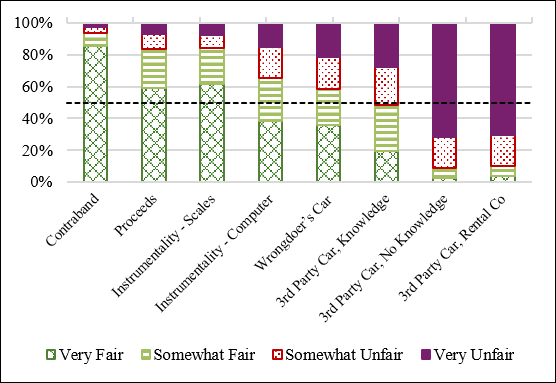 |
| Note. This Figure plots the responses reported in Table 1 for the eight scenarios of Study 1. From bottom in each column, the fills represent: Very Fair (diagonal dark green hatch); Somewhat Fair (horizontal light green stripe); Somewhat Unfair (red dots); Very Unfair (solid purple). Dashed horizontal reference line indicates 50%. |
The four remaining instrumentality cases described the seizure of a $10,000 car that was used in drug dealing. What varied across these scenarios was who owned the car and what they knew about the crime. When the car was owned by the dealer himself, 58.8 percent described its seizure as very or somewhat fair. A significantly smaller share (48.3 percent) described the seizure as very or somewhat fair if the car instead belonged to the drug dealer’s cousin and the cousin had knowledge of the illegal activity. Consider the text of the scenario:
Richard sold illegal drugs out of his cousin Olivia’s car. Olivia knew that Richard would do this but was not involved in the drug dealing – she had just loaned Richard the car for the day. The police seized the car, which is worth $10,000. It was otherwise legal for Olivia to possess the car.
In this scenario, Richard’s cousin (Olivia) had knowledge of the illegal activity, but she was not directly involved in it.117 In another scenario, where the cousin (there, Emily) did not know her car would be used in drug dealing, the proportion of participants believing the car seizure to be fair plummeted to just 9 percent. Similarly, only 10 percent of participants believed seizing the car was fair if it were rented from a car rental company that lacked knowledge of the drug dealer’s intended use.
Study 1 illustrates three points. First, for guilty owners, participants view forfeitures as fairer when the item being forfeited is more closely connected to the crime. For example, there is nearly unanimous agreement that traditional contraband, proceeds, and crime-adjacent instrumentalities (scales) can be fairly forfeited (the three leftmost columns in Figure 1). On the other hand, participants view forfeitures as less fair when they involve instrumentalities that have important innocent uses for the wrongdoer or others, such as a computer or car (columns 4 through 6 in Figure 1). Courts generally do not consider this factor when evaluating Excessive Fines challenges.
Second, there is nearly unanimous agreement that forfeitures are very unfair if the property owner is completely innocent, meaning unaware of the wrongdoer’s crime (the two rightmost columns in Figure 1). This finding confirms popular support for the innocent-owner exceptions included in forfeiture statutes in the late twentieth century, as described in Section I.A, and suggests that, according to widespread public views, any forfeiture of an innocent owner violates the Excessive Fines Clause.118
Third, when a car owner is aware that the car will be used for illegal activity, but does not participate in the crime, a bare majority of respondents still believe forfeiting the car is unfair.119 As described in Section I.C.1, such a forfeiture is authorized under federal law because the law does not treat a knowing but uninvolved owner as innocent.
Together, these results suggest that the public assesses the fairness of an asset forfeiture by evaluating the culpability of the person whose property is seized and the extent to which the property was also put to innocent use by the property owner. We did not ask participants to explain their reasoning, but we suspect participants were sensitive to the extent to which the instrumentality either was or could be used for substantial noncriminal activity, or the extent to which losing access to the instrumentality would hamper a person’s law-abiding activities.
2. Study 2: Property Value and Offense Severity
Study 1 focused on forfeitures of different types of items, holding (nearly) constant both the severity of the criminal conduct underlying the forfeiture and the value of the items taken. In Study 2, we vary those factors. The initial stages of Study 2 followed the process described in Section II.A, with one addition. When presented with an overview of civil asset forfeiture, half of the participants in Study 2 were also given a brief description of the Excessive Fines Clause:
Under the Excessive Fines Clause, the Constitution limits civil asset forfeiture by prohibiting the police from taking property if the value of the property is grossly disproportionate to the seriousness of the offense. This means that even if the property is connected to a crime, the police cannot keep it if the value of the property is much larger than the harm and seriousness of the crime.
This blurb was intended to prime half of the participants with the notion that there should be some proportionality between the value of the forfeiture and the seriousness of the offense. Though proportionality may seem intuitive, political actors sometimes expect the public to support disproportionate punishment under “no angel” thinking.120 We therefore expected that participants might be comfortable seizing very high-value property from a known drug dealer, particularly one who dealt a substantial quantity of drugs. We thus wanted to test whether more knowledge of the legal standard affected the public’s views.
Following these descriptions of civil forfeiture, participants were then asked to rate six scenarios in a three (property value) by two (crime severity) design. These scenarios varied the value of the item being forfeited (a car worth $4,000; a car worth $42,000; or a house worth $200,000) and the severity of the offense in question (selling drugs worth $385 or $20,000). For example, the low-severity, low-value scenario read:
John was dealing a small amount of illegal drugs out of his car. Agents estimated the total amount sold was worth about $385. This is a low severity crime and would normally receive a light sentence. The police seized the car, which was worth $4,000. It was otherwise legal for John to possess the car.
The low-severity, house scenario read:
Mark was dealing a small amount of illegal drugs out of his house. Agents estimated the total amount sold was worth about $385. This is a low severity crime and would normally receive a light sentence. The police seized the house, which was worth $200,000. It was otherwise legal for Mark to possess the house.
These scenarios were chosen in part to reflect real-life forfeiture amounts. In data on forfeitures conducted by DOJ between 1998 and 2019, a $4,000 car is in the 60th percentile of car values, while a $42,000 car (like Timbs’s) is in the 98th percentile. The forfeiture of a house was intended to reflect high-value forfeiture cases. In the data, a $200,000 house is in the 78th percentile of all homes forfeited and the 99th percentile of all property. It is also important to note that participants might view a home differently than a car given its critical importance to a person and their family’s life. Our research design does not allow us to determine whether fairness attitudes about a forfeiture of a home are driven by the house’s relatively large value versus its important function in day-to-day life. However, our two car scenarios allow a direct comparison.121
The crime severity mirrors plausible but low-end drug crimes. The low-severity crime (drugs worth $385) involves around three to five grams of cocaine.122 We chose this amount because it was the value of the drugs in Timbs. Under the U.S. Sentencing Guidelines, this quantity of cocaine would fall into the lowest category of drug weight and is unlikely to be prosecuted federally (as Timbs himself was not). The recommended federal sentencing range, if a person were convicted of possessing with intent to distribute around $385 of cocaine, is 0–6 months if the person does not have a prior criminal record.
Even the high-severity crime in our scenario (selling $20,000 of cocaine) is well below average for federal prosecution. This dollar amount is equivalent to around 200 to 300 grams, which is still under the 500 grams necessary to trigger a mandatory minimum sentence. The recommended federal sentence for a defendant convicted of possessing with intent to distribute 200 to 300 grams of cocaine is 27–33 months if the person does not have a prior criminal record.123
We kept our crime severity relatively low because this project concerns civil asset forfeiture. A defendant who is responsible for a larger quantity of drugs is more likely to have the forfeiture proceed as part of their criminal case, as described in Section I.B.
In another small change from Study 1, we supplemented our study procedure with a second question after each scenario. Retaining our previous fairness question, we also asked “Given the facts of the crime, is taking the car/house” (Very Excessive, Somewhat Excessive, Not at all Excessive)? This measure was meant to detect whether participants viewed excessiveness (the constitutionally relevant characteristic of a forfeiture) differently from unfairness. As described below, we do not detect any meaningful differences between fairness and excessiveness attitudes, indicating that ordinary people view the excessiveness inquiry as fundamentally a question of fairness.124
Figure 2. Unfairness and Excessiveness Perceptions by Property Value and Offense Severity
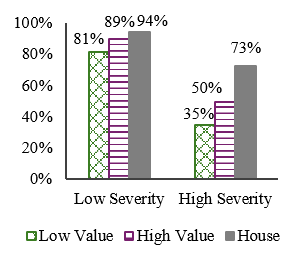 A. Percent of Participants Rating a Forfeiture as “Very Unfair” or “Somewhat Unfair” | 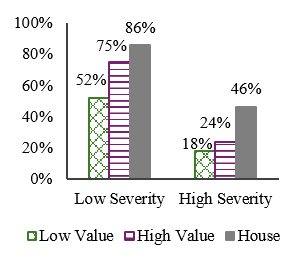 B. Percent of Participants Rating a Forfeiture as “Very Unfair” |
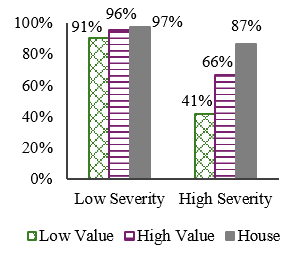 C. Percent of Participants Rating a Forfeiture as “Very Excessive” or “Somewhat Excessive” | 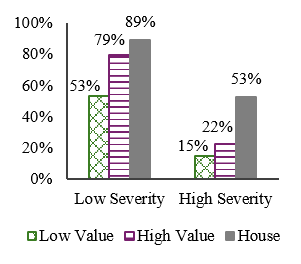 D. Percent of Participants Rating a Forfeiture as “Very Excessive” |
| Note. This Figure plots the responses reported in Table 2 for the six scenarios of Study 2. From left to right, the fills represent: Low-value car (diagonal green hatch); High-value car (horizontal purple stripe); and House (solid gray). | |
Figure 2 summarizes the perceptions of unfairness and excessiveness, respectively, in our six conditions. Panels A and C plot the share of participants who view a forfeiture as at all unfair or excessive, respectively. Panels B and D plot the share of participants who view a forfeiture as very unfair or very excessive, respectively. We include Panels B and D because a forfeiture will only violate the Excessive Fines Clause if it is “grossly disproportional.”125 We therefore think panels B and D reflect the share of the population who would characterize the forfeiture as unconstitutional, whereas panels A and C provide more information about the public’s general views. Table 2 reports the full results of Study 2.
Overall, participants were sensitive to both crime severity and the value of the item being seized.126 There was broad consensus that forfeitures for the low-severity crime were always unfair, even in our low-value asset condition. Across all types of assets, a majority of respondents viewed a seizure as very unfair and very excessive if the crime was low severity. For example, seizing even a low-value item in response to a low-severity crime is generally regarded as excessive. Less than 10 percent of respondents rated such seizures as “not at all excessive.” At the point where high-value property is being seized for its role in a minor crime, 89 percent rate this forfeiture as “very excessive.” As we discuss in Section III.B, infra, these findings suggest law enforcement should simply stop conducting forfeitures of property associated with low-severity crimes.
| Question A. Perceived Unfairness | |||||||||
| Value | Severity | Mean (SD) | Very Fair | Somewhat Fair | Somewhat Unfair | Very Unfair | |||
| Low-value car | High | 2.11 | (1.13) | 41.3% | 24.1% | 17.0% | 17.6% | ||
| High-value car | 2.53 | (1.06) | 20.2% | 30.3% | 26.0% | 23.5% | |||
| House | 3.07 | (1.04) | 11.5% | 16.1% | 26.4% | 46.1% | |||
| Low-value car | Low | 3.29 | (0.87) | 4.3% | 14.4% | 29.5% | 51.9% | ||
| High-value car | 3.61 | (0.78) | 3.8% | 6.8% | 14.4% | 75.0% | |||
| House | 3.78 | (0.60) | 1.7% | 4.1% | 8.6% | 85.6% | |||
| Question B. Perceived Excessiveness | |||||||||
| Value | Severity | Mean (SD) | Not at All Excessive | Somewhat Excessive | Very Excessive | ||||
| Low-value car | High | 1.56 | (0.74) | 58.7% | 26.4% | 14.9% | |||
| High-value car | 1.89 | (0.74) | 33.6% | 44.3% | 22.1% | ||||
| House | 2.39 | (0.71) | 13.4% | 33.9% | 52.7% | ||||
| Low-value car | Low | 2.44 | (0.66) | 9.4% | 37.2% | 53.4% | |||
| High-value car | 2.75 | (0.53) | 4.5% | 16.3% | 79.3% | ||||
| House | 2.86 | (0.41) | 2.7% | 8.0% | 89.2% | ||||
| Note. Perceived unfairness was measured on a 1–4 scale with higher numbers indicating greater perceived unfairness. Perceived Excessiveness was measured on a 1–3 scale with higher numbers indicating greater perceived excessiveness. | |||||||||
Some participants were more comfortable with forfeitures of property used in high-severity crimes, and public attitudes were quite varied.127 The results show that, in general, the public seems to internalize the proportionality principle that is at the heart of the Excessive Fines Clause: the larger the property value, the less fair and more excessive the forfeiture. As shown in Figure 2, each cluster of columns shows a stepwise increase in unfairness perceptions as the property value moves from left (smaller value property) to right (larger value property). For both low- and high-severity crimes, low-value ($4,000) forfeitures are seen as the least unfair and excessive; high-value ($42,000) forfeitures are in the middle; and house ($200,000) forfeitures are seen as most unfair and excessive.128 For example, even the sale of a large quantity of drugs is not enough to make a majority of participants approve of a house seizure. As described above, however, we cannot isolate how much of this effect is due to the value of the property versus its character as a home rather than a car.
In contrast, in the high-severity condition, a majority of participants are comfortable seizing a low-value car. But they are split nearly down the middle in the common case where an expensive vehicle is seized when used in a high-severity crime. Though much has been written about the general punitive nature of the American public,129 these data suggest that the public is more reluctant than one might expect to seize property, even when the owner committed a particularly serious crime.
Across all property types, there was a significant effect of crime severity such that forfeitures in response to high-severity crimes were viewed as fairer and less excessive than forfeitures in response to low-severity crimes.130
Finally, we consider the effect of the extra description of the Excessive Fines Clause that we provided to half of the participants. We included this description in part to prompt participants to conduct a balancing analysis. We were concerned that, absent this prompting, participants might not realize that they could be sensitive to the proportionality of the seizure. The inclusion of this information barely mattered. There was a very small effect on the perceived fairness of informing participants about the Excessive Fines Clause.131 Telling participants about the Clause made them rate the seizure as more excessive only when the seizure was of the house, not in either of the lower value conditions.132 It made participants rate the seizure as slightly more unfair in both the high value and house conditions, but to a greater extent in the house condition.133 We thus conclude that ordinary people view the Excessive Fines Clause as a fairness test.
3. Study 3: Owner Wealth, Types of Crime, Theories of Forfeiture
In Studies 1 and 2, we focused on drug crimes for four reasons. First, and most importantly, most forfeitures in the United States are justified by allegations that the property is connected to a drug crime.134 Second, asking respondents about drug offenses lends itself to testing the public’s views on forfeiting a variety of instrumentalities and proceeds because people use all sorts of property—cars, homes, phones, and other things—to conduct drug crimes. Third, drug crimes do not have a concrete victim who could be made whole by recovering property from the offender, which allows us to realistically isolate our fairness inquiry to a setting in which the government retains the forfeited property. Fourth, selling illegal drugs is a crime with which we assume the public is quite familiar.
But many forfeitures involve other types of crimes. In Study 3, we sought to investigate whether people’s fairness judgments shifted based on the type of crime. To that end, this study included new forfeiture scenarios in which the crime presented was a financial crime rather than a drug crime. We selected insider trading as the financial crime for this study. We chose insider trading as opposed to, for example, fraud or embezzlement, because insider trading—like drug dealing—does not have a concrete victim who would expect restitution from the offender. One could imagine a variety of reasons why public attitudes about forfeiture could be different for insider trading rather than selling drugs.135 Insider traders may be perceived as wealthier, whiter, and better educated than drug dealers. Their crimes may be viewed as less (or more) socially harmful or morally culpable than those of drug dealers. In short, we wanted to investigate whether public attitudes toward forfeiture vary by offense type.
We also used Study 3 to test three additional factors that we thought might affect public perceptions about forfeiture: whether the forfeited item represents criminal proceeds or an instrumentality, whether the defendant is indigent or wealthy, and whether the forfeiture involves cash or tangible property. Our previous studies focused almost exclusively on forfeitures of instrumentalities (mostly, cars). But, in the real world, many forfeitures involve the seizure of alleged proceeds rather than instrumentalities. Cash is the most forfeited type of asset in the United States, but cash is rarely an instrumentality of a crime.136 We expected participants to view forfeiting proceeds as more fair than forfeiting instrumentalities because instrumentalities (like cars, electronics, and homes) often have innocent and important uses and because such forfeitures are more likely to be disproportionate than forfeitures of proceeds. We theorized that “[l]ike the confiscation of money stolen from a bank,” the public would view forfeiting criminal proceeds as always fair because forfeiting proceeds amounts to nothing more than taking away property a person never had the right to acquire in the first place.137 Along these lines, several circuits have held that forfeitures of proceeds can never be grossly disproportional.138 We wondered whether laypeople view fairness the same way.
We also tested whether the property owner’s wealth affected perceptions of fairness regarding forfeitures. Often in popular discussions of civil forfeiture cases, observers point out that the seized funds or property constitute the targeted individual’s life savings, yet courts are split on whether this factor is relevant in the excessiveness analysis.139 While centuries of English law dating back to Magna Carta prohibit fines that are so excessive as to threaten a person’s livelihood, the U.S. Supreme Court has not decided whether a similar inquiry into a defendant’s financial circumstances is necessary in an Excessive Fines analysis, and if so, what such an inquiry would involve.140
Participants in Study 3 underwent the same basic procedure as participants in Studies 1 and 2, with the same instructions and comprehension questions. They were then exposed to six forfeiture scenarios. These scenarios varied the wealth of the defendant (rich versus indigent), the nature of the crime (insider trading versus drug trafficking), and whether the seized item was an instrumentality or proceeds of the crime. The value of the forfeiture was $10,000 in all scenarios.
One change in this study was how we depicted instrumentalities versus proceeds. To illustrate, the indigent, drugs, and instrumentality scenario reads as follows:
John sold illegal drugs out of his car. The police seized the car, which is worth $10,000. It is otherwise legal for John to possess the car. John is fairly poor. Besides his car, the total value of everything he owns, minus his debts, is $500.
This wording is very similar to the “wrongdoer’s car” scenario in Study 1 because the car was used to facilitate the criminal transaction, although it provides additional information about John’s net worth. In contrast, the rich, drugs, proceeds scenario read:
William sold illegal drugs. The police seized William’s car, which is worth $10,000. Though William did not use the car in his drug dealing, the police have proven that it was purchased with the profit from his drug dealing business. It is otherwise legal for William to possess the car. William is well-off. Besides the car, the total value of everything he owns, minus his debts, is $500,000.
These two scenarios test two differences. First, John “sold drugs out of his car” (making it an instrumentality), while William “purchased [the car] with the profit from his drug dealing business” (making it proceeds). In the William scenario, the police are seizing the proceeds of the crime, but the proceeds are not in the form of cash (as they were in Study 1). Here, the cash has been spent and now has wheels. Second, “John is fairly poor” with a net wealth of $500, while “William is well-off” with a net worth of $500,000.
Four of the scenarios iterated this distinction: car-as-instrument versus car-as-spent-proceeds and a defendant who was either rich or indigent.141 To keep the number of scenarios manageable, we used a total of six scenarios that allow direct comparison of the four types of differences we are interested in: drug versus financial crimes, proceeds versus instrumentalities, cash versus car, and indigent versus wealthy owners. We did not use a full factorial design (every possible combination of crime type, property type, forfeiture reason, and wealth) because that design would require sixteen different scenarios, which we thought would overwhelm participants. Our limited design thus allows us to observe differences in the factors we care about but does not allow us to detect all possible interaction effects between the variables.
Study 3 includes a complete two-by-two test of owner wealth and proceeds versus instrumentality. Figure 3 presents these results in a column graph, which are reported in the bottom four rows of Table 3. Based on Study 1, we expected all four scenarios to be rated as more fair than not but to generate disagreement. The comparable forfeiture in Study 1 (the wrongdoer’s car scenario) was rated as unfair by around 40 percent of respondents. Figure 3A shows the results are replicated in Study 3—between 37 and 50 percent of respondents viewed the car forfeiture as very or somewhat unfair.
Figure 3. Unfairness Perceptions by Forfeiture Justification and Owner Wealth
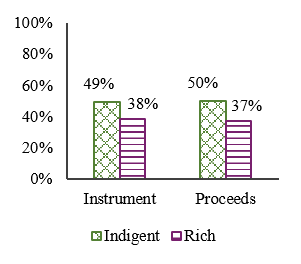 A. Percent of Participants Rating a Forfeiture as “Very Unfair” or “Somewhat Unfair” | 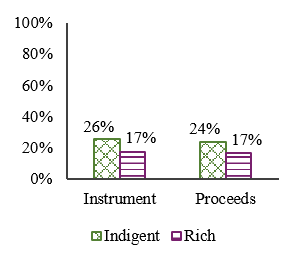 B. Percent of Participants Rating a Forfeiture as “Very Unfair” |
| Note. This Figure plots the responses reported in Table 3 for the four scenarios of Study 3 involving a drug crime. From left to right, the fills represent: Indigent property owner (diagonal green hatch) and Rich property owner (horizontal purple stripe). | |
As Table 3 and Figure 3 show, the public views forfeitures as less unfair when they involve a wealthy defendant relative to an indigent one, holding all else equal.142 While around half of participants find a forfeiture to be somewhat or very unfair when the property owner is indigent, less than 40 percent view it as unfair when the property owner is rich. In other words, it is fairer to seize from the person with more assets than from the person with fewer assets.
Figure 3 also shows that people view car forfeitures the same way regardless of whether the car represents proceeds or an instrumentality. In both Figures 3A and 3B, the averages in the “Instrument” columns are nearly identical to the corresponding averages in the “Proceeds” columns. For example, when the defendant is indigent, 49 percent of respondents view a $10,000 car forfeiture as somewhat or very unfair when the car is an instrumentality and 50 percent view it that way when the car represents proceeds—a difference that is not statistically significant. Similarly, when the owner is rich, 38 percent view the $10,000 car forfeiture as somewhat or very unfair when the car is an instrumentality and 37 percent view it that way when the car represents proceeds.
| Unfairness Mean | SD | Very Fair | Somewhat Fair | Somewhat Unfair | Very Unfair | |
| Rich, Financial, Cash (Proceeds) | 1.82a | (0.99) | 49.7% | 27.6% | 13.2% | 9.4% |
| Rich, Financial, Car (Proceeds) | 2.17b | (1.06) | 34.3% | 30.0% | 20.4% | 15.2% |
| Rich, Drugs, Car (Instrument) | 2.17b | (1.12) | 38.7% | 23.3% | 20.8% | 17.3% |
| Rich, Drugs, Car (Proceeds) | 2.20b | (1.08) | 33.5% | 29.5% | 20.4% | 16.6% |
| Indigent, Drugs, Car (Instrument) | 2.49c | (1.14) | 26.3% | 24.3% | 23.6% | 25.8% |
| Indigent, Drugs, Car (Proceeds) | 2.51c | (1.09) | 23.3% | 26.5% | 26.6% | 23.6% |
| Note. Fairness was measured on a 1–4 scale with larger numbers indicating greater perceived unfairness. Means with standard deviations reported in the left two columns; percentage of respondents giving each response on the right. Means not sharing a subscript are significantly different from each other at p < .001. | ||||||
To investigate whether attitudes changed by crime type, we did not think it made sense to include a low-net-worth offender in the insider trading scenario, because it is difficult for someone with a low net worth to make $10,000 from insider trading. We instead used two scenarios involving a rich defendant. In one, the government forfeited proceeds as cash, and in the other, the government forfeited a car as proceeds (the cash having been spent). Here is the rich, financial, cash scenario:
Richard committed the crime of insider trading. A person commits the crime of insider trading if they use secret information to buy or sell a stock in the stock market and unfairly profit from it. The police seized $10,000 from Richard and have proven that these particular dollars are the profits from Richard’s insider trading. It is otherwise legal for Richard to possess the $10,000. Richard is well-off. Besides the $10,000 from insider trading, the total value of everything he owns, minus his debts, is $500,000.
Perhaps surprisingly, fairness attitudes did not vary based on crime type. Participants were neither more nor less likely to rate as fair seizing a car (as proceeds) from a financial crime suspect than from a drug crime suspect; there were no significant differences between the scenarios (both means in Table 3 share a subscript b).
Participants viewed a forfeiture as significantly more fair, however, when it involved seizing cash proceeds than when it involved seizing a car as proceeds. This result surprised us. Doctrinally, it does not matter whether seized proceeds are in the form of cash or of spent cash. As a matter of logic, this makes perfect sense; there is no reason to reward a defendant for having transformed ill-gotten gains into more tangible items. As a matter of psychology, however, the connection between a crime and a purchased item may feel somewhat attenuated. People comingle funds. If a person earns $10,000 doing something, it is hard to say what they would have spent “that” money on. Though our scenario stipulated that the proceeds had been traced to the car, perhaps our participants were resisting that premise and therefore viewed the forfeiture of the car—useful property with many innocent uses—as less fair.
C. Findings: The Limited Role of Individual Differences
Given the uneven prevalence of asset forfeiture across different groups and places, we tested whether participants of particular races and ethnicities, from particular regions of the United States, or who hold particular ideological beliefs have systematically different attitudes toward the practice. As described in Section II.A, at the beginning of each study, we asked survey respondents about a broad array of their individual characteristics, including educational attainment, age, gender, race and ethnicity, self-reported social class, and political orientation on a liberal-to-conservative axis. We also asked several questions to measure each participant’s inclination towards right-wing authoritarianism. We set out to test whether any of these factors are relevant to attitudes toward forfeiture.
Most of these measures are standard demographic items—for more details on the distributions, see Appendix Table A1—but right-wing authoritarianism requires some explanation. The social psychological theory of authoritarianism defines authoritarians as people who are especially willing to submit to authority, who believe it is particularly important to yield to traditional conventions and norms, and who are hostile and punitive toward those who question authority or who violate traditional conventions and norms.143 Prior work has observed that attitudes toward governmental searches are correlated with right-wing authoritarianism, with those more supportive of authoritarianism being less privacy-protective.144 Those higher in authoritarianism are also more punitive toward criminal offenders.145 The specific authoritarianism scale used in prior legal privacy work, and again employed here, is the Authoritarian Submission scale. This scale is intended to measure the first of the defined impulses: the extent to which people believe authority should be respected and obeyed rather than challenged and questioned.146 Here, the scale exhibited high reliability.147
We tested whether these individual differences predicted unfairness attitudes using a series of linear multiple regressions, with individual characteristics as predictors and a composite variable of unfairness attitudes as the dependent measure. We constructed this composite by averaging the responses to each forfeiture scenario across studies. The results of these regressions are similar across all three studies. The results based on the Study 1 data are plotted in Figure 4, and the full results are presented in Table 4.
Figure 4. Individual Differences in Unfairness Attitudes
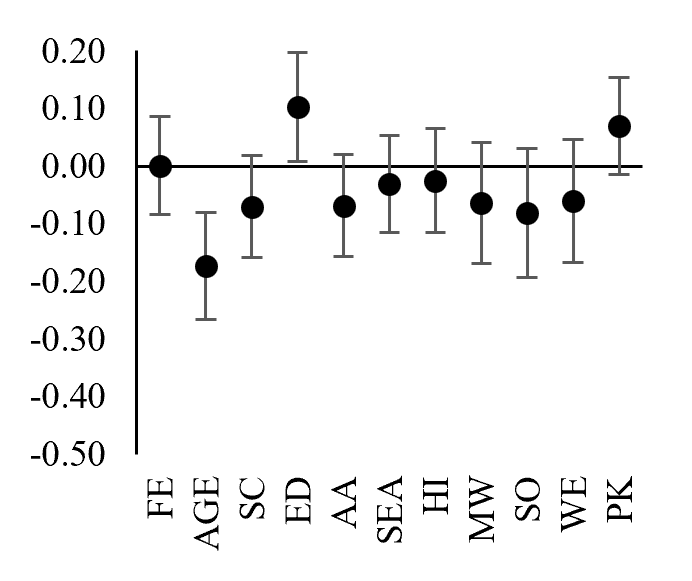 A. Estimates without Conservatism and Authoritarianism | 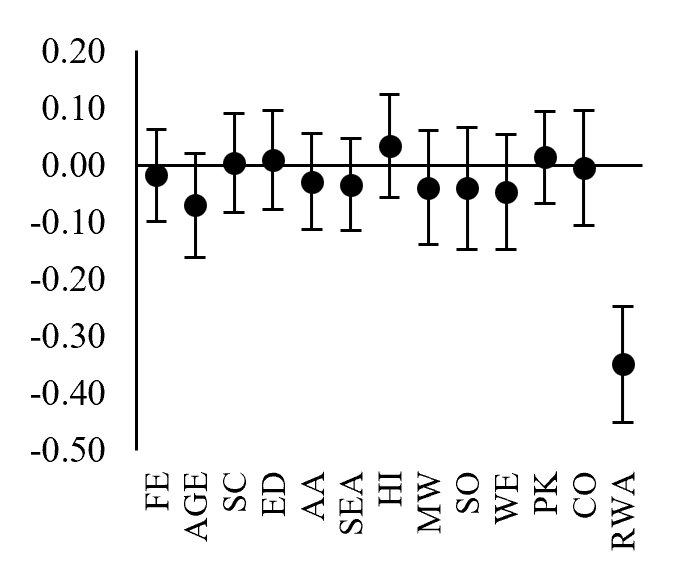 B. Estimates with Conservatism and Authoritarianism |
| Note. This figure plots means and 95 percent confidence intervals of standardized estimates of individual characteristics and their relationship to unfairness attitudes averaged across the eight scenarios in Study 1. Lower (more negative) estimates reflect the view that forfeitures are more fair. FE=female; AGE=age; SC=social class; ED=education; AA=African American; SEA=South or East Asian; HI=Hispanic; MW=Midwest; SO=South; WE=West; PK=prior knowledge of asset forfeiture; CO=conservatism; RWA=right-wing authoritarianism.148 | |
Figure 4 plots regression results when conservatism and right-wing authoritarianism are excluded (panel A, left side) and when those measures are included (panel B, right side). These results are reported in columns (1) and (5), respectively, in Table 4. Panel A shows that without the inclusion of conservatism and authoritarianism measures, two individual differences are statistically significant at the five-percent level: older respondents and less educated respondents view forfeitures as significantly more fair than younger respondents and more educated respondents.
As panel B shows, once conservatism and right-wing authoritarianism are included, age and educational attainment no longer significantly predict attitudes about forfeiture. Right-wing authoritarianism is a highly significant predictor, with people with authoritarian attitudes viewing forfeitures as much fairer than others, as we expected.
| Estimate | t | Estimate | t | Estimate | t | |
| (1) | (2) | (3) | (4) | (5) | (6) | |
| Female | 0.00 | 0.01 | −0.01 | −0.31 | −0.02 | −0.44 |
| Age | −0.17*** | −3.69 | −0.12** | −2.60 | −0.07 | −1.52 |
| Social Class | −0.07 | −1.55 | −0.02 | −0.44 | 0.01 | 0.19 |
| Education | 0.10* | 2.13 | 0.07 | 1.37 | 0.03 | 0.73 |
| Hispanic | −0.03 | −0.55 | −0.02 | −0.54 | 0.00 | 0.08 |
| African American | −0.07 | −1.54 | −0.06 | −1.37 | −0.03 | −0.68 |
| South or East Asian | −0.03 | −0.72 | −0.03 | −0.76 | −0.03 | −0.84 |
| Midwestern | −0.06 | −1.19 | −0.04 | −0.76 | −0.04 | −0.78 |
| Southern | −0.08 | −1.43 | −0.04 | −0.63 | −0.04 | −0.75 |
| Western | −0.06 | −1.12 | −0.04 | −0.80 | −0.05 | −0.91 |
| Prior Knowledge | 0.07 | 1.64 | 0.05 | 1.30 | 0.01 | 0.32 |
| Conservatism | – | – | −0.21*** | −4.90 | 0.00 | −0.09 |
| Right-wing Authoritarianism | – | – | −0.35*** | −6.77 | ||
| Observations | 592 | 592 | 592 | |||
| R2 | .037 | .075 | .143 | |||
| Note. OLS regressions of perceived unfairness (averaged across all eight scenarios) on personal characteristics. Since higher numbers indicate greater perceived unfairness, negative coefficients indicate that people high on a measure perceived forfeiture as fairer. N for all analyses is 592 due to missing data. For race, white is treated as the reference group. For region, the Northeast is treated as the reference group. Prior knowledge was recoded to have a value of 1 for reporting prior knowledge of civil forfeiture and a value of 0 otherwise. The single non-binary participant was coded as female for this analysis. *** means p < .001; ** means p < .01; * means p < .05. | ||||||
Study 1
Table 4 presents the full results of individual differences in Study 1. Overall, individual differences played a modest role in explaining variance in perceived fairness. The first model, which included a wide range of traditional demographics, explained only 3.7 percent of the overall variance. As shown in Figure 4, age and education are the only significant predictors of attitudes toward unfairness. Adding political orientation in the second model (column (3)) improved the model so that it explained 7.5 percent of the variance; conservatives thought forfeitures were significantly fairer. In other words, the conservatism measure explains as much of the variance as everything else combined. Including conservatism also made the effect of education vanish, though the age effect remained. The final model, which adds authoritarianism, explains 14.3 percent of the variance, and the single authoritarianism factor subsumes all other effects. This implies that bare demographic characteristics do not explain forfeiture attitudes. It instead suggests that, to the extent people systematically differ in their beliefs about forfeiture, they do so in keeping with their general attitudes about authority and punishment.
Notable here, too, are the many effects that are not significant. There is no effect of being Black or Hispanic despite the prevalence of civil forfeiture in areas with larger Black and Hispanic populations.149 There is no effect of social class, despite forfeitures falling disproportionately on those who cannot afford to litigate for their property. There is no effect of region, despite the practice being much more prevalent in some regions than others.
Table 5 shows that the patterns were broadly similar in Studies 2 and 3. In each, we again created composite variables that averaged the forfeiture judgments across our scenarios. These were again used as dependent variables in a series of multiple regression models.
The progression through models 1, 2, and 3 for each of Studies 2 and 3 are presented in Appendix Tables A2 and A3. The consistent story is that individual differences again play a modest role in explaining variance in perceived fairness. The first models in each study explained only a very small amount of variance (3.5 percent in Study 2, 2.9 percent in Study 3). Adding political orientation in the second models improved fit, approximately doubling the variance explained (rising to 8.1 percent in Study 2 and 5.1 percent in Study 3). The final models for each study, with the full array of predictor variables including authoritarianism, are displayed in Table 5. In them, authoritarianism is by far the strongest predictor, with more authoritarian respondents indicating that forfeitures were fairer. The inclusion of authoritarianism improves the model fit substantially in each study (to 11.3 percent in Study 2 and 7.9 percent in Study 3). The only other effects which survive are a small effect of social class in Study 2—those with higher self-reported social class were more likely to think forfeitures were fair—and an effect of prior civil forfeiture knowledge in Study 3—those reporting prior awareness thought forfeitures were fairer.
| Study 2 | Study 3 | |||
| Estimate | t | Estimate | t | |
| (1) | (2) | (3) | (4) | |
| Female | 0.01 | 0.24 | −0.01 | −0.25 |
| Age | 0.02 | 0.33 | −0.05 | −0.99 |
| Social Class | −0.09* | −2.02 | −0.02 | −0.56 |
| Education | 0.03 | 0.72 | 0.05 | 1.00 |
| Hispanic | 0.02 | 0.43 | −0.05 | −1.18 |
| African American | −0.07 | −1.64 | −0.03 | −0.61 |
| South or East Asian | −0.07 | −1.56 | −0.05 | −1.14 |
| Midwestern | 0.01 | 0.25 | −0.04 | −0.68 |
| Southern | −0.03 | −0.56 | −0.04 | −0.68 |
| Western | −0.06 | −1.05 | −0.09 | −1.72 |
| Prior Knowledge | −0.02 | −0.44 | −0.12** | −2.89 |
| Conservatism | −0.10 | −1.81 | 0.00 | −0.03 |
| Right-wing Authoritarianism | −0.26*** | −4.66 | −0.23*** | −4.24 |
| Observations | 581 | 596 | ||
| R2 | .133 | .079 | ||
| Note. Higher numbers indicate greater perceived unfairness, so negative coefficients indicate that people high on a measure perceived forfeiture as fairer. For region, the Northeast is the reference group. Prior knowledge was recoded to have a value of 1 for reporting prior knowledge of civil forfeiture and a value of 0 otherwise. The single non-binary participant in Study 2 was coded as female for this analysis. *** means p < .001; ** means p < .01; * means p < .05. | ||||
It is unclear why there are some small differences across studies here. Some might be due to the differing scenarios used in each study.150 Overall, however, there is a consistent pattern. Classic demographic characteristics explain vanishingly little of the variation in attitudes toward civil asset forfeiture. Merely knowing someone’s race, age, education, or social class contributes little to one’s ability to predict how the person feels about forfeiture. The only predictors with strong explanatory power are political: Overall political orientation explains as much variation as all prior factors combined, and the specific construct of authoritarianism explains variation still better.
III. Rethinking Forfeiture Doctrine and Practice
This Part discusses the legal and practical implications of our findings. We first make the threshold argument that public attitudes are a critical source of information for evaluating the constitutionality of forfeitures under the Excessive Fines Clause. Second, we argue that current forfeiture practice creates a proportionality problem whenever the government forfeits property that is an instrumentality of a low-severity crime, and we suggest constraints to guard against this practice. Third, we highlight other instances in which public attitudes seem to diverge from forfeiture law: the treatment of innocent owners, the relevance of property owner wealth, and the law’s distinction between an instrumentality and proceeds. Fourth, we discuss limitations of the survey design.
A. The Role of Public Attitudes in Excessive Fines Analysis
As described in Section I.C.1, the government violates the Eighth Amendment if it conducts an asset forfeiture that is excessive. This constitutional protection is young. It was not until the 1990s that the U.S. Supreme Court recognized that forfeitures could constitute excessive fines and formulated its first definition of what “excessive” means in the context of forfeiture.151 The Court has analyzed the merits of an Excessive Fines challenge only once.152 And it has been just seven years since the Court incorporated the Excessive Fines Clause against the states. This constitutional landscape suggests there is an opportunity today for substantive challenges to forfeitures that did not exist before the 1990s. In the decades since, courts have struggled with how to evaluate the excessiveness of a forfeiture or fine.
Understanding public attitudes is especially helpful in the Excessive Fines context. Excessiveness is a murky concept, and older cases and historical practice do not provide useful guidance because, as described in Part I, forfeiture law today only loosely resembles practice at the time the Eighth Amendment was ratified.
In 1958, the U.S. Supreme Court faced the same problem in interpreting the Cruel and Unusual Punishment Clause of the Eighth Amendment. That year, a plurality of the Court held in Trop v. Dulles that the meaning of the Eighth Amendment must be understood to adjust over time to reflect societal attitudes, writing, “The Amendment must draw its meaning from the evolving standards of decency that mark the progress of a maturing society.”153 Like a forfeiture, the punishment at issue in Trop was not carceral or physical punishment. Trop, a native-born U.S. citizen, was a deserting U.S. soldier in World War II. Trop was punished for desertion with the loss of his U.S. citizenship through a process called “denationalization.”154 Trop argued that this punishment violated the Eighth Amendment because it was cruel and unusual. The Court agreed, concluding that denationalization “is offensive to cardinal principles for which the Constitution stands.”155 To support this claim, the Trop plurality looked to how other countries punish desertion. It found that statelessness is “a condition deplored in the international community of democracies,” noting that only the Philippines and Türkiye used denationalization as a punishment for desertion.156 Chief Justice Warren concluded that under this newly articulated “evolving standards of decency” test, Trop’s punishment was unconstitutional.
In the seven decades since Trop was decided, it has been applied in many cases involving the Cruel and Unusual Punishment Clause of the Eighth Amendment,157 but the Court has not applied the test in its few Excessive Fines Clause cases.158 Yet the plain language and logic underlying Trop’s holding reinforce our claim that public attitudes ought to inform courts’ analyses of whether a forfeiture is unconstitutionally excessive. For one thing, the plurality in Trop justified the test by recognizing that “[t]he basic concept underlying the Eighth Amendment is nothing less than the dignity of man. While the State has the power to punish, the Amendment stands to assure that this power be exercised within the limits of civilized standards.”159 Throughout Trop, the plurality opinion broadly refers to “the Amendment,” not merely the Cruel and Unusual Punishment Clause, in its analysis and holding.
For another thing, the Trop plurality explained that an interpretive test that updated alongside societal attitudes made sense in the context of the Eighth Amendment because “[t]he Court has had little occasion to give precise content to the Eighth Amendment.”160 This reasoning applies with even more force to Excessive Fines challenges, which have been litigated far less frequently in the U.S. Supreme Court than Cruel and Unusual Punishment challenges.
It is, of course, possible that the U.S. Supreme Court will eventually retreat from the “evolving standards of decency” test, rather than recognize its applicability to the Excessive Fines Clause.161 The Trop test has been criticized for its majoritarian nature, which could make it ill-suited to protect the rights of criminal defendants, and for the Court’s failure to faithfully implement the test.162 John Stinneford points out, for example, that the Court has struck down punishments under the test that enjoy legislative and jury support, but argues that “[t]his change in the Court’s approach is not necessarily a bad thing” because the evolving standards of decency test is “a poor protection for criminal offenders when public opinion turns against them.”163
Even if the Court does not use the “evolving standards of decency” framework to analyze Excessive Fines challenges, public attitudes are nonetheless relevant outside the black-letter law. Though reformers have pushed for changes in forfeiture law and practice, our study presents the first detailed data showing which changes would be most consistent with public moral intuitions. Because juries are largely absent from forfeiture proceedings, our findings provide important layperson context about forfeiture.164 And, as prior research has shown, beliefs in the fairness and legitimacy of punishment have important effects on how people respond to the legal system.165 Our data, therefore, should inform lawmaking, executive branch policymaking, and judicial decisionmaking. The rest of this Part relates our key findings to current forfeiture law and practice and suggests both concrete and general advice for law enforcement agencies, courts, attorneys, advocates, lawmakers, and property owners.
B. Forfeiture’s Proportionality Problem
Studies 1 and 2 show that two characteristics of forfeitures generate very strong unfairness views among the public: forfeitures involving low-severity crimes and those in which the property owner is innocent. In this Section, we first discuss the results with respect to low-severity crimes. Second, we provide evidence that public attitudes reflect a proportionality approach when it comes to high-severity crimes. This Section also offers several recommendations to help law enforcement agencies and courts ensure that forfeitures do not violate the Eighth Amendment.
As described in Section II.B.2, the majority of respondents rated forfeitures as “very unfair” and “very excessive”—the maximum unfairness and excessiveness ratings proposed—in every scenario involving a low-severity crime. The low-severity crime in our scenario was the same offense for which Timbs was convicted: selling $385 worth of illegal drugs.
In the real world, many forfeitures involve low-severity crimes. As described in Section I.B, few forfeitures are criminal forfeitures; most forfeitures proceed without any person being formally accused or convicted of criminal activity.166 A court-watching study in Cook County, Illinois (the county home to Chicago) confirms that many forfeitures do not involve serious criminal conduct. The Cook County study found that more than half of civil forfeitures were premised on an allegation of drug possession—a less serious crime than the low-severity crime used in our vignettes (drug distribution).167 Another 44 percent of civil forfeitures in the Cook County study were premised on driving offenses, and just 5 percent involved a violent crime.168
The public’s unwillingness to endorse even low-value forfeitures for low-severity crimes suggests that law enforcement agencies should simply not conduct forfeitures of alleged criminal activity below certain severity thresholds. The public views such forfeitures as very excessive, even when the forfeited property is relatively low in value.169
Setting crime-severity thresholds for forfeiture is practicable. As described in Section I.C.3, law enforcement agencies already set forfeiture value thresholds below which they will not bother forfeiting a piece of property.170 Prioritizing certain forfeitures is a familiar exercise to any law enforcement agency operating under resource and time constraints. Value thresholds reflect the government’s revenue and safety goals in conducting forfeitures. Assets that are liquid and appealing to the government (like cash) have a lower minimum threshold ($5,000) than assets that are cumbersome (like airplanes, which have a $30,000 minimum threshold).171 Assets for which forfeiture advances safety goals, like ammunition and weapons, do not have a minimum dollar threshold.172 Our findings suggest that law enforcement agencies should similarly implement crime-severity thresholds.
Additionally, law enforcement agencies could consider the value-to-severity ratio at which a forfeiture becomes excessive. Study 2 allows us to estimate the point at which a majority of the public views a forfeiture as unfair or excessive. In Study 2, all scenarios provided dollar values for both the crime (dollars’ worth of cocaine sold) and the property (dollars’ worth of property forfeited), which allows a straightforward computation.
Proportionality is the central inquiry in determining whether a particular forfeiture violates the Excessive Fines Clause. As described above, the Court has held that a forfeiture will violate the Clause if it is “grossly disproportional to the gravity of a defendant’s offense.”173 Study 2 allows us to bring empirical evidence to bear on this question by using a straightforward computation.
Figure 5 plots the share of respondents rating a forfeiture as somewhat and/or very excessive based on the ratio of forfeiture severity to crime severity for each of the six scenarios for Study 2.174 Each point on the graph represents one scenario. For example, the farthest left points on the graph (x = 0.2) correspond with the low-value, high-severity scenario. In that scenario, the property seized was a $4,000 car and the crime involved selling $20,000 of cocaine, hence a property value–to–crime severity ratio of 0.2. The farthest right points on the graph (x ≈ 519) correspond with the house, low-severity scenario. In that scenario, the property forfeited was a $200,000 house and the crime involved selling $385 of cocaine, hence a property value–to–crime severity ratio of around 519.
The three rightmost points on each line are the three scenarios involving a low-severity crime. All of these points lie above the fifty percent reference line, indicating that a majority of respondents thought the forfeitures were very excessive in all low-severity scenarios.
Figure 5. Excessiveness Attitudes and Property Value–to–Crime Severity Ratio
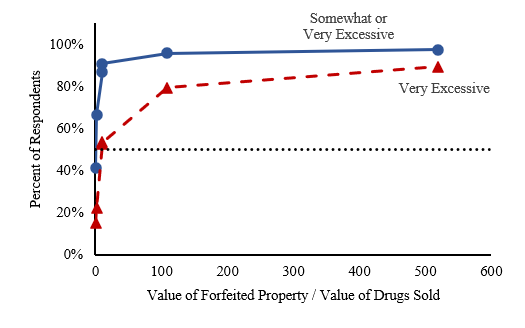 A. Full Sample |
 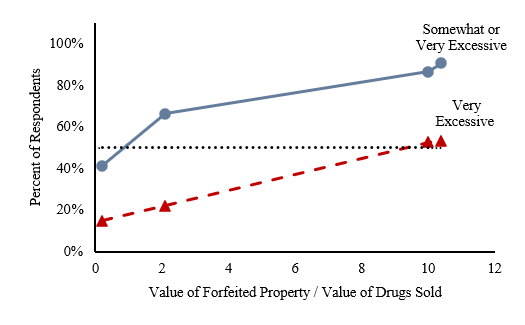 B. Truncated Sample |
| Note. This figure plots the percentages of respondents rating a forfeiture as “somewhat” and/or “very” excessive by the ratio of property value to crime severity (both measured in dollars). The solid blue line represents the percentage of respondents rating the forfeiture as somewhat or very excessive. The dashed red line represents the percentage rating the forfeiture as very excessive. Each data point represents one of six scenarios in Study 2 (Figure 5.A) and four of six scenarios (Figure 5.B). The dotted horizontal reference line is at 50 percent, and stars mark where each line crosses the 50 percent line. |
Figure 5 shows that the public instinctively applies a proportionality principle to its evaluations of excessiveness, just as the Excessive Fines Clause doctrine does. As the value of the forfeited property becomes larger relative to the severity of the crime, more and more members of the public view the forfeiture as excessive, and this relationship follows a concave pattern. What’s more, this pattern seems to persist irrespective of the underlying values making up the ratios. For example, the low-value, low-severity scenario and the house, high-severity scenario happen to both have value-to-severity ratios of around ten, and the public rated these forfeitures very similarly, even though they involved very different crime severities and property values. As Figure 5 shows, 53 percent of respondents rated each of these forfeitures as “very excessive,” making the points almost perfectly overlap in the very excessive (dashed) line. Similarly, 91 percent of respondents viewed the low-low scenario as a somewhat or very excessive forfeiture, and 87 percent viewed the house-high scenario that way, putting those circles very near each other on the “somewhat or very excessive” (solid) line.
The dotted reference line at y = 50% gives us a sense of the tipping point at which a majority of the public views a forfeiture as excessive. It indicates that a majority of the public will view a forfeiture as excessive if the value of the property forfeited is more than around 0.9 times the dollar value of drugs sold. It indicates that a majority of the public will view a forfeiture as very excessive if the value of the property forfeited is more than around nine times the dollar value of drugs sold. Figure 5.B depicts Figure 5.A without the two rightmost points so readers can more easily see the calculations.
This focus on dollar-value multipliers echoes a separate line of constitutional jurisprudence that places limits on punitive damages.175 Concerned about perceived runaway civil punitive awards in the 1990s,176 in 2003 the Supreme Court held that punitive damages that are too much in excess of compensatory damages may be unconstitutional under the Due Process Clause of the Fourteenth Amendment. Specifically, it noted that “[s]ingle-digit multipliers are more likely to comport with due process, while still achieving the State’s goals of deterrence and retribution, than awards with ratios in range of 500 to 1.”177 Were the Court to make a similar ruling about the Eighth Amendment based on our data, it would again require a multiplier between one and nine.
Of course, multipliers are harder to implement for non-dollar-value crimes.178 Though forfeiting $100,000 of property based on a $1,000 drug sale seems excessive, how does a $1,000 drug sale compare to a crime like stalking, assault, or bootlegging? We recognize the nuanced and varied nature of crime adds complexity, but there are reasons to think multiplier restrictions could nonetheless be useful in the forfeiture context. Many crimes leading to forfeiture—such as fraud and drug crimes—do have dollar-value amounts, and these types of crimes account for a large share of asset forfeitures. Also, it is broadly possible to sort nondollar crimes by severity. For example, the Federal Sentencing Guidelines treats a basic assault as similar in severity to a low-level fraud, which might allow a rough comparison of dollar and nondollar crime severity.179
C. Innocence and Indigence
Historically, the innocence of the property owner was no defense against forfeiture because all forfeitures were in rem proceedings, as described in Section I.A. Today, however, forfeiture statutes typically include exceptions for innocent property owners. Even without statutory exceptions, though, logic tells us that forfeiting property from an innocent owner will inevitably violate the Excessive Fines Clause because a forfeiture will always be disproportional when weighed against an absence of criminal conduct. The results of Study 1 confirm this observation. Seizing a vehicle loaned by an unknowing owner is rated at least somewhat unfair by over 90 percent of the sample.
Innocent-owner exceptions are not only unnecessary but also insufficient to address all excessive forfeitures for three reasons. Two are well-known. First, and most obviously, some property owners are not innocent. The Excessive Fines Clause applies to all forfeitures, but innocent-owner exceptions offer no protection to people like Timbs and Jouppi who plausibly committed a crime. Second, it is often evidentiarily difficult or financially impracticable for a property owner to prove their innocence and get their property back after it has been seized. For an innocent owner to recover property police have seized, they typically must navigate the “labyrinthine processes” that states have created “in the hopes that innocent owners will abandon attempts at recovery.”180 As the Institute for Justice points out, many innocent-owner exceptions place the burden of proof on the property owner to prove that they did not participate in, or even know about, the criminal activity alleged to justify the forfeiture.181
Our findings suggest a third problem with innocent-owner exceptions as presently codified: They are written more narrowly than public attitudes would insist. As described in Section I.C.1, forfeiture statutes typically define an innocent owner as one who is unaware, and should not have known, that their property would be used in a crime. The public does not conceive innocence so narrowly. In Study 1, one hypothetical forfeiture stipulated that a car owner knew their cousin would use her car to commit a drug offense. Participants were split on how they viewed the forfeiture, but most described it as unfair. Our findings thus suggest that forfeiture law does not comport with the public’s view of innocence.
Our results also provide guidance about the role of property owners’ personal financial circumstances in analyzing the fairness of a forfeiture. Study 3 found that participants thought forfeitures were less fair when the property owner was poor than when they were presented with an identical scenario involving a wealthy property owner. Lower courts are unsettled as to whether a property owner’s financial circumstances are a proper consideration in an Excessive Fines analysis. No court has adopted a broad “ability-to-pay” factor in its doctrinal test, but some federal circuits have expressed sensitivity to a property owner’s indigence, while others have ruled out this factor.182 In particular, some courts have suggested that a fine or forfeiture that deprives a property owner of their livelihood will be excessive.183 This notion stems from Magna Carta, as the Court explained in Bajakajian.184
As Beth Colgan and Nicholas McLean point out, some state courts, including the Indiana Supreme Court in Timbs, have considered property owners’ financial circumstances more broadly in assessing forfeitures.185 Forfeiture scholars have also argued that the financial hardship presented by a forfeiture is a critical factor in assessing whether the forfeiture is unconstitutionally excessive. Colgan and McLean argue that the history of the Excessive Fines Clause requires that financial hardship be a consideration. They explain that the Clause has served as a “‘constant shield’ against ‘[e]xorbitant tolls’ . . . throughout Anglo-American history.”186 They argue that courts must therefore consider “how forfeitures can impede employment and educational attainment, interfere with the ability of property owners and their families to meet basic human needs, undermine familial and social stability, and satisfy other legal obligations including child support orders and probation and parole conditions.”187 In other work, McLean argues that the history and purpose of the Eighth Amendment requires courts to consider financial hardship in analyzing Excessive Fines challenges.188
Louis Rulli’s study of elderly African American homeowners in Philadelphia critiques Pennsylvania’s approach along similar lines. Rulli documents a routine practice in Philadelphia, in which the District Attorney’s office forfeited the homes of many elderly residents after their adult children were arrested for minor drug offenses.189 When homeowners challenged the forfeitures, Pennsylvania courts concluded that the forfeitures were not unconstitutionally excessive whenever the market value of the home was less than the maximum fine authorized by the criminal statute.190 Rulli critiques the Philadelphia courts for not considering “the life-long impact of the loss of a home and car” on an elderly resident.
Our results in Study 3 provide empirical support for the notion that courts ought to consider the financial circumstances of a property owner in evaluating forfeitures under the Excessive Fines Clause. As described in Section II.B.3, Study 3 included two pairs of scenarios that were identical except for their description of the property owner’s wealth. In both pairs of scenarios, participants viewed a forfeiture as significantly fairer when the property owner was wealthy (described as having a net worth of $500,000) versus poor (described as having a net worth of $500). These gaps are meaningful. For both scenarios, the property owner being indigent was associated with a roughly 30 percent increase in the number of participants viewing the forfeiture as somewhat or very unfair relative to a wealthy property owner, and a more than 40 percent increase in the number of participants viewing the forfeiture as very unfair relative to a wealthy property owner.
D. Study Limitations
Every study has limitations, and there are several here that are worthy of note. First, we focus heavily on drug and financial crimes. This makes sense given the current forfeiture landscape: The overwhelming majority of forfeitures fall into those categories. But some do not, and the application of forfeiture proportionality to these offenses raises hard theoretical questions, as described in Section III.B.
Second, when investigating forfeitures connected to drug crimes, we often spoke of the value of the drugs in question. This is not the only metric we could have used. Values are often hard to estimate in drug cases—prices are local and mutable—and federal law ties offense severity to drug quantity and type, among other factors.191 We did not want to do that in our scenarios because we believed that most people do not have an informed sense of what counts as “a lot” of cocaine, or whether a certain weight of cocaine is consistent with personal use, small-time dealing, or significant trafficking. In contrast, people do understand the difference between $400 and $20,000. We therefore used dollar values as a shortcut to convey this otherwise complex information.
Finally, our studies sidestepped disputes of fact. We told participants to assume that the facts described in the questions were known and provable. In many real-life cases, this is not true. Goods and funds are seized based on suspicion, not court-adjudicated proof. Many actual forfeiture cases, therefore, have a more probabilistic weight on the “pro-forfeiture” side: There is a chance that these funds were the result of illegal activity rather than certainty that they are. This distinction could be deeply consequential. It may be that people would view even more forfeitures as unfair if they fully appreciated the due process that was not extended in advance of the seizure. Our conclusions may therefore be thought of as underestimates of how unfair people would view actual forfeitures.
Conclusion
This Article provides detailed information about how ordinary people view asset forfeitures in a variety of scenarios. We expect our findings and analysis to be useful to property owners seeking to challenge their forfeiture on excessiveness grounds, and to lawmakers and law enforcement agencies determining the proper limits on forfeiture.
In Study 1, we learned that the public is aligned on certain types of forfeitures. They believe that forfeitures of contraband, proceeds, and limited-purpose instrumentalities are fundamentally fair, while forfeitures of instrumentalities owned by uninvolved third parties are fundamentally unfair. These findings are broadly consistent with current constitutional doctrine.
Study 1 also showed that forfeitures of multipurpose instrumentalities owned by a wrongdoer were highly contested. In Studies 2 and 3, we investigated this contested space. When presented with crimes of varying seriousness and instrumentalities of varying value, people believed that fairness required proportionality, again consistent with what the Eighth Amendment doctrine requires. Yet participants were intolerant of forfeitures for low-severity crimes, even when the forfeited property’s value was modest. Participants also viewed forfeitures as less fair when they involved property that was important for non-criminal purposes. These findings suggest that much of current forfeiture practice—which often targets property that is allegedly associated with low-level crimes and primarily involves cash and vehicles—could be unconstitutionally excessive. It easily suggests, for example, that Alaska’s forfeiture of Jouppi’s airplane violated the Excessive Fines Clause.
Studies 1 and 3 highlight additional gaps between public attitudes and legal doctrine. The public views forfeitures as less fair when the property owner is poor, suggesting courts ought to consider a defendant’s financial circumstances when analyzing excessiveness. Ordinary people also weigh the innocence of both the owner and the property. The public strongly disapproves of forfeitures against an unknowing, innocent property owner, and even a bare majority finds a forfeiture unfair when the property owner knows of the criminal activity but does not participate in it. Yet, innocent-owner exceptions tend to be more narrowly written, and procedural hurdles often prevent innocent owners from recovering their property.
In the end, our findings raise challenges to the legitimacy of asset forfeiture. When forfeitures systematically diverge from community values, such as by taking property from the poor and property that is an instrumentality of a low-level crime, they undermine the treasured Eighth Amendment’s guarantee against excessive fines.
Appendix 1: Additional Tables
Table A1: Sample Demographics
| Study 1 | Study 2 | Study 3 | Census192 | |
|---|---|---|---|---|
| Gender | ||||
| Female | 50.6% | 50.3% | 52.6% | 50.8% |
| Male | 49.2% | 49.5% | 47.4% | 49.2% |
| Other | 0.2% | 0.2% | 0.0% | |
| Age (Years) | ||||
| Median | 44 | 44 | 42 | |
| Mean | 45.37 (16.17) | 45.17 (16.50) | 43.96 (16.24) | |
| Political Orientation (1–5)193 | 2.71 (1.31) | 2.60 (1.26) | 2.71 (1.25) | |
| Race and Ethnicity | ||||
| White alone | 78.2% | 80.3% | 78.2% | 75.5% |
| Black or African American alone | 14.6% | 14.7% | 14.9% | 13.6% |
| American Indian or Native American alone | 2.7% | 1.0% | 1.2% | 1.3% |
| Asian American alone | 6.6% | 5.0% | 5.9% | 6.3% |
| Hawaiian or Pacific Islander alone | 2.0% | 0.2% | 0.0% | 0.3% |
| Other or multiracial | 2.4% | 1.4% | 2.2% | 3.0% |
| Hispanic (of any race) | 15.5% | 18.7% | 17.8% | 19.1% |
| Educational Attainment | ||||
| Less Than High School Diploma | 2.0% | 0.3% | 0.7% | 8.8% |
| High School Diploma or GED | 29.9% | 27.2% | 26.3% | 28.5% |
| Two-Year or Some College | 28.2% | 30.1% | 31.7% | 25.0% |
| Four-Year College | 25.2% | 25.0% | 24.5% | 23.4% |
| Graduate Degree | 14.6% | 17.3% | 16.9% | 14.2% |
| Region | ||||
| Midwest | 20.4% | 20.0% | 18.1% | 20.4% |
| Northeast | 18.4% | 17.1% | 16.6% | 17.0% |
| South | 39.2% | 38.7% | 41.2% | 39.0% |
| West | 22.1% | 24.1% | 24.0% | 23.5% |
Table A2: Individual Differences in Perceived Fairness in Study 2
| Estimate | t | Estimate | t | Estimate | t | |
| (1) | (2) | (3) | (4) | (5) | (6) | |
| Female | 0.01 | 0.29 | 0.00 | −0.11 | 0.01 | 0.24 |
| Age | −0.08 | −1.48 | −0.01 | −0.16 | 0.02 | 0.33 |
| Social Class | −0.12* | −2.52 | −0.09* | −2.02 | −0.09* | −2.02 |
| Education | 0.10* | 2.01 | 0.05 | 1.09 | 0.03 | 0.72 |
| Hispanic | 0.02 | 0.35 | 0.01 | 0.21 | 0.02 | 0.43 |
| African American | −0.08 | −1.77 | −0.09* | −2.04 | −0.07 | −1.64 |
| South or East Asian | −0.08 | −1.81 | −0.09* | −2.07 | −0.07 | −1.56 |
| Midwestern | 0.00 | 0.01 | 0.01 | 0.16 | 0.01 | 0.25 |
| Southern | −0.08 | −1.30 | −0.03 | −0.60 | −0.03 | −0.56 |
| Western | −0.06 | −0.99 | −0.03 | −0.62 | −0.06 | −1.05 |
| Prior Knowledge | 0.04 | 0.91 | 0.00 | 0.11 | −0.02 | −0.44 |
| Conservatism | −0.27*** | −6.44 | −0.10 | −1.81 | ||
| Right-wing Authoritarianism | −0.26*** | −4.66 | ||||
| Observations | 581 | 581 | 581 | |||
| R2 | .035 | .100 | .133 | |||
| Note: Since higher numbers indicate greater perceived unfairness, negative coefficients indicate that people high on a measure perceived forfeiture as fairer. N for all analyses is 581 due to missing data. For region, the Northeast was treated as the reference group. Prior knowledge was recoded to have a value of 1 for reporting prior knowledge of civil forfeiture and a value of 0 otherwise. The single non-binary participant was coded as female for this analysis. *** means p < .001; ** means p < .01; * means p < .05. | ||||||
Table A3: Individual differences in perceived fairness in Study 3
| Estimate | t | Estimate | t | Estimate | t | |
| (1) | (2) | (3) | (4) | (5) | (6) | |
| Female | −0.01 | −0.25 | −0.03 | −0.66 | −0.01 | −0.25 |
| Age | −0.07 | −1.41 | −0.07 | −1.42 | −0.05 | −0.99 |
| Social Class | −0.04 | −0.94 | −0.02 | −0.53 | −0.02 | −0.56 |
| Education | 0.08 | 1.61 | 0.05 | 1.11 | 0.05 | 1.00 |
| Hispanic | −0.04 | −0.94 | −0.06 | −1.32 | −0.05 | −1.18 |
| African American | −0.05 | −1.02 | −0.06 | −1.26 | −0.03 | −0.61 |
| South or East Asian | −0.06 | −1.35 | −0.06 | −1.48 | −0.05 | −1.14 |
| Midwestern | −0.03 | −0.58 | −0.03 | −0.50 | −0.04 | −0.68 |
| Southern | −0.06 | −0.96 | −0.04 | −0.63 | −0.04 | −0.68 |
| Western | −0.10 | −1.70 | −0.08 | −1.52 | −0.09 | −1.72 |
| Prior Knowledge | −0.12** | −2.88 | −0.12** | −2.71 | −0.12** | −2.89 |
| Conservatism | – | – | −0.15** | −3.64 | 0.00 | −0.03 |
| Right-wing Authoritarianism | – | – | −0.23*** | −4.24 | ||
| Observations | 596 | 596 | 596 | |||
| R2 | .029 | .051 | .079 | |||
| Note: Since higher numbers indicate greater perceived unfairness, negative coefficients indicate that people high on a measure perceived forfeiture as fairer. For region, the Northeast was treated as the reference group. Prior knowledge was recoded to have a value of 1 for reporting prior knowledge of civil forfeiture and a value of 0 otherwise. *** means p < .001; ** means p < .01; * means p < .05. | ||||||
Appendix 2: Complete List of Scenarios from All Studies
Study 1
You will now see a series of short stories. In each of these, the police are seeking to take a particular piece of property from a particular person or company through Civil Forfeiture. This is different than collecting it as evidence. Please rate whether you think it is fair, or unfair, for the police to take this property. When thinking about whether it is fair, feel free to consider whatever factors you think are relevant. Assume that the facts given in each story have been proven to a court, meaning that the court knows that they are true.
Contraband: John sold illegal drugs. The police seized $10,000 worth of cocaine – about 100 grams – that he had in a backpack. It was not otherwise legal for John to possess the cocaine.
Proceeds: David sold illegal drugs. The police seized $10,000 from him and have proven that these particular dollars are profits from his drug dealing business. It was otherwise legal for David to possess this money.
Instrumentality, Scales: James sold illegal drugs. The police seized scales and lab equipment, and these were worth $10,000. James had used the supplies to process and package the illegal drugs, but it was otherwise legal for James to possess them.
Instrumentality, Computer: William made illegal threats online using his home computer. The police seized his home computer, which is worth $2,000. He had used the computer to post the threats but it was otherwise legal for him to possess it.
Wrongdoer’s car: Mark sold illegal drugs out of his car. The police seized the car, which is worth $10,000. It was otherwise legal for Mark to possess the car.
3rd Party, Knowledge: Richard sold illegal drugs out of his cousin Olivia’s car. Olivia knew that Richard would do this but was not involved in the drug dealing – she had just loaned Richard the car for the day. The police seized the car, which is worth $10,000. It was otherwise legal for Olivia to possess the car.
3rd Party, No Knowledge: Michael sold illegal drugs out of his cousin Emily’s car. Emily did not know Michael would do this – she had just loaned Michael the car for the day. The police seized the car, which is worth $10,000. It was otherwise legal for Emily to possess the car.
3rd Party, Rental Company: Thomas sold illegal drugs out of a car that he had rented from Enterprise Rental Car. Enterprise did not know Thomas would do this – it had just rented Thomas the car for the day. The police seized the car, which is worth $10,000. It was otherwise legal for Enterprise to possess the car.
Study 2
Low value car, high severity offense. Michael was dealing a large amount of illegal drugs out of his car. Agents estimated the total amount sold was worth about $20,000. This is a high severity crime and would normally receive a severe sentence. The police seized the car, which was worth $4,000. It was otherwise legal for Michael to possess the car.
High value car, high severity offense. Thomas was dealing a large amount of illegal drugs out of his car. Agents estimated the total amount sold was worth about $20,000. This is a high severity crime and would normally receive a severe sentence. The police seized the car, which was worth $42,000. It was otherwise legal for Thomas to possess the car.
House, high severity offense. Richard was dealing a large amount of illegal drugs out of his house. Agents estimated the total amount sold was worth about $20,000. This is a high severity crime and would normally receive a severe sentence. The police seized the house, which was worth $200,000. It was otherwise legal for Richard to possess the house.
Low value car, low severity offense. John was dealing a small amount of illegal drugs out of his car. Agents estimated the total amount sold was worth about $385. This is a low severity crime and would normally receive a light sentence. The police seized the car, which was worth $4,000. It was otherwise legal for John to possess the car.
High value car, low severity offense. James was dealing a small amount of illegal drugs out of his car. Agents estimated the total amount sold was worth about $385. This is a low severity crime and would normally receive a light sentence. The police seized the car, which was worth $42,000. It was otherwise legal for James to possess the car.
House, low severity offense. Mark was dealing a small amount of illegal drugs out of his house. Agents estimated the total amount sold was worth about $385. This is a low severity crime and would normally receive a light sentence. The police seized the house, which was worth $200,000. It was otherwise legal for Mark to possess the house.
Study 3
Indigent, Drugs, Car (Instrument): John sold illegal drugs out of his car. The police seized the car, which is worth $10,000. It is otherwise legal for John to possess the car. John is fairly poor. Besides his car, the total value of everything he owns, minus his debts, is $500.
Rich, Drugs, Car (Instrument): David sold illegal drugs out of his car. The police seized the car, which is worth $10,000. It is otherwise legal for David to possess the car. David is well-off. Besides his car, the total value of everything he owns, minus his debts, is $500,000.
Indigent, Drugs, Car (Proceeds): James sold illegal drugs. The police seized James’s car, which is worth $10,000. Though James did not use the car in his drug dealing, the police have proven that it was purchased with the profit from his drug dealing business. It is otherwise legal for James to possess the car. James is fairly poor. Besides the car, the total value of everything he owns, minus his debts, is $500.
Rich, Drugs, Car (Proceeds): William sold illegal drugs. The police seized William’s car, which is worth $10,000. Though William did not use the car in his drug dealing, the police have proven that it was purchased with the profit from his drug dealing business. It is otherwise legal for William to possess the car. William is well-off. Besides the car, the total value of everything he owns, minus his debts, is $500,000.
Rich, Financial, Car (Proceeds): Thomas committed the crime of insider trading. A person commits the crime of insider trading if they use secret information to buy or sell a stock in the stock market and unfairly profit from it. The police seized Thomas’s car, which is worth $10,000. Though Thomas did not use the car in his insider trading, the police have proven that it was purchased with the profit from his insider trading. It is otherwise legal for Thomas to possess the car. Thomas is well-off. Besides the car, the total value of everything he owns, minus his debts, is $500,000.
Rich, Financial, Cash (Proceeds): Richard committed the crime of insider trading. A person commits the crime of insider trading if they use secret information to buy or sell a stock in the stock market and unfairly profit from it. The police seized $10,000 from Richard and have proven that these particular dollars are the profits from Richard’s insider trading. It is otherwise legal for Richard to possess the $10,000. Richard is well-off. Besides the $10,000 from insider trading, the total value of everything he owns, minus his debts, is $500,000.
- 586 U.S. 146, 150 (2019). ↩︎
- Adam Liptak, He Sold Drugs for $225. Indiana Took His $42,000 Land Rover, N.Y. Times (June 25, 2018), https://www.nytimes.com/2018/06/25/us/politics/supreme-court-civil-asset-forfeiture.
html [https://perma.cc/5Z79-UMRP]. ↩︎ - State v. Timbs, 84 N.E.3d 1179, 1181 (Ind. 2017), vacated, Timbs, 586 U.S. 146. ↩︎
- Id. The New York Times headline refers to $225 of drugs because there were two transactions, the first of which was for $225 and the second of which was for $160. Id. ↩︎
- In this case, it was clear the Land Rover was an instrumentality but did not represent criminal proceeds because Timbs purchased the car with life insurance money he received after his father’s death. Timbs, 586 U.S. at 149. ↩︎
- The authors are not aware of any comprehensive data that measures all forfeiture in the United States. The Institute for Justice reports that the federal government forfeits between $2 billion and $3 billion worth of property each year, while the thirty-four states for which they have collected data forfeit a total of $300 million to $350 million worth of property each year. Lisa Knepper, Jason Tiezzi, Matthew P. West, Elyse Pohl & Mindy Menjou, Policing for Profit: The Abuse of Civil Asset Forfeiture 48–49 (Inst. for Just., 4th ed. 2026). ↩︎
- Stephanie Holmes Didwania, Asset Forfeiture and Inequality, 77 Stan. L. Rev. 159, 195 (2025) (showing that more than 75 percent of forfeitures conducted by DOJ between 1998 and 2019 were administrative forfeitures). ↩︎
- See, e.g., Dong v. United States, 656 F. Supp. 3d 788, 792 (N.D. Ind. 2023) (dismissing a property owner’s challenge to a $244,000 cash forfeiture because the owner waited more than the maximum thirty-five days to contest the forfeiture). ↩︎
- Lisa Knepper, Jennifer McDonald, Kathy Sanchez & Elyse Smith Pohl, Poli¢ing for Profit: The Abuse of Civil Asset Forfeiture 6 (Inst. for Just., 3d ed. 2020). ↩︎
- Dong, 656 F. Supp. 3d at 791–96. ↩︎
- Jouppi v. State, 566 P.3d 943 (Alaska 2025), cert. granted, No. 25-246, 2026 WL 2082257 (U.S. July 20, 2026). ↩︎
- Id. at 948. ↩︎
- Id. In addition to the six-pack in the grocery bag, police found three cases’ worth of beer in closed boxes in the plane. At trial, there was conflicting testimony as to whether Jouppi opened those boxes and observed that beer was inside. ↩︎
- See id. at 948 n.2. ↩︎
- Id. at 949. ↩︎
- Id. ↩︎
- Id. The legal definition of a “forfeiture,” like a “seizure,” is an action that the government takes against property. See Forfeiture, Black’s Law Dictionary (12th ed. 2024) (defining “forfeiture” as the “divestiture of property without compensation”). Thus, as is customary, we use “forfeit” throughout this Article to mean “take,” rather than “give up.” ↩︎
- Jouppi, 566 P.3d at 957–58. ↩︎
- United States v. Bajakajian, 524 U.S. 321, 334 (1998). In Jouppi, the Court might not reach the merits of Jouppi’s Excessive Fines challenge. The question presented to the Court is “whether, in determining whether a fine contravenes the Excessive Fines Clause, courts may consider the gravity of the underlying offense purely in the abstract or should consider the gravity of the specific defendant’s wrongdoing.” Petition for a Writ of Certiorari at i, Jouppi v. Alaska, No. 25-246, 2025 WL 2550026 (U.S. Aug. 29, 2025). The Court therefore might use Jouppi to clarify the Excessive Fines standard without reaching the merits of Jouppi’s Eighth Amendment claim. ↩︎
- As described in Part II, infra, our survey design mostly asked respondents about fairness because we thought fairness is a concept that is familiar and intuitive to participants. Study 2, however, asked participants about both fairness and excessiveness, and found that participants’ views about fairness were very similar to their views about excessiveness. ↩︎
- See Trop v. Dulles, 356 U.S. 86, 101 (1958) (plurality opinion). In subsequent cases, the Court adopted the Trop rule. See, e.g., Kennedy v. Louisiana, 554 U.S. 407, 419–20 (2008); Roper v. Simmons, 543 U.S. 551, 560–61 (2005); Gregg v. Georgia, 428 U.S. 153, 172–73 (1976). ↩︎
- See Trop, 356 U.S. at 101 (“The [Eighth] Amendment must draw its meaning from the evolving standards of decency that mark the progress of a maturing society.”). ↩︎
- Paul H. Robinson & John M. Darley, Intuitions of Justice: Implications for Criminal Law and Justice Policy, 81 S. Cal. L. Rev. 1, 21 (2007). ↩︎
- See, e.g., Tom R. Tyler, Why People Obey the Law 97 (2006) (finding that participants’ views towards the police and the courts are “more strongly influenced by procedural fairness than by favorability of outcome or fairness of outcome”). ↩︎
- Janice Nadler, Flouting the Law, 83 Tex. L. Rev. 1399, 1399 (2005); see also Elizabeth Mullen & Janice Nadler, Moral Spillovers: The Effect of Moral Mandate Violations on Deviant Behavior, 44 J. Experimental Soc. Psych. 1239, 1239 (2008). ↩︎
- See, e.g., Stuart P. Green & Matthew B. Kugler, Community Perceptions of Theft Seriousness: A Challenge to Model Penal Code and English Theft Act Consolidation, 7 J. Empirical Legal Stud. 511, 515–17 (2010); Matthew B. Kugler et al., Differences in Punitiveness Across Three Cultures: A Test of American Exceptionalism in Justice Attitudes, 103 J. Crim. L. & Criminology 1071, 1098 (2013); see generally Paul H. Robinson & John M. Darley, Justice, Liability, and Blame: Community Views and the Criminal Law (1995); Josh Bowers & Paul H. Robinson, Perceptions of Fairness and Justice: The Shared Aims and Occasional Conflicts of Legitimacy and Moral Credibility, 47 Wake Forest L. Rev. 211 (2012). ↩︎
- See infra Sections II.B, III.B, and III.C; see also Eric Blumenson & Eva Nilsen, Policing for Profit: The Drug War’s Hidden Economic Agenda, 65 U. Chi. L. Rev. 35, 44–56 (1998). ↩︎
- Many experts trace forfeiture’s roots to the Biblical rule: “When an ox gores a man or a woman to death, the ox shall be stoned, and its flesh shall not be eaten, but the owner of the ox shall not be liable.” Exodus 21:28 (New Revised Standard Version Updated Edition). For historical accounts of how asset forfeiture law developed, see Charles Doyle, Cong. Rsch. Serv., 97-139, Crime and Forfeiture 1–2 (2023), https://www.congress.gov/crs-product/97-139 [https://perma.cc/3VE9-BF
BV]; Kevin Arlyck, The Founders’ Forfeiture, 119 Colum. L. Rev. 1449, 1449–50 (2019); Didwania, supra note 7, at 170–77; Caleb Nelson, Feature, The Constitutionality of Civil Forfeiture, 125 Yale L.J. 2446, 2456–87 (2016). ↩︎ - Three states—Maine, Montana, and New Mexico—have eliminated civil forfeiture and only permit asset forfeiture through the criminal process. Civil Forfeiture Reforms on the State Level, Inst. for Just., https://ij.org/legislative-advocacy/civil-forfeiture-legislative-highlights [https://perma.cc/
3TVF-Y3WP] (last visited June 7, 2026). ↩︎ - Austin v. United States, 509 U.S. 602, 611–12 (1993) (citing 4 William Blackstone, Commentaries *381). ↩︎
- Crimes Act of 1790, ch. 9, § 24, 1 Stat. 112, 117 (“[N]o conviction or judgment for any of the offenses aforesaid, shall work corruption of blood, or any forfeiture of estate.”). ↩︎
- Forfeiture Act 1870, 33 & 34 Vict. c. 23 (Eng., Wales & Ireland). ↩︎
- Calero-Toledo v. Pearson Yacht Leasing Co., 416 U.S. 663, 683 (1974). ↩︎
- Id. at 684. But see Arlyck, supra note 28, at 1492–98 (showing that early Treasury Secretaries such as Alexander Hamilton often exercised discretion to return property to innocent owners). ↩︎
- Dobbins’s Distillery v. United States, 96 U.S. 395, 397, 404 (1878). ↩︎
- J.W. Goldsmith, Jr.-Grant Co. v. United States, 254 U.S. 505, 508, 513 (1921); Van Oster v. Kansas, 272 U.S. 465, 467–68 (1926). ↩︎
- Calero-Toledo, 416 U.S. at 693 (Douglas, J., dissenting in part). ↩︎
- Bennis v. Michigan, 516 U.S. 442, 443, 453 (1996). ↩︎
- Racketeer Influenced and Corrupt Organizations Act, Pub. L. No. 91-452, sec. 901, § 1963(a)(1), 84 Stat. 941, 943 (1970) (codified as amended at 18 U.S.C. § 1963(a)(1)) (permitting forfeiture of “any interest . . . acquired or maintained in violation of [RICO]”). ↩︎
- David J. Fried, Rationalizing Criminal Forfeiture, 79 J. Crim. L. & Criminology 328, 330 (1988) (observing that the RICO Act’s creation of criminal forfeiture “made it possible for the government to seek forfeiture more aggressively and with a greater likelihood of success, [which] created a scholarly and public uproar”). ↩︎
- 18 U.S.C. § 1963(a)(3); Continuing Criminal Enterprise (CCE) Statute, Pub. L. No. 91-513, § 408(a)(2), 84 Stat. 1265, 1265–66 (1970) (codified at 21 U.S.C. § 848(a) (1970)). ↩︎
- See Kenneth Carlson & Peter Finn, U.S. Dep’t of Just., Bureau of Just. Stat., Prosecuting Criminal Enterprises 1 (1993), https://bjs.ojp.gov/content/pub/pdf/pce.pdf [https://
perma.cc/L5JQ-XG5T] (showing that, in 1990, 1,124 people were prosecuted for RICO and CCE Act violations, while more than 17,000 were prosecuted for other drug-trafficking crimes). ↩︎ - Psychotropic Substances Act of 1978, Pub. L. No. 95-633, sec. 301, § 511, 92 Stat. 3768, 3777 (codified as amended at 21 U.S.C. § 881(a)(1)); see also Remarks About an Intensified Program for Drug Abuse Prevention and Control, 1 Pub. Papers 202 (June 17, 1971) (“America’s public enemy number one in the United States is drug abuse. In order to fight and defeat this enemy, it is necessary to wage a new, all-out offensive.”). ↩︎
- Didwania, supra note 7, at 179 (quoting United States v. 92 Buena Vista Ave., 507 U.S. 111, 121–22 (1993)). ↩︎
- 21 U.S.C. § 881(a)(6). ↩︎
- Fried, supra note 40, at 350 (citing Forfeiture Issues: Hearing on H.R. 273 and H.R. 1193 Before the Subcomm. on Crime of the H. Comm. on the Judiciary, 99th Cong. 240 (1985) (statement of Rep. William J. Hughes)). ↩︎
- Civil Asset Forfeiture Reform Act of 2000, Pub. L. No. 106-185, 114 Stat. 202. ↩︎
- Id. sec. 2, § 983(b)(2)(A), 114 Stat. at 205. ↩︎
- Didwania, supra note 7, at 195 tbl. 2 (showing real property assets were 1.2 percent of assets forfeited by DOJ between 1998 and 2019). ↩︎
- Id. at 214 (“CAFRA does not appear to have been particularly effective at curbing forfeiture, yet it is hard to know for sure because CAFRA was enacted shortly after the sample period [of the data] started.”); see also Eric Moores, Note, Reforming the Civil Asset Forfeiture Reform Act, 51 Ariz. L. Rev. 777, 783 (2009) (noting that since CAFRA was enacted, the value of asset forfeitures conducted by the federal government has “risen substantially”). ↩︎
- Didwania, supra note 7, at 195 tbl. 2. ↩︎
- Id. at 196. ↩︎
- 18 U.S.C. § 985(a) (“[A]ll civil forfeitures of real property and interests in real property shall proceed as judicial forfeitures.”). ↩︎
- Types of Federal Forfeiture, U.S. Dep’t of Just. (Oct. 11, 2023), https://www.justice.gov/
afp/types-federal-forfeiture [https://perma.cc/B4XU-79WX]. States vary in how they set the burdens of proof in forfeiture proceedings. See Beth A. Colgan, The Burdens of the Excessive Fines Clause, 63 Wm. & Mary L. Rev. 407, 417 n.30 (2021) (“The burden of proof required to establish the ‘nexus’ between cash and property to be forfeited and the alleged criminal activity varies across jurisdictions.”). For example, Professor Colgan shows that some states use a “reasonable doubt” standard in some circumstances, others use a “clear and convincing evidence” standard, others use a preponderance standard, and others require “mere probable cause.” Id. at 438. ↩︎ - Didwania, supra note 7, at 195 tbl. 2. ↩︎
- Id. ↩︎
- Types of Federal Forfeiture, supra note 54. ↩︎
- Knepper et al., supra note 9, at 15. ↩︎
- U.S. Dep’t of Just. & U.S. Dep’t of Treas., Guide to Equitable Sharing for State, Local, and Tribal Law Enforcement Agencies 3 (2024), https://www.justice.gov/criminal/
media/1044326/dl?inline [https://perma.cc/M9L4-YY8R]. ↩︎ - Beth A. Colgan, Fines, Fees, and Forfeitures, in 4 Reforming Criminal Justice 205, 212 (Erik Luna ed., 2017). ↩︎
- Types of Federal Forfeiture, supra note 54. ↩︎
- See, e.g., Dong v. United States, 656 F. Supp. 3d 788, 795 (N.D. Ind. 2023). ↩︎
- Knepper et al., supra note 9, at 21. ↩︎
- See Rachel A. Harmon, Federal Programs and the Real Costs of Policing, 90 N.Y.U. L. Rev. 870, 930 (2015) (“[E]quitable sharing programs are specifically designed to provide a financial incentive to local police departments to seize property.”); see also Colgan, supra note 60, at 209 (pointing out that forfeiture law “promot[es] policing and adjudication methods that are most likely to increase revenue [rather than] public-safety needs” and “undermines the checks and balances otherwise afforded through normal budgeting practices”). ↩︎
- Most of the empirical evidence, however, suffers from endogeneity challenges (because forfeiture laws are not exogenously created) and omitted variable concerns (because changes to forfeiture law often accompany other significant criminal legal changes). For example, a few papers have found that states are more likely to participate in the federal equitable sharing program when state law permits them to keep a smaller share of forfeiture proceeds. See, e.g., Jefferson E. Holcomb, Marian R. Williams, William D. Hicks, Tomislav V. Kovandzic & Michele Bisaccia Meitl, Civil Asset Forfeiture Laws and Equitable Sharing Activity by the Police, 17 Criminology & Pub. Pol’y 101, 106, 114–15 (2018); John L. Worrall & Tomislav V. Kovandzic, Is Policing for Profit? Answers from Asset Forfeiture, 7 Criminology & Pub. Pol’y 219, 234–35 (2008). But this finding has recently been contested. See Alexander Billy, Policing for Profit and Asset Forfeiture: Evidence from Equitable Sharing Suspension 3–4 (May 6, 2020) (unpublished manuscript), https://ssrn.com/abstract=3594881 [https://perma.cc/2PAM-ZELZ] (finding that when the equitable sharing program was suspended in 2015, police departments did not respond differently in states with forfeiture laws that were generous for police). Others have documented what appear to be profit-motivated responses to the creation of the equitable sharing program in 1984. See, e.g., Shawn Kantor, Carl T. Kitchens & Steven Pawloski, Civil Asset Forfeiture, Crime, and Police Incentives: Evidence from the Comprehensive Crime Control Act of 1984, 59 Econ. Inquiry 217, 219–20 (2021) (finding that after Congress created the equitable sharing program in 1984, local law enforcement agencies reallocated policing efforts towards drug crime). But the 1984 Act that created the equitable sharing program also created many other legal changes to encourage drug prosecutions. It is not clear that forfeiture was the driving force behind the results. ↩︎
- Didwania, supra note 7, at 209 tbl. 5, 210–11; Michael D. Makowsky, Thomas Stratmann & Alex Tabarrok, To Serve and Collect: The Fiscal and Racial Determinants of Law Enforcement, 48 J. Legal Stud. 189, 198–200 (2019). ↩︎
- Didwania, supra note 7, at 189. ↩︎
- See U.S. Const. amend. VIII (“[E]xcessive fines [shall not be] imposed . . . .”). ↩︎
- Austin v. United States, 509 U.S. 602, 604 (1993). ↩︎
- Timbs v. Indiana, 586 U.S. 146, 150 (2019). ↩︎
- United States v. Bajakajian, 524 U.S. 321, 334 (1998). ↩︎
- David Pimentel, Forfeitures and the Eighth Amendment: A Practical Approach to the Excessive Fines Clause as a Check on Government Seizures, 11 Harv. L. & Pol’y Rev. 541, 543–44 (2017) (noting that the Bajakajian standard “has not proven to be a very useful guide for lower courts” and that the test has resulted in “a patchwork of inconsistent tests that have emerged in the various circuits and only muddled the issue”). ↩︎
- Bajakajian, 524 U.S. at 325. ↩︎
- Id. at 324–26. ↩︎
- Id. ↩︎
- Id. at 344. ↩︎
- Id. at 327 (“This Court has had little occasion to interpret, and has never actually applied, the Excessive Fines Clause.”). ↩︎
- Id. at 334–35. ↩︎
- Id. at 336–37. ↩︎
- Id. at 339 (noting that the only party affected by Bajakajian’s crime was the federal government itself and that “[h]ad his crime gone undetected, the Government would have been deprived only of the information that $357,144 had left the country”). ↩︎
- Id. at 338. ↩︎
- Id. ↩︎
- Id. at 340. ↩︎
- Id.; State v. Timbs (Timbs II), 169 N.E.3d 361, 368 (Ind. 2021); United States v. Bennett, 986 F.3d 389, 399 (4th Cir. 2021); United States v. Suarez, 966 F.3d 376, 385 (5th Cir. 2020); United States v. Dodge Caravan Grand SE/Sport Van, 387 F.3d 758, 763 (8th Cir. 2004); Pimentel v. City of Los Angeles, 974 F.3d 917, 921 (9th Cir. 2020). ↩︎
- Bajakajian, 524 U.S. at 340; Timbs II, 169 N.E.3d at 368; Bennett, 986 F.3d at 399; Suarez, 966 F.3d at 385; Dodge Caravan Grand SE/Sport Van, 387 F.3d at 763; United States v. $100,348.00 in U.S. Currency, 354 F.3d 1110, 1122 (9th Cir. 2004). ↩︎
- Bajakajian, 524 U.S. at 340; Timbs II, 169 N.E.3d at 368; Suarez, 966 F.3d at 385; $100,348.00 in U.S. Currency, 354 F.3d at 1122. ↩︎
- Contrast, e.g., United States v. Al Sharairei, 130 F.4th 656, 667 (8th Cir. 2025) (rejecting owner’s financial circumstances as a relevant factor), and United States v. Malewicka, 664 F.3d 1099 (7th Cir. 2011) (ignoring owner’s financial circumstances in evaluating excessiveness), with State v. Goodenow, 282 P.3d 8, 17 (Or. Ct. App. 2012) (“Whether an otherwise proportional fine is excessive can depend on, for example, the financial resources available to a defendant, the other financial obligations of the defendant, and the effect of the fine on the defendant’s ability to be self-sufficient.”), and Bajakajian, 524 U.S. at 335 (noting that Magna Carta required that “amercements (the medieval predecessors of fines) . . . should not deprive a wrongdoer of his livelihood”). ↩︎
- Trop v. Dulles, 356 U.S. 86, 101 (1958). ↩︎
- In Browning-Ferris Industries of Vermont v. Kelco Disposal, 492 U.S. 257, 264 n.4 (1989), the Court in dicta might be read as suggesting the “evolving standards of decency” test would apply when considering the scope of the Excessive Fines Clause. However, the Court in Browning-Ferris held that the Clause does not apply to punitive damage awards in a case between private parties, so it did not perform an Excessive Fines analysis. Id. at 275–76. ↩︎
- 18 U.S.C. § 983(d)(2)(A)(i)–(ii). ↩︎
- Id. § 983(d)(2)(B)(i)(I)–(II). ↩︎
- Id. § 983(d)(1). ↩︎
- But see Colgan, supra note 60, at 221 (arguing that many jurisdictions conduct forfeitures in a way that violates the Due Process Clause). ↩︎
- Culley v. Marshall, 601 U.S. 377, 380–81 (2024). The process is different for real property, which is more protected. Id. at 384. ↩︎
- 18 U.S.C. § 983(a)(4)(A); Fed. R. Civ. P. Supp. R. G(5)(a). ↩︎
- 18 U.S.C. § 983(a)(2)(B). ↩︎
- Id. § 983(c). ↩︎
- Id. § 983(b)(2)(A). ↩︎
- Didwania, supra note 7, at 175, 195 tbl. 2. ↩︎
- Doyle, supra note 28, at 7. ↩︎
- Didwania, supra note 7, at 185–86. ↩︎
- Id. at 185 tbl. 1. ↩︎
- Id. ↩︎
- Id. at 224. ↩︎
- Despite not achieving a perfectly representative distribution, we still had 31.9 percent (with 27.5 percent in Study 2 and 27.0 percent in Study 3) of the sample with either a high school diploma or less as their highest completed level of education, versus 37.3 percent targeted. We also only slightly overrepresent the most educated subset—those with a graduate-level degree (14.6 percent in Study 1, 17.3 percent in Study 2, and 16.9 percent in Study 3 versus 14.2 percent targeted). ↩︎
- These checks excluded zero speeders in Study 1 (with one in Study 2 and three in Study 3), zero people giving gibberish comments (in all studies), and five people in Study 1 (with eighteen in Study 2 and fifteen in Study 3) for incorrect comprehension answers following the description of civil asset forfeiture (see infra). ↩︎
- In both Study 2 and Study 3, we started with a little over 600 participants, which is why we ended up with 584 and 597, respectively, after removing participants as described. ↩︎
- See supra note 106 and accompanying text. ↩︎
- The question asked: “Prior to this study, had you heard of Civil Asset Forfeiture? It is okay if you had not.” This wording was intended to encourage participants to report honestly whether they had heard of the practice. ↩︎
- In Study 2, 46.9 percent of respondents said that they had heard of civil asset forfeiture, 44.5 percent that they had not, and 8.6 percent that they were not sure. In Study 3, the proportions were 45.7 percent having heard of it, 45.9 percent having not, and 8.4 percent unsure. ↩︎
- Technically, this scenario is not an asset forfeiture because a person does not have a cognizable property interest in contraband. ↩︎
- The prior research had tested the perceived race of various full names (first and last). The first names chosen here were from male full names that were predominately perceived to be white. Charles Crabtree et al., Validated Names for Experimental Studies on Race and Ethnicity, 10 Sci. Data, Mar. 10, 2023, art. no. 130. ↩︎
- In Study 1, we bolded what was seized and, in the knowledge conditions, whether the person knew or did not know. We did not use bolding in Studies 2 and 3. In this Part, we use the words “seize” and “seizure” interchangeably with “forfeit” and “forfeiture.” Although these terms have different legal meanings, we used the word “seized” in our vignettes to improve clarity for participants. For that reason, we use the same terminology here. ↩︎
- Means were compared using a repeated measures analysis of variance using a Greenhouse–Geisser correction due to lack of sphericity. Means differed significantly, F(5.06, 3004.60) = 837.15, p < .001, η2 = .59. Pairwise comparisons were conducted using a Bonferroni correction. ↩︎
- See supra Section I.C.3. ↩︎
- The computer scenario, described below, was valued at $2,000 because it was not plausible for a standard home computer to be worth $10,000. ↩︎
- This scenario does not tell participants that Olivia could also be guilty of a crime based on providing her car to Richard. Although not directly involved, Olivia’s behavior in this scenario might expose her to criminal liability for Richard’s drug crimes as an accomplice. ↩︎
- This finding is comforting because, logically, any forfeiture of an innocent owner must be excessive because the forfeited property’s value will always be disproportionate to a lack of criminal conduct. ↩︎
- A goodness-of-fit chi-square test was conducted to see whether the proportion of participants rating the seizure as very or somewhat fair was significantly different than 50 percent. It was not significant. χ2 (1, N = 595) = 0.74, p = .39. ↩︎
- Often in criminal justice discourse, a politician will insist that some alleged mistreated person is “no angel” and thus is deserving of punishment disproportionate to the offense. See, e.g., Austin Bogues, The Real Meaning of “He’s No Angel” for Journalism, Nieman Reports (July 14, 2021), https://niemanreports.org/the-real-meaning-of-hes-no-angel-for-journalism/ [https://perma.cc/NUW2-U4AN] (discussing media discourse about the killing of George Floyd); Kristin Iversen, A Brief History of People the New York Times Has Called “No Angel,” Brooklyn Mag. (Aug. 25, 2014), https://www.
bkmag.com/2014/08/25/a-brief-history-of-people-the-new-york-times-has-called-no-angel/ [https://per
ma.cc/55B4-LWGG] (discussing media discourse around the killing of Michael Brown); Shayan Sardarizadeh, Merlyn Thomas, Jake Horton & Mike Wendling, What We Know About Kilmar Abrego Garcia and MS-13 Allegations, BBC (Apr. 30, 2025), https://www.bbc.com/news/articles/c1k
4072e3nno [https://perma.cc/WM7A-YXX9] (discussing the deportation of Kilmar Abrego Garcia). ↩︎ - There might be some values that could plausibly encompass both a home and a car. For example, there are $100,000 cars and houses. However, these items provide very different signals to participants about the property owner’s underlying wealth: A person who owns a $100,000 home is very likely to be less wealthy than a person who owns a $100,000 car. Given our findings in Study 3 that participants evaluate forfeiture fairness in part based on property owner wealth, it would not have made sense to use a common value for the house and car in Study 2. ↩︎
- See United Nations Off. on Drugs & Crime, Price and Purity, https://www.unodc.org/
documents/data-and-analysis/WDR2021/8.1_Prices_an_purities_of_Drugs.pdf [https://perma.cc/PUG
8-QLQQ] (showing that the typical street price of a gram of cocaine in the United States was $120 in 2019). However, the price of cocaine in the United States fell in 2025. See Steve Fisher, José de Córdoba & Santiago Pérez, America Loves Cocaine Again—Mexico’s New Drug King Cashes In, Wall St. J. (Sept. 16, 2025, at 21:00 ET), https://www.wsj.com/world/americas/mexico-drugs-cartel-oseguera-trump-586f0cec [https://perma.cc/4375-BD5C] (reporting that as President Trump shifted attention away from drug enforcement at the U.S.-Mexico border, record levels of cocaine have flooded the United States and prices for powder cocaine have fallen to $60–$75 per gram). ↩︎ - See U.S. Sent’g Guidelines Manual § 2D1.1(c)(11) (U.S. Sent’g Comm’n 2025) (giving a person convicted of trafficking 200–300 grams of cocaine a base offense level of eighteen); id. § 5A (showing that a person with a base offense level of eighteen in criminal history category I will be subject to an advisory sentencing range of 27–33 months). ↩︎
- We initially used, and prefer, “fairness” as a measure because we believe it makes more intuitive sense to people. But the Constitution uses “excessive,” and we wished to be thorough. ↩︎
- United States v. Bajakajian, 524 U.S. 321, 334 (1998). ↩︎
- Means were compared using a mixed analysis of variance using crime severity and value as within-subjects factors and condition as a between-subjects factor. For the within-subjects analysis, a Greenhouse–Geisser correction was used due to lack of sphericity. For all within-subjects comparison, significance was assessed using a Bonferroni correction. ↩︎
- The value and crime-severity factors interacted for perceived excessiveness. F(1.94, 1127.72) = 85.25, p < .001, η2 = 0.13. The effect of value was larger among the high-severity scenarios F(1.83, 1064.67) = 404.24, p < .001, η2 = 0.41 than the low-severity scenarios F(1.72, 1002.32) = 181.04, p < .001, η2 = 0.24. As shown in Figure 2, people were strongly opposed to all forfeitures in the low-severity condition but discriminated between forfeitures in the high-crime-severity condition. The two factors also interacted for perceived fairness in the same way. F(1.89, 1098.96) = 55.15, p < .001, η2 = 0.09. The effect of value was larger among the high-severity scenarios F(1.75, 1021) = 284.97, p < .001, η2 = 0.33 than the low-severity scenarios F(1.81, 1052.78) = 151.19, p < .001, η2 = 0.21. ↩︎
- Seizures of higher value items were seen as less fair and more excessive compared to seizures of lower value items. Excessiveness differed significantly across value condition. F(1.75, 1016.85) = 515.12, p < .001, η2 = 0.47. Seizing the house was seen as more excessive (M = 2.63, SD = 0.46) than seizing the high-value car (M = 2.32, SD = 0.52), which was seen as more excessive than seizing the low-value car (M = 2.00, SD = 0.58). The same was true when the question was phrased in terms of fairness. F(1.77, 1032.93) = 407.33, p < .001, η2 = 0.41. Seizing the low-value car was seen as fairer (M = 2.70, SD = 0.84) than seizing the high-value car (M = 3.07, SD = 0.77), which was seen as fairer than seizing the house (M = 3.43, SD = 0.71). ↩︎
- See, e.g., Tom R. Tyler & Robert J. Boeckmann, Three Strikes and You Are Out, but Why? The Psychology of Public Support for Punishing Rule Breakers, 31 L. & Soc’y Rev. 237 (1997); Kugler et al., supra note 26. ↩︎
- There was a main effect of severity on perceived excessiveness F(1, 582) = 1007.86, p < .001, η2 = 0.63. For each level of value, the effect of severity on perceived excessiveness is significant at the p < .001 level. There was also a main effect of severity on perceived fairness, F(1, 582) = 956.36, p < .001, η2 = 0.62. For each level of value, the effect of severity on perceived fairness is significant at the p < .001 level. ↩︎
- F(1, 582) = 4.50, p < .05, η2 = 0.01. Though this effect is significant (due to a large sample), the effect size is minuscule. ↩︎
- Low-value car mean difference (clause present – clause absent) = −0.019, SE = 0.048, ns. High-value car mean difference = 0.049, SE = 0.043, ns. House mean difference = 0.099, SE = 0.038, p = .01. ↩︎
- Low-value car mean difference (clause present – clause absent) = −0.026, SE = 0.069, ns. High-value car mean difference = 0.16, SE = 0.064, p < .05. House mean difference = 0.229, SE = 0.059, p < .001. ↩︎
- Didwania, supra note 7, at 225 n.259 (noting that around 54 percent of forfeitures conducted by DOJ between 1998 and 2019 were premised on a drug crime). ↩︎
- For a consideration of how public attitudes are impacted by the different varieties of white-collar crime, see Stuart P. Green & Matthew B. Kugler, Public Perceptions of White Collar Crime Culpability: Bribery, Perjury, and Fraud, 75 Law & Contemp. Probs., no. 2, 2012, at 33, 33–37, 58–59. ↩︎
- Didwania, supra note 7, at 195 (reporting that between 1998 and 2019, 48 percent of assets forfeited by DOJ were cash and that the next most common category, weapons, accounted for 21 percent of forfeitures). We are aware of just a few cases in which cash could potentially be characterized as instrumentality rather than proceeds, both involving people not properly reporting large currency transfers as required by federal law. For example, in United States v. Bajakajian, 524 U.S. 321, 324–25 (1998), the defendant was convicted of violating the federal law requiring a person traveling internationally to or from the United States with more than $10,000 in value to report it on a federal form. Mr. Bajakajian and his family were traveling from Los Angeles to Italy with $357,144 in their luggage (to pay a debt) and did not declare it. See also United States v. Malewicka, 664 F.3d 1099, 1108–10 (7th Cir. 2011) (upholding a $279,500 forfeiture from a housekeeper who regularly withdrew money from her bank account in increments intended to avoid reporting the transactions to the federal government as required by federal law). ↩︎
- United States v. Ursery, 518 U.S. 267, 298 (1996) (Stevens, J., concurring in the judgment in part and dissenting in part); see also Pimentel, supra note 72, at 557. ↩︎
- Pimentel, supra note 72, at 557 n.119 (collecting cases). ↩︎
- See supra note 87; see also Beth A. Colgan & Nicholas M. McLean, Financial Hardship and the Excessive Fines Clause: Assessing the Severity of Property Forfeitures After Timbs, 130 Yale L.J. F. 430, 431 (2020) (“Whether a court called upon to assess the excessiveness of a property deprivation under the Excessive Fines Clause should determine the severity of the punishment based solely on the dollar value of the property at issue, or also treat relevant the hardship imposed through property deprivation, remains unsettled.”). ↩︎
- Bajakajian, 524 U.S. at 340 n.15 (“Respondent does not argue that his wealth or income are relevant to the proportionality determination or that full forfeiture would deprive him of his livelihood . . . and the District Court made no factual findings in this respect.”); see also Colgan, supra note 60, at 217 (noting that “the question of whether consideration of a defendant’s ability to pay is relevant to assessing punishment severity” remains an open question for the Court). ↩︎
- These net worths were chosen based on data on the U.S. population. A person whose net worth is $500 is around the 15th percentile of household net worth in the United States. A person whose net worth is $500,000 is around the 70th percentile of household net worth in the United States. See U.S. Census Bureau, Wealth and Asset Ownership for Households, by Type of Asset and Selected Characteristics: 2023, tbl. 1 (July 24, 2025), https://www.census.gov/data/tables/2023/
demo/wealth/wealth-asset-ownership.html [https://perma.cc/8PS2-2X83]. ↩︎ - F(3.72, 2219.04) = 77.07, p < .001, η2 = 0.12. Means were compared using a within-subjects analysis of variance. Due to a sphericity violation, a Greenhouse–Geisser correction was again used. For all within-subjects comparison, significance was assessed using a Bonferroni correction. ↩︎
- See Bob Altemeyer, The Other “Authoritarian Personality,” in 30 Advances in Experimental Social Psychology 47 (Mark P. Zanna ed., 1998). ↩︎
- See, e.g., Matthew B. Kugler & Lior Jacob Strahilevitz, Actual Expectations of Privacy, Fourth Amendment Doctrine, and the Mosaic Theory, 2015 Sup. Ct. Rev. 205, 252–55; Matthew B. Kugler & Mariana Oliver, Constitutional Pandemic Surveillance, 111 J. Crim. L. & Criminology 909, 938–40 (2021); Matthew B. Kugler, Public Perceptions Can Guide Regulation of Public Facial Recognition, 25 Colum. Sci. & Tech. L. Rev. 1, 35–36 (2023). ↩︎
- Tyler & Boeckmann, supra note 129, at 249–53 (combining an authoritarianism measure with a dogmatism measure to create a “social values” composite, and then showing it predicts attitudes toward criminal justice policy better than do actual beliefs about crime); Monica M. Gerber & Jonathan Jackson, Authority and Punishment: On the Ideological Basis of Punitive Attitudes Towards Criminals, 23 Psychiatry Psych. & L. 113, 120–21 (2016). ↩︎
- We measured this at the beginning of the survey, prior to the fairness task. Scale items were presented in random order and included, “It’s great that many young people today are prepared to defy authority,” (reverse coded) and, “What our country needs most is discipline, with everyone following our leaders in unity.” The response scale ranged from 1 (strongly disagree) to 5 (strongly agree). Higher scores indicate stronger endorsement of authoritarian ideologies. John Duckitt, Boris Bizumic, Stephen W. Krauss & Edna Heled, A Tripartite Approach to Right-Wing Authoritarianism: The Authoritarianism-Conservatism-Traditionalism Model, 31 Pol. Psych. 685, 690 (2010) (“Thus, the ‘authoritarian submission’ dimension can be defined as expressing attitudes favouring uncritical, respectful, obedient, submissive support for existing societal or group authorities and institutions (protrait) versus critical, questioning, rebellious, oppositional attitudes to them (contrait).”). ↩︎
- Cronbach’s alpha: Study 1 = .893; Study 2 = .902; Study 3 = .887. ↩︎
- Educational attainment was measured using an ordinal scale with potential values 1 – Less than High School; 2 – High School Diploma, GED, or equivalent; 3 – Some College Credits or Associate’s Degree (AA, AS, etc.); 4 – 4 Year College (BA, BS etc.); 5 – Graduate or professional degree. Social class was measured on a similar scale 1 – Lower class; 2 – Working class; 3 – Middle class; 4 – Upper middle class; 5 – Upper class. ↩︎
- Didwania, supra note 7, at 202. ↩︎
- Given the number of scenarios used, it was impractical to conduct scenario-by-scenario regressions in each of the three studies. The use of a single composite dependent measure in each study obscures variation between scenarios within the same study. ↩︎
- United States v. Bajakajian, 524 U.S. 321, 327–28 (1998). ↩︎
- Id. at 327. Many forfeitures under old in rem justifications appear unconstitutional now that the Excessive Fines Clause applies. ↩︎
- 356 U.S. 86, 101 (1958) (plurality opinion). ↩︎
- Id. at 87, 94. ↩︎
- Id. at 102. ↩︎
- Id. at 102–03. ↩︎
- See, e.g., Kennedy v. Louisiana, 554 U.S. 407, 446–47 (2008) (holding that the Eighth Amendment prohibits capital punishment for rape of a child where the defendant did not kill, or intend to kill, the child victim); Roper v. Simmons, 543 U.S. 551, 573–74 (2005) (holding that capital punishment against juveniles violates the Eighth Amendment); Furman v. Georgia, 408 U.S. 238, 240 (1972) (invalidating the death sentences of more than 600 people); Robinson v. California, 370 U.S. 660, 667–68 (1962) (holding that it violates the Eighth Amendment to imprison a person for being addicted to narcotics). ↩︎
- The Court has indicated in dicta that the Trop test might apply when analyzing the merits of an Excessive Fines challenge. See supra note 89. ↩︎
- Trop, 356 U.S. at 100 (plurality opinion). ↩︎
- Id. ↩︎
- See Meghan J. Ryan, The Death of the Evolving Standards of Decency, 51 Fla. St. U. L. Rev. 255, 284–87 (2024) (arguing that, since at least 2015, the Court has retreated from the “evolving standards of decency” test and increasingly analyzed Eighth Amendment issues with an originalist approach). ↩︎
- See John F. Stinneford, Evolving Away from Evolving Standards of Decency, 23 Fed. Sent’g Rep. 87, 87–90 (2010). ↩︎
- Id. at 87 (“[I]n Graham and several other recent cases, the Court has found certain punishments to violate current standards of decency despite the fact that many legislatures approved them and that juries continued to impose them.”). ↩︎
- Some states guarantee a jury trial in a civil forfeiture proceeding. See, e.g., State v. $2,435 in U.S. Currency, 220 N.E.3d 542, 546 (Ind. 2023); State v. Items of Real Prop. Owned and/or Possessed by Chilinski, 383 P.3d 236, 243 (Mont. 2016); Commonwealth v. One (1) 1984 Z-28 Camaro Coupe, 610 A.2d 36, 38 (Pa. 1992). In the federal system, a criminal defendant who has a jury trial can insist that a jury also determine forfeiture under Federal Rule of Criminal Procedure 32.2(b)(5). The vast majority of federal forfeitures will not fall into this category. Federal Rule of Criminal Procedure 31(e) provided for jury determinations of criminal forfeitures between 1972 and 2000. ↩︎
- See supra notes 23–26 and accompanying text. ↩︎
- Didwania, supra note 7, at 195 tbl. 2 (showing that between 1998 and 2019, 18 percent of forfeitures conducted by DOJ were criminal forfeitures). This estimate overstates the prevalence of criminal forfeitures because the federal government also conducts forfeitures through the U.S. Department of the Treasury, which does not perform criminal forfeitures. ↩︎
- Chi. Appleseed Ctr. for Fair Cts. & Chi. Council of Laws., I Don’t Know Why I’m Here: Observations from Cook County’s Civil Asset Forfeiture Courtrooms 7 tbl. 1 (2023), https://www.chicagoappleseed.org/wp-content/uploads/2023/04/FINAL-updated-Civil-Asset-Forfeitur
e-Report-April-2023.pdf [https://perma.cc/2BD6-EBJ8]. ↩︎ - Id. This included driving without a license (22 percent); aggravated fleeing or eluding (13 percent); and driving under the influence (9 percent). Id. ↩︎
- See supra Section II.B.2. ↩︎
- U.S. Dep’t of Just., Crim. Div., Money Laundering & Asset Recovery Section, Asset Forfeiture Policy Manual 6–8 (2023). ↩︎
- Id. ↩︎
- Id. ↩︎
- United States v. Bajakajian, 524 U.S. 321, 334 (1998). ↩︎
- The results are presented numerically in Table 2 and presented visually in Figure 2. The full text of all scenarios is reproduced in Appendix 2. ↩︎
- Other scholars have drawn this connection. See generally, e.g., Jill Wieber Lens, Justice Thomas, Civil Asset Forfeitures, and Punitive Damages, 51 U.C. Davis L. Rev. Online 33 (2017) (arguing that civil forfeitures and punitive damages share many similarities in their logic, history, and disadvantages). ↩︎
- For a review of the policy thinking behind this movement, see generally Cass R. Sunstein, Reid Hastie, John W. Payne, David A. Schkade & W. Kip Viscusi, Punitive Damages: How Juries Decide (2002) (collecting essays based on empirical studies of jury behavior). ↩︎
- State Farm Mut. Auto. Ins. Co. v. Campbell, 538 U.S. 408, 425 (2003). But see Lens, supra note 175, at 44 (“[T]he quest to reform punitive damages through courts was a relative failure.”). ↩︎
- Moreover, even for crimes involving dollar-values, like drug sales or financial crimes, the number of dollars involved in the crime does not necessarily capture the comprehensive social harm of the offense. In Jouppi, the Alaska Supreme Court upheld the forfeiture of Mr. Jouppi’s plane based on this logic. Jouppi v. State, 566 P.3d 943, 957 (Alaska 2025), cert. granted, No. 25-246, 2026 WL 2082257 (U.S. July 20, 2026) (“The nature and extent of harm caused by Jouppi’s illegal alcohol smuggling is far greater. Alcohol abuse in rural Alaska leads to increased crime; disorders, such as alcoholism; conditions, such as fetal alcohol spectrum disorder; and death, imposing substantial costs on public health and the administration of justice. Within this context, it is clear that the illegal importation of even a six-pack of beer causes grave societal harm.”). ↩︎
- Compare U.S. Sent’g Guidelines Manual § 2A2.3 (U.S. Sent’g Comm’n 2025) (assigning a base offense level of seven to basic assault involving contact), with id. § 2B1.1 (assigning a base offense level of six to low-severity fraud). ↩︎
- Culley v. Marshall, 601 U.S. 377, 405 (2024) (Sotomayor, J., dissenting). ↩︎
- Knepper et al., supra note 6, at 14. ↩︎
- Pimentel, supra note 72, at 580. ↩︎
- United States v. Levesque, 546 F.3d 78, 83–84 (1st Cir. 2008) (holding that a fine may be unconstitutionally excessive if it deprives the individual of their livelihood); United States v. Hantzis, 403 F. App’x 170, 172 (9th Cir. 2010) (upholding a forfeiture of a wealthy defendant who refused to submit a financial affidavit and therefore did not present evidence that the forfeiture would deprive him of his livelihood). But see United States v. Dicter, 198 F.3d 1284, 1292 n.11 (11th Cir. 1999) (noting that the “personal impact of a forfeiture on the specific defendant” is not relevant in an Eighth Amendment challenge); United States v. Al Sharairei, 130 F.4th 656, 667 (8th Cir. 2025) (rejecting the defendant’s claim that a forfeiture is unconstitutionally excessive if it did not consider his indigency). ↩︎
- United States v. Bajakajian, 524 U.S. 321, 335–36 (1998) (quoting Magna Carta 1225, 9 Hen. 3 c. 14). ↩︎
- See generally Colgan & McLean, supra note 139 (noting that state courts in Indiana, Pennsylvania, and Tennessee have all considered financial hardship in analyzing forfeiture challenges). ↩︎
- Id. at 433. ↩︎
- Id. See generally Beth A. Colgan, Reviving the Excessive Fines Clause, 102 Calif. L. Rev. 277 (2014) (providing detailed historical evidence that the Excessive Fines Clause analysis must consider characteristics of the offender, including their financial circumstances). ↩︎
- See generally Nicholas M. McLean, Livelihood, Ability to Pay, and the Original Meaning of the Excessive Fines Clause, 40 Hastings Const. L.Q. 833 (2013). ↩︎
- Louis S. Rulli, Seizing Family Homes from the Innocent: Can the Eighth Amendment Protect Minorities and the Poor from Excessive Punishment in Civil Forfeiture?, 19 U. Pa. J. Const. L. 1111, 1124 tbl. 1 (2017) (showing that between 2005 and 2014, Philadelphia forfeited around eighty homes per year, ranging from thirty-eight homes per year in 2012–14 to 118 homes in 2009). ↩︎
- Id. at 1149. ↩︎
- See 21 U.S.C. § 841 (listing statutory minimum sentences for drug trafficking crimes based on drug type and quantity, with increases based on physical violence and the nature of the defendant’s prior criminal record). ↩︎
- Ethnicity and gender statistics are from the U.S. Census website. QuickFacts, U.S. Census Bureau (July 1, 2025), https://www.census.gov/quickfacts/fact//table//US//PST045217 [https://
perma.cc/QB8T-7FCA]. Educational attainment was calculated for the population over the age of twenty-five from data in table 2 in Educational Attainment in the United States: 2022, U.S. Census Bureau (Feb. 16, 2023), https://www.census.gov/data/tables/2022/demo/educational-attainment/cps-detailed-tables.html [https://perma.cc/E3FP-BAEQ]. Region statistics were taken from United States Population Growth by Region: 2024, U.S. Census Bureau (2024), https://www.census.gov/
popclock/data_tables.php?component=growth [https://perma.cc/98Q8-XWQE]. ↩︎ - Political orientation was assessed on a scale ranging from 1 (very liberal) to 5 (very conservative). ↩︎