Abstract
Executive clemency presents a law and policy puzzle. The executive power to grant clemency is quite broad and unregulated; historically, it was frequently exercised. Although discretion remains powerful, the use of clemency has declined dramatically in practice. One common and well-supported explanation might be that the exercise of mercy in criminal cases began to be seen as politically infeasible, given strong public support for incarceration. While that might explain the decline in clemency from the 1970s through the 1990s, in the past two decades, public-opinion polling in the United States suggests a steady decline in support for harsh sentencing, death sentencing, and overuse of incarceration. Today, large majorities support the use of clemency, at least when used in sound ways, to address overly harsh or erroneous results. Alternative explanations include that, with politics polarized, views on clemency may be partisan. It may also be that public support changes when people consider the facts of a specific case, rather than considering the exercise of clemency in general.
This Commentary presents the findings from a public-opinion survey assessing attitudes toward executive clemency. We sought to test these questions regarding public support for clemency in the context of a high-profile recent clemency decision in Missouri, the capital case of Lance Shockley. A sample of 440 participants was weighted to be representative of registered voters in Missouri in terms of age, sex, race, and political affiliation. Participants were presented with a summary of the case facts in the Lance Shockley case, drawn from the description provided by the Missouri Supreme Court. At that time, the Governor had not yet decided whether to grant clemency or not (the Governor ultimately declined to do so). We asked participants whether the Governor should commute Shockley’s death sentence to life imprisonment without the possibility of parole. After reviewing the details of the case, 65 percent of Missouri voters indicated that the Governor should grant clemency, with an additional 15 percent undecided and seeking more information. Only 19 percent opposed clemency. This support was bipartisan, with a majority of voters across political affiliations—Democrat, Republican, and Independent—expressing support for clemency. Public support for clemency also cut across ideological lines on the death penalty.
The results demonstrate that a clear majority of voters, across partisan divides, supports clemency in a particular, and quite high-profile, case. This finding suggests that attitudes towards and support for clemency are not driven solely by partisan leanings but reflect broader public attitudes about fairness and finality. Attitudes appeared to reflect doubts about the conclusiveness of the evidence, concerns about procedural irregularities (such as the imposition of a death sentence by a judge without unanimous jury agreement), and recognition of the person’s rehabilitative efforts while incarcerated. Even among those undecided, the dominant theme was a desire for additional information to make a more confident judgment, rather than outright rejection of clemency.
Taken together, these findings suggest that the public, even in the context of a high-profile case, is receptive to clemency when there are lingering doubts, legal ambiguities, or evidence of meaningful rehabilitation. These findings may be relevant to policymakers and elected officials tasked with making clemency decisions, as they indicate that serious consideration is warranted—particularly when the decision aligns with values of justice, proportionality, and second chances. These findings further suggest a sizable disconnect between the current diminished executive practice of clemency and the broad public appetite for a far more robust exercise of executive clemency.
Introduction
The discretionary power of executive clemency, vested in the President, governors, and pardon boards to grant pardons, commutations, and reprieves to persons convicted of crimes, has never been more high-profile or fraught.1 Indeed, the state of executive clemency in the United States presents both a law and policy puzzle.2 Executive power to grant clemency remains quite broad. The Supreme Court has called it not just a matter of mercy alone, but rather the “‘fail safe’ in our criminal justice system.”3 Yet the use of the clemency power has experienced a historic decline in practice.4 This cannot be due to a lack of candidates for mercy during a time of historically lengthy sentences and high incarceration rates in the United States.5 Nor can it be due to the successful use of judicial review to challenge convictions and sentences, given the pronounced trend towards limiting post-conviction relief in the courts.6
The most common explanation in the literature for the decline in the use of clemency by executives is that broader exercise of mercy in criminal cases is politically unpopular, given strong public support for retribution and incarceration. While there is evidence that executives have long been affected by public opinion when deciding whether to grant clemency, and public opinion may very well explain the decline in use of clemency in the 1970s through the 1990s,7 more recent public-opinion polling in the United States suggests a steady decline in support for harsh sentencing, death sentencing, and overuse of incarceration.8 We have far less evidence concerning clemency, but a handful of recent polls suggest that large majorities support the use of clemency, at least when used in sound ways, to address overly harsh or erroneous results.9 Today, there is evidence that large numbers of people support executive grants of mercy to individuals, including those serving sentences for non-violent offenses, those serving outdated sentences, and those who claim innocence.10 Clemency practices may slowly be adjusting; for example, President Joseph Biden granted a record 4,245 acts of clemency.11 And, to be sure, support for clemency is not unqualified, as members of the public have expressed particular concerns about the potential for political or partisan uses of the clemency power.12
So, have executive actors become out of touch with public opinion, or are there other explanations for the persistence of the decline in the use of clemency? One alternative explanation is that with growing partisan divides, executive actors may be appealing to a narrower base, which may itself have stronger views than the public as a whole regarding the appropriateness of clemency.13 Clemency may have become more partisan if public opinion has become more partisan. Another explanation is that support for clemency is different when people are presented with the facts of a particular case, rather than the case for using clemency in general.14 It is possible that, in particular cases, executives are justified in fearing public disapproval due to concerns for community safety; conversely, it is also possible that executives have far less to fear than they might suppose. Apart from public opinion surveys, however, there is no empirical work on attitudes towards clemency in the context of particular cases, as opposed to the general use of clemency.15
Given how attitudes towards clemency may be case-specific, and given how partisanship and other attitudes may have changed in recent years, we sought to examine how American adults view clemency decisions in the capital case of Lance Shockley, which was at the time pending before the Governor of Missouri (the Governor has since rejected the request for clemency).16 A sample of 440 participants was weighted to be representative of registered voters in Missouri by age, sex, race, and political affiliation.17 Using a vignette-based approach, participants were presented with a summary of the case facts, drawn from the Missouri Supreme Court, and asked whether the Governor should commute Shockley’s death sentence to life imprisonment without the possibility of parole.18
The results raise questions about the common explanations for the decline in executive clemency use and suggest alternative approaches and future research directions. As we describe, after reviewing the details of the case vignette, a nearly two-thirds majority of participants expressed support for clemency: 65 percent of Missouri voters indicated that the Governor should grant clemency, with an additional 15 percent undecided and seeking more information.19 Only 19 percent opposed clemency outright.20 This support was bipartisan, with a majority of voters across political affiliations—Democrat, Republican, and Independent—expressing support for clemency in this case.21 Public support for clemency also cut across ideological lines on the death penalty: Sixty-three percent of those who somewhat support the death penalty and 23 percent of strong supporters believe clemency should be granted in this case, with many others unsure.22
Among those who supported clemency, many cited doubts about the strength of the evidence, concerns about the fairness of the judicial process, and Shockley’s positive conduct and transformation while incarcerated. Even among the undecided participants, the most commonly requested information involved clarifying the evidence, understanding the judge’s rationale for imposing the death sentence despite a non-unanimous jury, and providing further details about Shockley’s behavior in prison.23 Participants who opposed clemency most often did so based on the belief that the death penalty is appropriate in cases involving the murder of a law enforcement officer or because they did not believe in Shockley’s innocence.24
Overall, the findings indicate that voters—when given factual context in a vignette-based survey—tend to support clemency, reflecting both substantive concerns about the case and a broader openness to reconsidering death sentences in exceptional circumstances. Neither partisan divides nor demographics fully explain their positions; instead, the strongest predictors of support for clemency in the Shockley case were views on the importance of mercy and attitudes toward the death penalty. These mercy-oriented views, therefore, explained opinions about the specific case and were common across political affiliations and demographics among Missouri adults in this sample. These findings suggest that, rather than public opinion continuing to explain patterns in executive clemency, executives may, if they broadly respond to their constituents over time, be more likely to return to broader clemency-granting practices.
We then discuss the implications of these findings for future research regarding clemency in the United States. These findings suggest that while public-opinion surveys regarding clemency in general are informative, attitudes in specific cases, which can be studied using vignette-based methods, further indicate broad amenability to reconsidering sentences, even in quite serious, high-profile cases. If executive clemency practices have tracked public opinion, then those practices may be changing. If, instead, the decline in executive clemency reflects other institutional or political considerations, then we may see a growing divide between public opinion and the practice of executive clemency.
I. Studying Clemency
In this Part, we first describe the breadth of the executive clemency power in the United States, its constitutional authority, and its uses. Second, we describe the decline in the use of clemency in practice, particularly since the 1970s. Third, we summarize existing research on public attitudes toward the use of executive clemency, which consists of just a handful of mostly relatively recent polls. We focus on the heightened concerns regarding the use of clemency in death penalty cases, given the stakes for the inmate, as well as the role of public opinion.
A. The Clemency Power
The exercise of clemency by an executive is a largely unregulated power to reverse convictions and sentences in criminal cases.25 In the federal system, the U.S. Constitution provides the President with the “Power to grant Reprieves and Pardons for Offenses against the United States, except in Cases of Impeachment.”26 As noted, clemency is the catch-all term that may include pardons, which excuse all criminal responsibility for conduct;27 amnesty, which prevents future prosecution of groups of persons;28 commutations, which provide relief from a sentence;29 reprieves, which delay the exercise of punishment;30 as well as remissions of fines or forfeitures in criminal cases.31
This executive power is broad, discretionary, and essentially not subject to judicial review,32 although in many states some of the power is delegated to administrative bodies, such as parole boards.33 Beginning with the first U.S. Supreme Court case to consider the subject, United States v. Wilson in 1833, the Justices have consistently interpreted the presidential power as broadly discretionary.34 As the Court put it in Ex parte Garland, in 1867, the clemency power is “unlimited,” except in cases of impeachment, and “is not subject to legislative control. Congress can neither limit the effect of his pardon, nor exclude from its exercise any class of offenders.”35
The exercise of clemency is also traditionally considered to be a routine stage in the administration of criminal law. Thus, the Supreme Court has called it not just a matter of mercy alone, but rather the “‘fail safe’ in our criminal justice system.”36 Or, as Justice Oliver Wendell Holmes explained:
A pardon . . . is not a private act of grace from an individual happening to possess power. It is a part of the Constitutional scheme. When granted it is the determination of the ultimate authority that the public welfare will be better served by inflicting less than what the judgment fixed.37
As discussed next, however, the use of clemency in practice is no longer a routine or typical part of the administrative process in criminal cases but rather an extremely exceptional one.
B. Declining Exercise of Executive Clemency
Given this broad, largely unfettered clemency power, executives might view its use as routine, expected, and part of administering the justice system. Indeed, in early American history, the use of clemency was commonplace.38 Yet the decline in the use of executive clemency, whether in the form of pardons or sentence commutations, has been well documented. At the federal level, the use of clemency has declined over the decades,39 although with some notable recent revivals that we will discuss further.40
The decline in the use of clemency in death penalty cases is also well documented.41 In the nineteenth and early twentieth centuries, when the death penalty was commonly imposed for a broader range of offenses, states exercised clemency frequently in capital cases.42 Death sentences increased from 1976, when the Supreme Court reauthorized their use in a trio of decisions that reversed its prior invalidation of all capital sentencing statutes on Eighth Amendment grounds in Furman v. Georgia,43 through the 1990s, but the use of executive clemency markedly declined during this same period.44 Many have written about the reluctance of governors to exercise clemency in capital cases, with different theories regarding what explains that pronounced trend, including broader changes in politics regarding crime, changes to the administration of clemency processes in states, a focus on retributivism, and increased constitutional regulation of criminal cases more generally and capital punishment specifically.45 Political considerations have clearly also been relevant; governors, for example, have been particularly reluctant to grant clemency in death penalty cases in election years.46 When executives have exercised the power, such as when Governor George Ryan did so in Illinois,47 or when President Joseph Biden did so regarding almost all of the federal death row, it has been at the very end of their last term in office.48
C. Surveys of Public Opinion on Clemency
Many scholars have suggested that public opinion plays a decisive role in executive decision-making regarding the clemency power, as described.49 This poses a puzzle. Recent public-opinion polling in the United States suggests that large majorities support the use of clemency, at least in some suitable cases, to address overly harsh or erroneous sentencing results.50 Despite research documenting growing partisan divides in the United States,51 which we will discuss further, these polls show broad bipartisan support for clemency.52 However, there are only a handful of these polls, perhaps because clemency was not seen as a topic of great interest when its use had become so infrequent. These polls are mostly fairly recent and not the subject of ongoing polling that might help to show trends, as with the decades of national polling regarding the death penalty.53 As noted, these polls ask people about their general support for clemency, or specific types of clemency, rather than whether they would support it in particular cases.
In addition, several recent polls have asked members of the public about well-known and controversial presidential pardons. For example, researchers conducted more pointed polling asking questions about President Joseph Biden’s pardon of Hunter Biden and President Donald Trump’s pardons of close acquaintances and then the January 6 rioters (polling has found that large majorities oppose such pardons).54 Similar polls were conducted after the January 6 pardons, showing a lack of public support (but also partisan differences of view, at least as to pardons of nonviolent offenders).55
This public-opinion evidence poses a puzzle in the specific context of clemency in death penalty cases. Support for capital punishment has also been steadily declining, according to public-opinion research.56 Similarly, death sentencing itself has been steadily declining since the late 1990s.57 As part of that decline, jurors in particular capital trials have rejected death sentences in notable ways.58 There is evidence that support for the death penalty is lower, particularly when people consider a life-without-parole option, but also that support for the death penalty is less partisan. Put differently, there is evidence that broader groups of Americans, across parties, increasingly oppose the use of the death penalty.59
One question, then, is whether the more detailed, long-standing, and deep body of research regarding attitudes towards the death penalty is consistent with public attitudes towards clemency. The relationship might be fairly direct, to the extent that clemency is being considered in death penalty cases. The available research, however, on clemency and public opinion is relatively recent and scant, as we have described. To advance our understanding of how Americans think about clemency decisions, we conducted the study to which we turn next.
II. Surveying Missouri Voters Regarding the Shockley Case
In this Part, we begin by describing the Shockley case that served as the basis for this survey research, our research methods, the individuals surveyed, and the materials they reviewed before responding to our questions. Next, we present the study results, beginning with a descriptive overview of our findings. We then provide more detailed information on the respondents’ demographics and preferences, as well as the qualitative answers they shared, which offer further insight into what might explain the overall patterns observed.
A. The Shockley Case
In this study, we focused on the Lance Shockley case, which, as of October 2025, the Governor of Missouri, Mike Kehoe, was still considering for possible clemency (and, as noted, the Governor ultimately declined to grant the request for clemency).60 Shockley was sentenced to death in 2009 for the murder of a police officer who was investigating a fatal car crash involving Shockley.61 The case relied heavily on forensic ballistics evidence, which later experts have questioned. At the sentencing phase of the trial, the jurors could not reach a unanimous decision on whether to impose the death penalty, but in Missouri, the judge could then do so, and did in this case. We used a summary of the case as set out by the Missouri Supreme Court.62 It follows, below:
In November 2004, Lance Shockley was involved in a car crash in Missouri that resulted in the death of his passenger. The crash was under investigation by Missouri Highway Patrol Sergeant Carl DeWayne Graham, Jr.
On March 20, 2005, Sergeant Graham was fatally shot outside his home. Earlier that day, witnesses observed a red car with a yellow sticker parked near his residence. Around that time, Shockley had borrowed a red car from his grandmother that matched that description. Investigators noted that Shockley returned the vehicle shortly after the shooting. It was estimated that the drive from his grandmother’s home to Graham’s neighborhood would have taken approximately 18 minutes.
Ballistic evidence initially suggested that a bullet recovered from the scene came from a .243 caliber rifle. That evening, Shockley’s wife gave a box of .243 caliber bullets to his uncle, reportedly saying that Shockley said he “would know what to do with them.” Investigators later identified a rifle connected to Shockley’s family. A State ballistics expert initially concluded there was a match between that rifle and the bullet, though a second expert called the results inconclusive. Both testified at trial. During post-conviction proceedings, the first expert revised his opinion to “inconclusive,” but later reaffirmed the original finding after consulting with colleagues.
Shockley denied involvement in the shooting and told police he had been home working around his property with a neighbor. The next day, he elaborated that he was also visiting relatives and saw the neighbor working while he was inside. He also stated—without being asked—that he did not know where Sergeant Graham lived. Investigators viewed this as suspicious. Later, Shockley allegedly asked his grandmother to say he had been home all day, and when she refused, he reportedly placed his finger over her mouth and said, “I was home all day.”
Shockley was charged with first-degree murder. Prosecutors argued he killed Sergeant Graham to stop the investigation into the fatal crash. His defense team maintained that he was innocent and that it was unreasonable to believe that killing one officer would prevent a legal inquiry. They also contended that investigators quickly focused on Shockley and failed to consider other suspects, and that his actions and statements reflected stress and confusion rather than guilt.
The jury convicted Shockley of first-degree murder. They found three statutory aggravating factors proven beyond a reasonable doubt: that the victim was a peace officer killed in the line of duty, that the murder was committed to avoid arrest, and that Graham was targeted as a potential witness. The jury could not unanimously agree on a sentence, and the judge imposed the death penalty. Although permitted under Missouri law, it is relatively uncommon for a judge to impose a death sentence without a unanimous jury recommendation.
Shockley has continued to maintain his innocence. Since his incarceration, he has developed a strong relationship with his faith and has taken steps to contribute positively within the prison community. He once intervened to save the life of another incarcerated person, an act that was documented by prison staff. He has also maintained a record of good behavior and has engaged in educational and rehabilitative efforts while in custody.63
That description is fairly detailed. It includes the evidence of guilt, an overview of the trial, new evidence that was obtained post-conviction, and information regarding Shockley’s behavior in prison. For a post-conviction case summary, it provides a comprehensive overview of all of the evidence that one would want a governor to consider in a case, including both what was available to the jury at trial and information about what has transpired since.
B. Survey Methods and Procedure
The survey regarding the Shockley case was administered online. Online surveys are now commonly used to gauge public opinion following the widespread use of the internet and the decline in the use of landline phones.64 Additionally, compared to telephone surveys administered by a human interviewer, online surveys reduce the tendency of participants to respond to questions in a “socially desirable” but inaccurate manner.65 Participants were recruited through Prolific.co. Data were collected from May 19 through June 3, 2025. Participants were eligible for the study if they were over 18 years old and registered to vote in the state of Missouri.
A final sample size of 400 participants was targeted.66 This sample size produces generally accepted statistical precision for survey research.67 Based on official demographic data, a quota was established to yield a representative sample of Missouri registered voters, taking into account age, sex, race, and political affiliation.68 Case weights were applied to ensure that the sample and population characteristics (“baseline”) matched exactly. They reflect either under-sampling (case weight > 1) or over-sampling (case weight < 1), correcting for any disproportionate representation across demographic groups. This ensures that estimates derived from the sample are representative of the target population and not biased by sampling imbalances.69
The final sample consisted of responses from 440 registered voters in the state of Missouri. Table 1 in Appendix A presents sample frequencies and percentages by sex, age, race, and political affiliation for the total sample of n = 440, along with the baseline percentage according to official demographic data and the case weight. In addition to the four demographics used to weight the sample (sex, age, race, and political affiliation), information was also collected from each participant regarding education, political ideology, religious affiliation, support or opposition to the death penalty in Missouri, and the extent to which the justice system should allow for mercy or rehabilitation in rare and exceptional cases. Frequencies and percentages for these variables are presented in Table 2 of Appendix A, for the total sample.
As noted, participants were presented with the summary of the Shockley case, drawn from the Missouri Supreme Court, that we excerpted above.70 They were then asked: “Given this information, do you believe the governor should grant clemency (i.e., change the death sentence to life imprisonment) for Lance Shockley?” Participants were subsequently asked questions about the criminal justice system, and they provided demographic information. Furthermore, as we will discuss, they were also allowed to provide open-ended responses.
C. Survey Results
All analyses reported herein utilize the weighted sample to make the data and results representative of Missouri voters by age, sex, race, and political affiliation. The results of the primary question appear in Figure 1 below.
Figure 1: Overall Support for Clemency
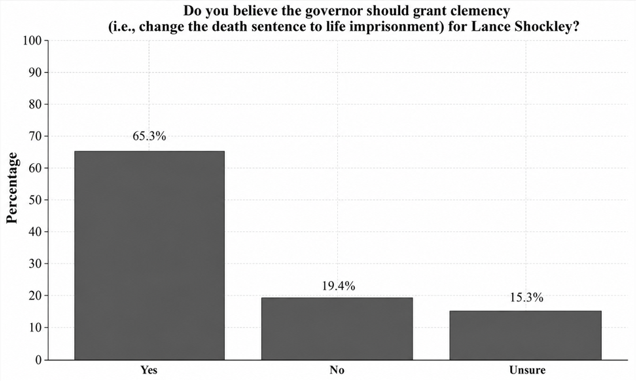
One can readily see that after reviewing the facts of this case, a clear majority supports clemency. That overall result, with almost two-thirds supporting clemency, was also, as discussed next, supported by open-ended responses, which shed light on the reasoning behind these participants’ views.
1. Open-Ended Responses
After deciding on whether clemency should be granted, all participants were asked, “Do you believe the death penalty was appropriate in this case? Why or why not?” The complete list of responses appears in Table 1 of Appendix B, which also displays each participant’s age, sex, and ultimate decision (yes, no, unsure).71 After reviewing the complete set of responses, four major themes emerged regarding the appropriateness of the death penalty in this case.
First, many participants expressed concern about the reliability of the evidence and the possibility that Shockley may not be factually guilty. Participants repeatedly cited the lack of direct evidence and the inconclusive nature of key forensic testimony. One participant noted, “I do not support the death penalty unless there is irrefutable evidence that the accused committed the crime (DNA, video footage, etc.).” Another similarly stated, “The evidence seems merely circumstantial. I didn’t see anything incontrovertible proving his guilt, which should be the bar for the death penalty.” Another wrote, “It seems that the judge made a rash decision and imposed a strong penalty on a case where the evidence was inconclusive.” These doubts led many to conclude that the death penalty was too extreme in a case with unresolved factual questions.
Second, numerous participants objected to the judge’s imposing the death penalty despite the jury’s failure to reach a unanimous sentencing recommendation. This was seen as both procedurally unfair and indicative of judicial overreach. One person wrote, “As the jury could not reach a unanimous decision and could not agree on a sentence, the judge was overstepping to sentence him to death.” Others were more emphatic: “A single judge should not pass a death sentence; that itself is shocking.” Many saw this as a departure from fair judicial practice and questioned the appropriateness of overriding the jury in a capital case. “There’s a process for a reason, judges aren’t meant to be, and shouldn’t be, executioners.”
Third, a large group of participants expressed outright opposition to the death penalty, regardless of the case facts. Some framed this as a moral or ethical stance: “I am against the death penalty ever being considered appropriate because I do not believe the government should have the power to kill citizens.” Others highlighted structural concerns: “Even one instance of wrongful execution is too much in my opinion.” Even among those who believed Shockley was guilty, this firm opposition to execution influenced their views.
Finally, many people believed that while Shockley was likely guilty, the death penalty was still not justified. These participants favored life without parole, both as a more humane punishment and as a safeguard against potential error. As one put it, “While it is likely he committed murder, he is not 100% without a doubt guilty, and the possibility for wrongful conviction means the death penalty should be out of the question. I also believe the death penalty is morally objectionable on its own.” Several others echoed the view that “lifetime imprisonment is a more suitable punishment.” These individuals often cited concerns about finality, fairness, or the potential for reform.
Together, these themes highlight widespread public discomfort with both the evidence and the process used to impose the death penalty in this case, even among those who felt the defendant was likely responsible. Again, the complete responses are available online.72
2. Support for Clemency Was Bipartisan
To assess whether support for clemency was bipartisan, we examined participants’ political affiliations in conjunction with their views on the Shockley case. Participants identified as Republican, Democrat, or Independent, allowing us to compare clemency support across party lines. The results are plotted in Figure 2 below.
Figure 2: Support for Clemency by Political Affiliation
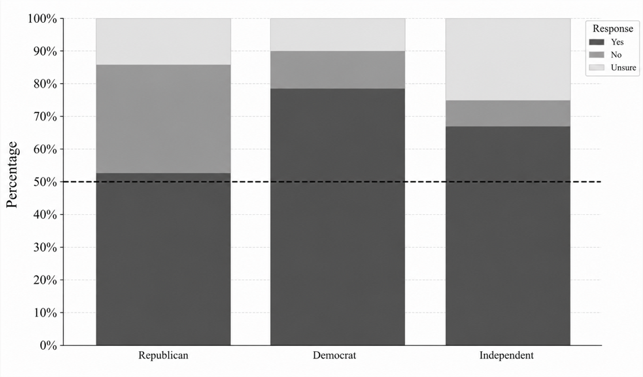
The data show strong support for clemency for Lance Shockley across all political affiliations, indicating that this was not a partisan issue. Among Democrats, support was overwhelming: 79.0 percent said yes, 11.1 percent said no, and 9.9 percent were unsure. Independents also showed clear support, with 67.3 percent in favor, 8.2 percent opposed, and 24.5 percent unsure. Among Republicans, a majority (52.8 percent) supported clemency, compared to 33.6 percent who opposed it and 14.0 percent who were unsure. Thus, a majority of each of the three major political groups supported clemency, although the level of support varied across groups.
We also note that a notable proportion of participants, particularly among Independents (24.7 percent) and Republicans (13.9 percent), selected “Unsure.” This indicates that many voters were hesitant to affirm a death sentence—a penalty that allows no room for error or reconsideration. Furthermore, only 11.3 percent of Democrats, 8.6 percent of Independents, and 33.6 percent of Republicans opposed clemency. These relatively low opposition rates—especially from groups that span the political spectrum—indicate that few were firmly convinced that execution was appropriate in the Shockley case.
3. Clemency and Death Penalty Support
Regarding views on the death penalty, Figure 3 below shows how participants’ opinions on granting clemency to Lance Shockley varied by their level of support for the death penalty in Missouri. The x-axis represents participants’ baseline views on the death penalty in Missouri—categorized as strongly support, somewhat support, somewhat oppose, strongly oppose, or unsure—as reported before they were presented with details about the Lance Shockley case.
Figure 3: Support for Clemency by Support for the Death Penalty
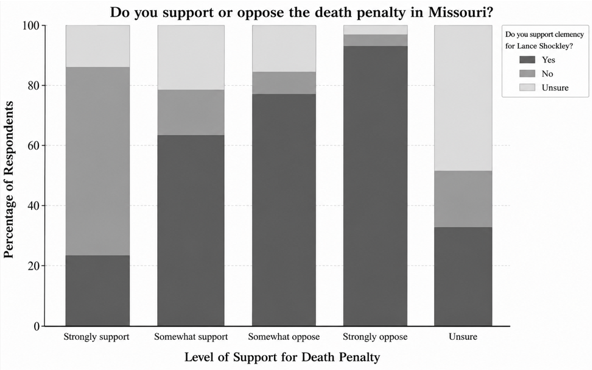
The results show strong public support for granting clemency to Lance Shockley, even among those who generally supported the death penalty. Among those who somewhat supported the death penalty, 63.1 percent supported clemency, compared to just 16.1 percent who opposed it and 20.8 percent who were unsure. And among the strongest supporters of the death penalty, 22.9 percent favored clemency and 12.9 percent were unsure—indicating that over one in three expressed doubt about whether execution was appropriate in this case.
Among participants who opposed the death penalty, support for clemency was overwhelming. 76.5 percent of those who somewhat opposed and 94.1 percent of those who strongly opposed the death penalty believed the Governor should commute Shockley’s sentence. This near-unanimous agreement among opponents is not surprising—but what is most notable is that a significant share of death penalty supporters also favored clemency, a rare convergence in public opinion. The consistently high rates of uncertainty—12.9 percent among strong death penalty supporters and 20.8 percent among moderate death penalty supporters—further highlight public discomfort with the case. These findings demonstrate that clemency for Lance Shockley, although ultimately not granted, was not a fringe position. It reflected a clear and cross-cutting public consensus that this case warranted clemency.
4. Clemency and Religious Affiliation
Regarding religious affiliation, Figure 4 below presents the percentage of participants in each affiliation who supported, opposed, or were unsure about granting clemency to Lance Shockley.
Figure 4: Support for Clemency by Religious Affiliation
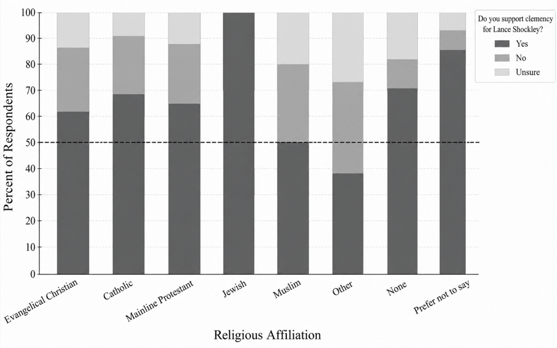
Support for clemency was clearly the dominant view across nearly all groups. Among participants with no religious affiliation, a striking 72 percent favored clemency, compared to just 11 percent who opposed it and 17 percent who were unsure. Evangelical Christians—often associated with more conservative views—still showed strong support, with 64 percent in favor, 21 percent opposed, and 15 percent unsure. Similarly, among Catholics, 69 percent supported clemency, while 22 percent were opposed, and 9 percent were unsure. Mainline Protestants showed a comparable pattern, with 66 percent in support, 21 percent opposed, and 13 percent unsure. Even among those who selected “Other” for their religious affiliation, support outweighed opposition (38 percent vs. 36 percent), although the proportion of undecided (26 percent) was relatively high. Smaller groups of participants, such as Jewish and Muslim participants, were too few to support strong conclusions, but neither group had a majority that expressed opposition. Importantly, every group—regardless of religious identity—showed more support than opposition for clemency, and in most cases, support exceeded 60 percent. These results suggest that the call for clemency in Shockley’s case resonated across religious lines and reflected a broad and diverse base of moral concern.
Participants who did not support clemency (n = 85) were asked to indicate the main reasons for that decision. They were presented with the following options and were permitted to select as many as they saw fit.
| Reason(s) for Rejecting Clemency | Number of Participants |
| I believe the death penalty is appropriate for killing a law enforcement officer | 60 |
| I trust the jury and courts made the right decision | 48 |
| I don’t believe Lance Shockley is innocent | 65 |
| Clemency would undermine accountability | 36 |
| I don’t support clemency in any death penalty cases | 13 |
| I think the governor should not interfere with court decisions | 20 |
| Other | 6 |
The modal (most common) response was disbelief that Shockley is innocent, followed by the view that the death penalty was appropriate for killing a police officer. Note that half of the participants who opposed clemency selected three or fewer reasons from the list.
Participants who were unsure whether the governor should grant clemency were also asked: “What information would help you decide whether the governor should grant clemency (i.e., change the death sentence to life imprisonment) in this case?” The responses were quite varied. Many participants expressed a desire for more or clearer evidence (for example, “I would need to see more conclusive evidence one way or the other.”). Several participants indicated that they would support clemency if Shockley showed genuine personal change or contrition (for example, “Is his behavior in prison genuine?”). The complete responses appear in Table 2 of Appendix B.73
5. Regression Analyses Regarding Support for Clemency
We examined whether support for clemency for Lance Shockley varied by demographic variables (age, sex, and race), life experiences (identifying with a religious belief, attending college), and political beliefs and affiliations (importance of mercy in the justice system, political party affiliation, political orientation, and support for the death penalty). This analysis allowed us to determine how ubiquitous the nearly two-thirds support for clemency was among subgroups and to examine whether support for clemency varied across these characteristics while accounting for the other predictors in the model.
We used Binary Logistic Regression (BLR) to predict support for clemency for Lance Shockley, with 1 = Yes and 0 = No or Unsure. We estimated three nested BLRs: (1) demographic predictors only; (2) demographic and life experience predictors; and (3) demographic, life experience, and political beliefs and affiliations predictors. Table 2 presents the results for each of the three BLRs.
| Predictors | Model | ||
|---|---|---|---|
| (1) | (2) | (3) | |
| Constant | 1.756 | 1.041 | 0.712 |
| Age (Centered around 40 years) | 1.009 | 1.007 | 1.017* |
| Sex (-.5 = Male, 0 = Other, .5 = Female) | 0.995 | 1.172 | 1.036 |
| Race (-.5 = White & Non-Hispanic, .5 = Non-white or Hispanic) | 1.044 | 0.995 | 1.023 |
| Religious (-.5 = None, .5 = Religious) | 0.576* | 1.227 | |
| Education (-.5 = No College, .5 = Some College) | 4.187*** | 3.393** | |
| Importance of Mercy in the Justice System (5 points) (-2 = Not at all, 2 = Extremely) | 1.896*** | ||
| Political Party (-.5 = Republican, 0 = Independent and Other, .5 = Democrat) | 0.931 | ||
| Political Orientation (5 points) (-2 = Very Conservative, 2 = Very Liberal) | 1.247 | ||
| Support for the Death Penalty (5 points) (-2 = Strongly Support, 2 = Strongly Oppose) | 1.722*** | ||
| Model Fit Indices | Model | ||
| (1) | (2) | (3) | |
| -2 Log likelihood | 527.033 | 504.225 | 395.093 |
| Cox & Snell R Square | 0.004 | 0.058 | 0.279 |
| Nagelkerke R Square | 0.006 | 0.080 | 0.384 |
| Chi-square Model | 1.679 | 24.486*** | 133.619*** |
| (df) | (3) | (5) | (9) |
| Chi-square Block | NA | 22.808*** | 109.132*** |
| (df) | NA | (2) | (4) |
| Note: N = 406. Values are estimated odds ratios, calculated as: exp (raw Beta parameter). Support for Clemency is coded: Yes = 1, No or Unsure = 0. * p < .05, ** p < .01, *** p < .001 | |||
Demographics. The demographic predictors in Model 1 do not enhance the prediction of clemency support beyond the base rate in the sample (65.3 percent). The odds ratios for age, sex, and race are all close to 1.0, indicating that support for clemency did not vary across participants’ age, sex, or race.
Life Experiences. Model 2 includes the demographic variables and adds religious beliefs and education to the BLR. The Chi-Square values for Model 2 indicate that including religious beliefs and education significantly predicted clemency support for Lance Shockley, compared with using either the base rate or demographic variables alone. Likewise, the -2* log likelihood value has decreased, and the R-squared values have increased. Those who had no religious affiliation had 1.736 (=1/.576) times greater odds of supporting clemency for Lance Shockley than those who identified with a religion. Those who had attended college had over four times greater odds of supporting clemency for Lance Shockley than those who had never attended college. All three demographic variables remain not significantly predictive of clemency support.
Political beliefs and affiliations. The last four predictors related to political beliefs and affiliations (Model 3) significantly predicted clemency support for Lance Shockley, over and above the predictors in Model 2. The -2*log likelihood values were dramatically attenuated for Model 3, and the R-Square values were substantially increased. An increase of one unit on the five-point scale of the importance of mercy in the justice system increased the odds of clemency support by a factor of nearly 1.9. In addition, for each unit increase in opposition to the death penalty, the odds of supporting clemency for Lance Shockley increased by a factor of over 1.7 once all predictors are entered into Model 3. In addition, attending college still increased the odds of supporting clemency for Lance Shockley by nearly 3.4 times. Similarly, for the full nine-predictor model, we found that older adults were more supportive than young adults of clemency for Lance Shockley; each additional year increased the odds of supporting clemency by a factor of 1.017, equivalent to a factor of just over 1.18 for each additional decade. Neither political party affiliation nor political orientation (conservative vs. liberal) was predictive of support for clemency for Lance Shockley.
These results indicate that support for clemency for Lance Shockley was not significantly associated with sex and race and only slightly associated with age; older adults were slightly more likely to support clemency than younger adults. We also found that support for clemency for Lance Shockley was substantially higher for those who had attended college. There was also a small relationship between religious affiliation and support for clemency, but it became non-significant once political beliefs and affiliations were entered as predictors. Finally, we found that support for clemency for Lance Shockley was not significantly associated with political party affiliation and political identification as conservative or liberal. The strongest predictors of support for clemency for Lance Shockley were belief in the importance of mercy in the justice system and support for or opposition to the death penalty.
Thus, these findings suggest that participants held nuanced views regarding the case and engaged with the fact pattern as one might expect jurors to. They were examining questions of culpability, the strength of the evidence of guilt, and the finality and appropriateness of the sentence. Their views on the importance of mercy and the death penalty influenced their views regarding clemency. And those views were far more predictive than partisan affiliations, demographics, or other factors. As discussed below, these findings have implications for the case at hand and for clemency research and policy more broadly.
III. Implications for Research and Policy on
Executive Clemency
We began this Commentary by asking what executive clemency is for, what explains the decline in its use, and whether its use tracks public opinion. This Part turns from the survey results regarding the Lance Shockley case to those more fundamental questions raised by the current state of executive clemency in the United States. We examine the implications of these study findings for future research regarding clemency and for the practice of executive clemency in high-profile, capital, and more routine cases. Finally, we discuss broader implications for our understanding of the nature of public opinion and its relevance to important decisions in the criminal justice system. Most significant, in our view, are the findings that partisan affiliations and demographics did not explain people’s views, but rather that broadly shared views regarding sentencing and mercy did.
A. Directions for Future Research
This study suggests the utility of conducting vignette-based research on case-specific topics such as clemency. As described in Part I, most of the evidence we have regarding public opinion and clemency has taken the form of a small number of general surveys on approval of clemency practices and brief questions in surveys on particular high-profile examples of executive clemency.74 It has long been recognized that to understand jury behavior, mock jury studies using realistic vignettes provide a helpful model for experimental research.75 While people may not be able to put themselves in the shoes of a governor or president, opinions of those executive decisions may be shaped by the facts of the cases before those executives.
To be sure, the public opinions formed may not reflect a neutral, judicial description of the facts, as outlined in the Missouri Supreme Court’s description that we provided to the participants in this study. Unlike jurors who may become polarized because of groupthink during their deliberations,76 but who may also be carefully instructed and receive carefully marshaled evidence,77 the public receives information about legal cases in very disparate ways. People may consume far more polarizing and slanted social media and news coverage regarding such high-profile cases.78
In contrast, executives may consider submissions from a wide range of constituencies when making these decisions. Their decision-making may not simply rely on the wisdom of crowds, or at least of their voting constituents. Indeed, there are hard questions to ask about the consideration of research like ours. What if executives did this type of research before making decisions regarding clemency? As informative as research on public opinion may be, relying on it in the executive context might be problematic, potentially linking such decisions to popular opinion and biases, rather than the ends of justice.
Turning from clemency to underlying attitudes regarding the death penalty, the views expressed by these participants were aligned with their concerns regarding both the importance of mercy and the use of the death penalty. As discussed in Part I, there is a substantial body of public-opinion research regarding the death penalty and evidence that support for the death penalty has declined, including in a bipartisan way. Similarly, support for severe sentencing has declined, but there is less polling on that topic. The concordance between views on clemency and views on the death penalty, of course, could reflect that this case was a capital case. One open question, then, is whether people would express similar views regarding clemency in a case involving a serious but non-capital sentence, or a lower-level criminal sentence. Further research should examine these questions.
B. Directions for Executive Clemency Policy
This study suggests that, on the one hand, the handful of popular opinion polls conducted in recent years on the topic are not misleading in finding that a growing majority of Americans generally support executive clemency. Our findings confirm those results in the context of a capital case, in line with survey work on public opinion and declining support for the death penalty in the United States. Our findings, in the context of a complex and troubling case, point to underlying reasons why this is so and, in particular, a non-partisan, not polarized consensus view regarding what factors are appropriate to consider when granting clemency.
These results also support the view that, while politics may be more polarized on a range of issues, attitudes towards criminal justice remain decidedly shared, bipartisan, and focused on alternatives to harsh sentencing and on public safety.79 People do not just want to end incarceration, nor do they care only about public order. They do not fully endorse either of what Herbert Packer famously called the “crime control” and “due process” models of criminal justice;80 they care about both.
These views and our finding that the most predictive factors were support for mercy and concerns regarding the death penalty may reflect a broad majority of the American public, which is concerned with public safety as well as due process and fair treatment of individuals accused of crimes.81 Future research, as noted, should investigate whether these views extend beyond the most serious criminal cases, but policymakers should also explore whether clemency practices continue to reflect public attitudes towards appropriate criminal punishment.
Conclusion
The results of this study demonstrate that a clear majority of Missouri voters supported clemency for Lance Shockley. When presented with a concise, neutral summary of the case—drawn from the Missouri Supreme Court’s description—nearly two-thirds of participants endorsed the idea that the Governor should commute Shockley’s death sentence to life without parole. This finding held across political affiliations, suggesting that support for clemency in this case was not driven solely by partisan leanings but reflected broader public attitudes about fairness and finality in capital punishment.
Significantly, support for clemency was not based on a categorical opposition to the death penalty. Indeed, many participants who expressed support for capital punishment in principle also supported clemency. Their openness in this case appears to reflect doubts about the conclusiveness of the evidence, concerns about procedural irregularities (such as the imposition of a death sentence by a judge without unanimous jury agreement), and recognition of Shockley’s rehabilitative efforts while incarcerated. Even among those undecided, the dominant theme was a desire for additional information to make a more confident judgment, rather than outright rejection of clemency.
Taken together, these findings suggest that the public is receptive to clemency in cases involving lingering doubts, legal ambiguities, or evidence of meaningful rehabilitation. These data may be relevant to policymakers and elected officials tasked with making clemency decisions, as they indicate that serious public consideration is warranted in cases like Shockley’s—particularly when the decision aligns with values of justice, proportionality, and second chances. The public may increasingly view clemency as the “fail-safe,” as the Supreme Court has described it, rather than a type of extraordinary mercy.
These findings have broader implications for the future of executive clemency in the United States. These findings suggest that while public opinion surveys on clemency in general are informative, attitudes in specific cases further indicate a broad willingness to reconsider sentences, even in the most serious, high-profile cases. If executive clemency practices have tracked public opinion, then those practices may be changing. If, instead, the decline in executive clemency reflects other institutional or political considerations, then we may see a growing divide between public opinion and the practice of executive clemency.
Appendix A
Table A1: Quota Sample Frequencies and Percentages versus Baseline by Sex, Age, Race, Political Affiliation
| Sex | Sample N | Sample % | Baseline % | Case Weights |
| Male | 169 | 38.41% | 47% | 1.1931 |
| Female | 260 | 59.09% | 53% | 0.8745 |
| Non-binary | 8 | 1.82% | 1.0000 | |
| Prefer not to say | 3 | 0.68% | 1.0000 | |
| Total | 440 | 100.00% | 100.00% | |
| Age (Years) | Sample N | Sample % | Baseline % | Case Weights |
| 18-29 | 97 | 22.05% | 15% | 0.6804 |
| 30-44 | 178 | 40.45% | 25% | 0.6180 |
| 45-64 | 136 | 30.91% | 35% | 1.1324 |
| 65+ | 29 | 6.59% | 25% | 3.7931 |
| Total | 440 | 100% | 100.00% | |
| Race | Sample N | Sample % | Baseline % | Case Weights |
| White (non-Hispanic) | 355 | 80.68% | 77.00% | 0.9500 |
| African American (non-Hispanic) | 35 | 7.95% | 11.40% | 1.4266 |
| Hispanic (any race) | 20 | 4.55% | 4.90% | 1.0731 |
| Other & Multi-racial (non-Hispanic) | 28 | 6.36% | 6.70% | 1.0481 |
| Prefer not to say | 2 | 0.45% | 1.0000 | |
| Total | 440 | 100.00% | 100.00% | |
| Political Affiliation | Sample N | Sample % | Baseline % | Case Weights |
| Republican | 110 | 25.00% | 41.68% | 1.6293 |
| Democrat | 176 | 40.00% | 36.46% | 0.8908 |
| Independent | 128 | 29.09% | 19.52% | 0.6558 |
| Other | 16 | 3.64% | 2.34% | 0.6289 |
| Prefer not to say | 10 | 2.27% | 1.0000 | |
| Total | 440 | 100.00% | 100.00% | |
Table A2: Sample Frequencies and Percentages by Education, Political Ideology, Religious Affiliation, Views of the Death Penalty, and Mercy in the Justice System
| Education | Sample N | Sample % |
| Less than a high school diploma | 6 | 1.4% |
| High school graduate | 49 | 11.1% |
| Some college but no degree | 98 | 22.3% |
| Associate’s degree in college | 55 | 12.5% |
| Bachelor’s degree in college | 147 | 33.4% |
| Graduate or professional degree (MA, MS, MBA, PhD, JD, MD, DDS, etc.) | 84 | 19.1% |
| Prefer not to say | 1 | 0.2% |
| Total | 440 | 100% |
| Political Ideology | Sample N | Sample % |
| Very conservative | 34 | 7.7% |
| Somewhat conservative | 78 | 17.7% |
| Moderate | 100 | 22.7% |
| Somewhat liberal | 114 | 25.9% |
| Very liberal | 106 | 24.1% |
| Prefer not to say | 8 | 1.8% |
| Total | 440 | 100% |
| Religious Affiliation | Sample N | Sample % |
| Evangelical Christian | 86 | 19.5% |
| Catholic | 65 | 14.8% |
| Mainline Protestant | 44 | 10.0% |
| Jewish | 4 | 0.9% |
| Muslim | 3 | 0.7% |
| Other | 57 | 13.0% |
| None | 166 | 37.7% |
| Prefer not to say | 15 | 3.4% |
| Total | 440 | 100% |
| Death Penalty Views | Sample N | Sample % |
| Strongly support | 59 | 13.4% |
| Somewhat support | 147 | 33.4% |
| Somewhat oppose | 98 | 22.3% |
| Strongly oppose | 117 | 26.6% |
| Unsure | 19 | 4.3% |
| Total | 440 | 100.0% |
| How important is it to you that the justice system allows for mercy or rehabilitation in rare and exceptional cases? | Sample N | Sample % |
| Not at all important | 17 | 3.9% |
| Slightly important | 61 | 13.9% |
| Moderately important | 94 | 21.4% |
| Very important | 147 | 33.4% |
| Extremely important | 120 | 27.3% |
| Total | 439 | 99.8% |
- Clemency is the general term for the exercise of executive discretion to grant relief from criminal punishment, which includes pardons, which entirely extinguish responsibility for criminal conduct; commutations, which reduce a sentence; and reprieves, which temporarily suspend or defer the exercise of punishment. For descriptions, see, for example, Ex parte Garland, 71 U.S. (4 Wall.) 333, 379–80 (1867) (describing pardons); Schick v. Reed, 419 U.S. 256, 264 (1974) (describing commutations). For an overview of the English roots of the power, see, for example, Stanley Grupp, Some Historical Aspects of the Pardon in England, 7 Am. J. Legal Hist. 51, 52–55 (1963). ↩︎
- For work examining concerns with partisan use of the clemency power, dating back to the earliest presidential administrations, see generally Bradley D. Hays, The Politics of Clemency in the Early American Presidency: Power Inherited, Power Refashioned, 34 J. Pol’y Hist. 91 (2022). For studies over use during the twentieth century, see generally, for example, Andrew B. Whitford & Holona L. Ochs, The Political Roots of Executive Clemency, 34 Am. Pol. Rsch. 825 (2006). For an overview of the political science literature, see generally, for example, P.S. Ruckman Jr., The Study of Mercy: What Political Scientists Know (and Don’t Know) About the Pardon Power, 9 U. St. Thomas L.J. 783 (2012). ↩︎
- Herrera v. Collins, 506 U.S. 390, 415 (1993). ↩︎
- For data regarding federal clemency, see Clemency Statistics, U.S. Dep’t of Just. (Jan. 23, 2025), https://www.justice.gov/pardon/clemency-statistics [https://perma.cc/D3LU-R86K]; regarding state clemency, see generally, for example, Cara H. Drinan, Clemency in a Time of Crisis, 28 Ga. St. U. L. Rev. 1123 (2012). For data on state-level clemency, see 50-State Comparison: Pardon Policy & Practice, Restoration of Rts. Project (July 2025), https://ccresourcecenter.org/state-restoration-profiles/50-state-comparisoncharacteristics-of-pardon-authorities-2/ [https://perma.cc/4ZK6-CSVF]. ↩︎
- Derek Mueller, Prisons Report Series, Preliminary Data Release, 2023, Bureau of Just. Stat. (Dec. 2024), https://bjs.ojp.gov/preliminary-data-release-prisons-2023 [https://perma.cc/FW9D-H6CX]. ↩︎
- See, e.g., Antiterrorism and Effective Death Penalty Act, 28 U.S.C. § 2254(d). ↩︎
- For a discussion on how public opinion influences clemency, see Ctr. for Pol’y Rsch., Nat’l Governors’ Ass’n, Guide to Executive Clemency Among the American States 1 (1988), https://www.ojp.gov/ncjrs/virtual-library/abstracts/guide-executive-clemency-among-american
-states [https://perma.cc/7EFS-BGGS]. ↩︎ - For an overview, see generally Brandon L. Garrett, Unified Criminal Justice Reform, 85 Law & Contemp. Probs., no. 3, 2022, at 123 (describing public opinion and common ground on a range of criminal justice reforms). ↩︎
- See, e.g., Danny Franklin & Jessica Reis, Bully Pulpit Interactive, Majority Supports Clemency to Address Unfair Sentencing (2022), https://www.aclu.org/documents/
majority-supports-clemency-address-unfair-sentencing [https://perma.cc/AB74-986C] (describing over two-thirds of those surveyed supporting clemency in cases where laws or sentencing guidelines changed, for excessive sentences, and for persons not posing a threat to the community). ↩︎ - Id. (describing support for clemency “for people serving time for crimes that are no longer considered illegal under the current law” and those “serving time for selling marijuana”); see also infra Section I.C. ↩︎
- See John Gramlich, Biden Granted More Acts of Clemency than Any Prior President, Pew Rsch. Ctr. (Feb. 7, 2025), https://www.pewresearch.org/short-reads/2025/02/07/biden-granted-more-acts-of-clemency-than-any-prior-president/ [https://perma.cc/A5PL-W4BR]. ↩︎
- See Monmouth Univ. Polling Inst., Few Approve of Hunter Biden Pardon 1 (2024), https://www.monmouth.edu/polling-institute/reports/monmouthpoll_us_121124/ [https://perma.cc/BM
2A-KXPJ] (describing public disapproval of Hunter Biden pardon by President Joseph Biden and potential pardons of January 6 rioters and associates of President Donald Trump during his first term). For an article examining the use of clemency to cement political corruption, see Lee Kovarsky, Patronage Pardons, 76 Duke L.J. (forthcoming 2026) (manuscript at 19–38), https://papers.ssrn.
com/sol3/papers.cfm?abstract_id=5376034 [https://perma.cc/7ARN-P9BU]; see also Mark Osler, The Trump Clemencies: Celebrities, Chaos, and Lost Opportunity, 31 Wm. & Mary Bill Rts. J. 487, 487, 507–16 (2022). ↩︎ - See generally, e.g., James E. Campbell, Polarized: Making Sense of a Divided America (2016) (describing evidence of increasing polarization, over decades, in the United States); Simon A. Levin, Helen V. Milner & Charles Perrings, The Dynamics of Political Polarization, 118 PNAS, issue no. 50, Dec. 2021, art. no. e2116950118, at 1 (providing an overview of the special issue’s research regarding polarization in the United States). ↩︎
- Peter M. Steiner, Christiane Atzmüller & Dan Su, Designing Valid and Reliable Vignette Experiments for Survey Research: A Case Study on the Fair Gender Income Gap, 7 J. Methods & Measurement Soc. Scis. 52, 53 (2016) (describing advantages of vignette studies, including that “since vignettes are multivalent representations of subjects or situations, the corresponding questions are embedded in a concrete, realistic context”). ↩︎
- There have been studies examining general support for “second chance” relief for sentences, in addition to clemency. See generally Colleen M. Berryessa, A Tale of “Second Chances”: An Experimental Examination of Popular Support for Early Release Mechanisms That Reconsider Long-Term Prison Sentences, 18 J. Experimental Criminology 783 (2021) (providing a broad overview of “second chance” relief). ↩︎
- See Steph Quinn, Advocates for a Man Sentenced to Death by a Missouri Judge Ask Governor for Clemency, Mo. Indep. (Oct. 10, 2025, at 10:11 CT), https://missouriindependent.com/
2025/10/10/advocates-for-a-man-sentenced-to-death-by-a-missouri-judge-ask-governor-for-clemency/ [https://perma.cc/UCZ4-BKKJ]. Regarding the denial of the request for clemency, see Press Release, Mike Kehoe, Governor, State of Missouri, Governor Kehoe Denies Clemency Request of Mr. Lance Shockley (Oct. 13, 2025), https://governor.mo.gov/press-releases/archive/governor-kehoe-denies-clemency-request-mr-lance-shockley [https://perma.cc/VDB9-UHA8]. ↩︎ - See infra Section II.B. ↩︎
- See infra Section II.C. These survey results were presented to the Missouri Governor’s Office when clemency was being considered. See Editorial, Gov. Kehoe, There Are Too Many Questions to Execute Lance Shockley Now, Kan. City Star (Oct. 8, 2025, at 13:58 CT), https://www.kansascity.
com/opinion/editorials/article312428824.html [https://perma.cc/CU5B-XKS5] (describing the results presented to the Governor of “a public opinion survey of 440 registered voters in Missouri that found overwhelming and bipartisan support to grant clemency to Shockley”). ↩︎ - See infra Section II.C. ↩︎
- See infra Section II.C. ↩︎
- See infra Section II.C. ↩︎
- See infra Section II.C. ↩︎
- See infra Section II.C. ↩︎
- See infra Section II.C. ↩︎
- Ohio Adult Parole Auth. v. Woodard, 523 U.S. 272, 280–81 (1998) (plurality opinion) (“[T]he heart of executive clemency . . . is to grant clemency as a matter of grace, thus allowing the executive to consider a wide range of factors not comprehended by earlier judicial proceedings and sentencing determinations.”). ↩︎
- U.S. Const. art. II, § 2. ↩︎
- For an overview, see Daniel T. Kobil, The Quality of Mercy Strained: Wresting the Pardoning Power from the King, 69 Tex. L. Rev. 569, 576 (1991). ↩︎
- See Burdick v. United States, 236 U.S. 79, 94–95 (1915) (comparing the similarities and differences between amnesty and pardons). ↩︎
- See, e.g., Schick v. Reed, 419 U.S. 256, 273 n.8 (1974) (Marshall, J., dissenting). ↩︎
- See, e.g., Ex parte United States, 242 U.S. 27, 43–44 (1916). ↩︎
- See Grupp, supra note 1, at 51. ↩︎
- For an overview of state pardon power and caselaw, see 59 Am. Jur. 2d Pardon and Parole § 10 (2001). ↩︎
- Solesbee v. Balkcom, 339 U.S. 9, 12 (1950) (“Power of executive clemency . . . has traditionally rested in governors or the President, although some of that power is often delegated to agencies such as pardon or parole boards. Seldom, if ever, has this power of executive clemency been subjected to review by the courts.” (citing Ex parte United States, 242 U.S. at 42)). ↩︎
- 32 U.S. (7 Pet.) 150 (1833). ↩︎
- 71 U.S. (4 Wall.) 333, 380 (1867). ↩︎
- Herrera v. Collins, 506 U.S. 390, 415 (1993). ↩︎
- Biddle v. Perovich, 274 U.S. 480, 486 (1927). ↩︎
- Margaret Colgate Love, The Twilight of the Pardon Power, 100 J. Crim. L. & Criminology 1169, 1175 (2010). ↩︎
- Rachel E. Barkow & Mark Osler, Restructuring Clemency: The Cost of Ignoring Clemency and a Plan for Renewal, 82 U. Chi. L. Rev. 1, 9 (2015). ↩︎
- Regarding the record numbers of pardons granted by President Joseph Biden, see Gramlich, supra note 11. ↩︎
- Stuart Banner, The Death Penalty: An American History 53–62 (2002); Michael Heise, The Death of Death Row Clemency and the Evolving Politics of Unequal Grace, 66 Ala. L. Rev. 949, 949–50, 958, 985 (2015); Michael A.G. Korengold, Todd A. Noteboom & Sara Gurwitch, And Justice for Few: The Collapse of the Capital Clemency System in the United States, 20 Hamline L. Rev. 349, 350 (1996); Paul J. Larkin Jr., The Demise of Capital Clemency, 73 Wash. & Lee L. Rev. 1295, 1307–13 (2016). ↩︎
- Banner, supra note 41, at 291 (describing the use of clemency in “significant numbers,” including, for example, a third of death sentences in North Carolina in the first half of the twentieth century). ↩︎
- 408 U.S. 238 (1972) (per curiam). ↩︎
- Adam M. Gershowitz, Rethinking the Timing of Capital Clemency, 113 Mich. L. Rev. 1, 6 (2014) (describing how, apart from mass commutations, only sixty-six death sentences were commuted between 1976 and 2013); Michael Heise, Mercy by the Numbers: An Empirical Analysis of Clemency and Its Structure, 89 Va. L. Rev. 239, 241 (2003) (describing a decrease in clemency during the modern era of capital punishment). ↩︎
- See generally Carol S. Steiker & Jordan M. Steiker, Capital Clemency in the Age of Constitutional Regulation: Reversing the Unwarranted Decline, 102 Tex. L. Rev. 1449 (2024) (arguing the constitutional regulation of the death penalty caused a decline in executive clemency in capital cases); Paul J. Larkin, Jr., Revitalizing the Clemency Process, 39 Harv. J.L. & Pub. Pol’y 833 (2016) (describing possible contributors to the decline in clemency, including the turn to retribution and greater confidence in the capital punishment system following the constitutional criminal procedure revolution); Victoria J. Palacios, Faith in Fantasy: The Supreme Court’s Reliance on Commutation to Ensure Justice in Death Penalty Cases, 49 Vand. L. Rev. 311, 344–45 (1996) (describing changes in the administration of clemency, such as the creation of clemency boards, and the relative susceptibility of different models to political pressures); Michael L. Radelet & Barbara A. Zsembik, Executive Clemency in Post-Furman Capital Cases, 27 U. Rich. L. Rev. 289 (1993) (examining a well-documented reluctance to grant clemency in capital cases); Stephen E. Silverman, Note, There Is Nothing Certain Like Death in Texas: State Executive Clemency Boards Turn a Deaf Ear to Death Row Inmates’ Last Appeals, 37 Ariz. L. Rev. 375 (1995) (discussing the increased use of clemency boards in the death penalty context). ↩︎
- Jeffrey D. Kubik & John R. Moran, Lethal Elections: Gubernatorial Politics and the Timing of Executions, 46 J.L. & Econ. 1, 3 (2003) (“We find that the occurrence of a gubernatorial election increases the probability of a state execution by approximately 25 percent.”). ↩︎
- See Austin Sarat, Mercy on Trial: What It Means to Stop an Execution 1–32 (2005). ↩︎
- See Deepa Shivaram, Biden Commutes Sentences of 37 Federal Death Row Prisoners, NPR (Dec. 24, 2024, at 12:50 ET), https://www.npr.org/2024/12/23/g-s1-38794/biden-death-row-commu
tations [https://perma.cc/3KW7-TCSS]. ↩︎ - Paul J. Larkin, Jr., Public Choice Theory and Overcriminalization, 36 Harv. J.L. & Pub. Pol’y 715, 731–35, 756–63 (2013). ↩︎
- See, e.g., Franklin & Reis, supra note 9. ↩︎
- See Campbell, supra note 13; see also Corwin D. Smidt, Polarization and the Decline of the American Floating Voter, 61 Am. J. Pol. Sci. 365, 379 (2017) (discussing elite polarization). ↩︎
- See Franklin & Reis, supra note 9; see also Molly Green & Sean McElwee, Poll: Use Clemency Power to Fight Mass Incarceration, The Appeal (Apr. 28, 2021), https://theappeal.org/the-lab/polling-memos/use-clemency-power-to-fight-mass-incarceration/ [https://perma.cc/TBT5-EGAQ]. ↩︎
- For an overview of national-level death penalty polling, including by Gallup, over the years, see Public Opinion, Death Penalty Info. Ctr., https://deathpenaltyinfo.org/policy-issues/policy/
public-opinion-polls?amp%3Bscid=23&did=209 [https://perma.cc/J55U-6MBC]. For an overview of state-level polling on the death penalty, see State Polls and Studies, Death Penalty Info. Ctr., https://deathpenaltyinfo.org/policy-issues/policy/public-opinion-polls/state-polls-and-studies [https://
perma.cc/FU4C-TY2A]. ↩︎ - See Monmouth Univ. Polling Inst., supra note 12. ↩︎
- News Release, Marquette Univ., New Marquette Law School Poll National Survey Finds Public Strongly Favors Some Trump Policies, Strongly Opposes Others (Feb. 12, 2025), https://law.
marquette.edu/poll/wp-content/uploads/2025/02/MLSPSC24NationalIssuesPressRelease.pdf [https://
perma.cc/LKG4-TZEV] (“The pardon of all January 6 defendants is opposed by 65% and favored by 34%.”); Public Anticipates Changes with Trump but Is Split Over Whether They Will Be Good or Bad, Pew Rsch. Ctr. (Feb. 7, 2025), https://www.pewresearch.org/wp-content/uploads/sites/20/2025/02/
PP_2024.7.2_views-of-trump_REPORT.pdf [https://perma.cc/VK75-SGVZ] (“Nearly eight-in-ten Republicans approve of Trump’s pardons for those convicted of nonviolent crimes related to Jan. 6, 2021. But fewer than half (45%) approve of pardoning those convicted of violent crimes.”). ↩︎ - For a summary of Gallup polling regarding the death penalty, see Death Penalty, Gallup, http://www.gallup.com/poll/1606/death-penalty.aspx [https://perma.cc/V6AY-BXVF] (showing a steady decline in American death penalty support since the mid-1990s, with 52 percent supporting and 43 percent not favoring as of 2025). ↩︎
- See generally Brandon L. Garrett, End of Its Rope: How Killing the Death Penalty Can Revive Criminal Justice (2017) (describing the decline in death sentencing and assessing its broader implications); Brandon L. Garrett, Alexander Jakubow & Ankur Desai, The American Death Penalty Decline, 107 J. Crim. L. & Criminology 561 (2017) (examining the decline and increasing geographic concentration of death sentences). ↩︎
- Brandon L. Garrett, The Decline of the Virginia (and American) Death Penalty, 105 Geo. L.J. 661, 664, 666–67 (2017). ↩︎
- Brandon Garrett, Daniel Krauss & Nicholas Scurich, Capital Jurors in an Era of Death Penalty Decline, 126 Yale L.J.F. 417, 420 (2017) (“[B]road demographics retained opposition to the death penalty.”). ↩︎
- See Quinn, supra note 16. ↩︎
- Shockley v. Crews, 696 F. Supp. 3d 589, 616–17 (E.D. Mo. 2023). ↩︎
- Shockley v. State (Shockley II), 579 S.W.3d 881, 890–92 (Mo. 2019). ↩︎
- Id. ↩︎
- See Eyal Peer, David Rothschild, Andrew Gordon, Zak Evernden & Ekaterina Damer, Data Quality of Platforms and Panels for Online Behavioral Research, 54 Behav. Rsch. Methods 1643, 1643–44 (2022). ↩︎
- See, e.g., Scott Keeter, From Telephone to the Web: The Challenge of Mode of Interview Effects in Public Opinion Polls, Pew Rsch. Ctr. (May 13, 2015), http://www.pewresearch.org/
2015/05/13/from-telephone-to-the-web-the-challenge-of-mode-of-interview-effects-in-public-opinion-polls/ [https://perma.cc/3DPT-FDQE]. ↩︎ - Due to concerns about attrition, an additional 15 percent of participants were sampled (n = 460). Twenty were removed for failing to complete the study or to enter a valid ZIP code when asked where they reside. ↩︎
- Louis M. Rea & Richard A. Parker, Designing and Conducting Survey Research: A Comprehensive Guide 164–65 (4th ed. 2014) (explaining that a sample of 400 reduces the margin of error while maintaining a 95 percent confidence level). ↩︎
- For the sources consulted, see Voting and Registration in the Election of November 2020, U.S. Census Bureau (Apr. 2021), https://www.census.gov/data/tables/time-series/demo/voting-and-registration/p20-585.html [https://perma.cc/3G8L-QWRA]; QuickFacts: Missouri, U.S. Census Bureau (2022), https://www.census.gov/quickfacts/fact/table/MO/PST045222 [https://perma.cc/
35HW-AL8R]; Missouri Election Results, Mo. Sec’y State, https://www.sos.mo.gov/elections/
s_default [https://perma.cc/8N8C-SA58]; Missouri Voter Registration & Party Affiliation Statistics, Indep. Voter Project, https://independentvoterproject.org/voter-stats/mo [https://perma.cc/FRD8-VZVS]. ↩︎ - The final case weights (CW) were calculated as: CW = CWsex * CWage * CWrace * CWPoliticalAffiliation. ↩︎
- Shockley II, 579 S.W.3d 881, 890–92 (Mo. 2019). ↩︎
- Appendix B is available online at https://washulawreview.org/clemency-and-public-opinion-a-survey-of-missouri-voters/ [https://perma.cc/PB8Y-PACA]. ↩︎
- Appendix B is available online at https://washulawreview.org/clemency-and-public-opinion-a-survey-of-missouri-voters/ [https://perma.cc/PB8Y-PACA]. ↩︎
- Appendix B is available online at https://washulawreview.org/clemency-and-public-opinion-a-survey-of-missouri-voters/ [https://perma.cc/PB8Y-PACA]. ↩︎
- See supra Section I.C. ↩︎
- See Steiner et al., supra note 14, at 53 (discussing how vignette studies provide a useful experimental model for studying decision-making). ↩︎
- Daniel J. Isenberg, Group Polarization: A Critical Review and Meta-Analysis, 50 J. Personality & Soc. Psych. 1141, 1142 (1986). ↩︎
- See generally Neil Vidmar & Valerie P. Hans, American Juries: The Verdict (2007) (examining the factors that shape jury decision-making). ↩︎
- See, e.g., Zach Sommers, Missing White Woman Syndrome: An Empirical Analysis of Race and Gender Disparities in Online News Coverage of Missing Persons, 106 J. Crim. L. & Criminology 275, 311 (2016); Travis L. Dixon, Cristina L. Azocar & Michael Casas, The Portrayal of Race and Crime on Television Network News, 47 J. Broad. & Elec. Media 498, 506 (2003) (examining the role of race in crime stories on nightly national television news programs); John W.C. Johnstone, Darnell F. Hawkins & Arthur Michener, Homicide Reporting in Chicago Dailies, 71 Journalism & Mass Commc’n Q. 860, 867 (1994). ↩︎
- See, e.g., Overwhelming Majority of Americans Support Criminal Justice Reform, New Poll Finds, Vera Inst. Just. (Jan. 25, 2018), https://www.vera.org/blog/overwhelming-majority-of-amer
icans-support-criminal-justice-reform-new-poll-finds [https://perma.cc/NXX6-CMT2]; Colleen Long & Hannah Fingerhut, AP-NORC Poll: Nearly All in US Back Criminal Justice Reform, Associated Press (June 23, 2020, at 10:02 CT), https://apnews.com/article/police-us-news-ap-top-news-politics-kevin-richardson-ffaa4bc564afcf4a90b02f455d8fdf03 [https://perma.cc/W9Z8-A4TJ]; As Public Safety Tops the Agenda, Americans Want Both Order and Justice, IPSOS (July 8, 2021), https://
www.ipsos.com/en-us/news-polls/usa-today-crime-and-safety-2021 [https://perma.cc/TC9R-AA95]. ↩︎ - Herbert L. Packer, Two Models of the Criminal Process, 113 U. Pa. L. Rev. 1, 9–23 (1964). ↩︎
- See Brandon L. Garrett & Gregory Mitchell, Error Aversions and Due Process, 121 Mich. L. Rev. 707, 748–49 (2023). ↩︎